

Deadlock persists between Azad Kashmir government, protesters on demands as unrest kills one

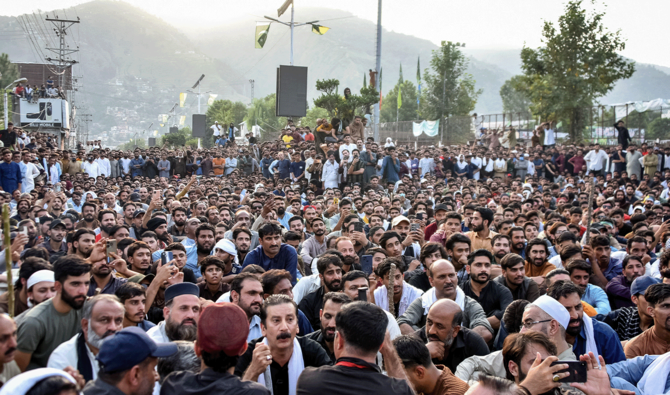
Awami Action Committee (AAC) members gather as they take part in a demonstration in Muzaffarabad, the capital of Pakistan-administered Kashmir, on September 29, 2025, demanding structural reforms along with political and economic rights. (AFP/File)
Short Url
Updated 30 September 2025
Follow

Deadlock persists between Azad Kashmir government, protesters on demands as unrest kills one

  • The Jammu Kashmir Joint Awami Action Committee has laid a 38-point charter of demands before the Azad Kashmir government
  • The demands include removal of perks of ruling elites, ending 12 Azad Jammu and Kashmir Assembly seats reserved for migrants

ISLAMABAD: A deadlock persists between protesters and the Azad Kashmir government over a 38-point charter of demands laid by the demonstrators, Pakistan Minister for Kashmir Affairs Ameer Muqam said on Monday, with clashes between rival groups killing at least one person.

The Jammu Kashmir Joint Awami Action Committee (JKJAAC) has laid a 38-point charter of demands before the Azad Kashmir government, which includes removal of perks of the ruling elites, ending 12 seats in the Azad Jammu and Kashmir Assembly reserved for Kashmiri migrants who came from the Indian-side of the territory, and royalty for hydel power projects in Azad Kashmir.

The JKJAAC, which has organized several protests in Azad Kashmir in recent years to demand resolution of public issues with some of them even turning violent, on Monday went ahead with its call for an indefinite “lockdown” and staged protests at multiple locations in the territory. A clash between JKJAAC and the Muslim Conference, which supports the AJK government, in Muzaffarabad killed one person.

The situation prompted Muqam to hold negotiations with JKJAAC representatives this week that failed to yield results as a deadlock persisted between the two sides, mainly over the dissolution of AJK Assembly seats reserved for Kashmiri migrants who came from the Indian side of the territory.

“I stand here and on behalf of the Government of Pakistan and the Prime Minister of Pakistan, I want to say this again... we believe in talks,” he told reporters in Islamabad. “If there are genuine problems, they should be resolved through talks and dialogue.”

He confirmed the killing of a man in the clash between Muslim Conference and JKJAAC supporters.

“I say this with sorrow that in this [clash], a citizen, Muhammad Sudhir, son of Muhammad Salman, died and a few people were injured,” he said. “This is a matter of great sadness and regret.”

The development came a day after Pakistan Prime Minister Shehbaz Sharif urged the Jammu Kashmir Joint Awami Action Committee (JKJAAC) to withdraw its call for lockdown, a senior member of Sharif’s party said on Sunday.

“’I will reach Pakistan within next two days’,” Mushtaq Minhas, a member of Sharif’s PML-N party, quoted the Pakistan premier as telling him at their meeting in London. “The prime minister said, ‘We will contact the Joint Action Committee, I will have its representatives invited’.”

Minhas said the prime minister promised to resolve the issues faced by all the Kashmiri people, not just the joint action committee.

“Whatever issues are being faced by the Kashmiris, he will, God willing, play his role regarding their resolution,” he added.

The JKJAAC staged a similar protest in Nov. last year that continued for days and ended after assurances by the AJK government to meet their demands.

In May 2024, at least three protesters and a police officer were killed and several others wounded in days of clashes between demonstrators demanding subsidies on wheat flour and electricity and law enforcement in Azad Kashmir, according to officials.

The protests were called off after Pakistan announced $83 million subsidies and prompted the regional government to notify a reduction in prices of wheat flour and electricity.

The Himalayan territory of Kashmir has been divided between Pakistan and India since their independence from British rule in 1947. Both sides claim it in full but rule in part and have fought multiple wars over the region.

The protest in Azad Kashmir comes days after demonstrations demanding greater political autonomy in Ladakh, Indian-administered Kashmir turned violent in the sparsely populated, high-altitude region bordering China and Pakistan.

New Delhi blamed the unrest on “provocative speeches” by prominent activist Sonam Wangchuk, who had been on a hunger strike demanding either full federal statehood for Ladakh or constitutional protections for its tribal communities, land and fragile environment.

Prime Minister Narendra Modi’s government split Ladakh off from Indian-administered Kashmir in 2019, imposing direct rule on both. New Delhi has yet to fulfil its promise to include Ladakh in the “Sixth Schedule” of India’s constitution, which allows people to make their own laws and policies.


Pakistan, Afghanistan trade heavy casualty claims, battlefield losses as cross-border fighting escalates

Updated 4 sec ago
Follow

Pakistan, Afghanistan trade heavy casualty claims, battlefield losses as cross-border fighting escalates

  • Pakistan says 133 Afghan Taliban killed in counter-strikes, Kabul says 55 Pakistani soldiers dead
  • Both sides report destruction, capture of military posts as escalation deepens, signaling widening conflict

Islamabad/Karachi: Pakistan and Afghanistan traded claims of heavy battlefield losses early Friday as cross-border fighting intensified along their shared frontier, marking the most serious escalation in hostilities between the bitter neighbors in recent months.

The fighting follows Pakistani airstrikes earlier this week targeting what Islamabad said were Tehreek-e-Taliban Pakistan (TTP) and Daesh militant camps inside Afghanistan. Pakistan said those strikes killed more than 100 militants, while Kabul said women and children were killed and condemned the attacks as violations of Afghan sovereignty.

With both governments now announcing retaliatory operations and publishing sharply conflicting casualty figures, the confrontation signals a rapid deterioration in relations between the two countries.

Pakistani officials said the latest strikes were in response to what they described as unprovoked firing by Afghan forces along multiple sectors of the border late Thursday. The Pakistani prime minister’s spokesman Mosharraf Zaidi said at 0345 hours Friday counter-strikes were continuing.

“A total of 133 Afghan Taliban are confirmed killed, more than 200 wounded,” Zaidi said in an X update. “Twenty seven (27) Afghan Taliban posts have been destroyed, and nine (9) have been captured.”

He added that strikes had targeted military positions in Kabul, Paktia and Kandahar, and that corps headquarters, brigade headquarters, ammunition depots, logistics bases and other installations had been destroyed.

Pakistan’s Information Minister Attaullah Tarar described the military action as “Operation Wrath for the Sake of Truth,” saying Pakistan’s “effective counter operations are ongoing.”

Defense Minister Khawaja Asif adopted sharply escalatory language on X, declaring: “Now it is open war between us and you.”

On the Afghan side, Taliban government spokesperson Zabihullah Mujahid accused Pakistan of bombing major cities. 

“The cowardly Pakistani army has bombed some places in Kabul, Kandahar, and Paktia. Praise be to God, no one was harmed,” Mujahid said on X.

In a separate statement, Afghanistan’s Ministry of National Defense said its forces had conducted retaliatory operations along the shared border. 

The ministry claimed 55 Pakistani soldiers were killed, two garrisons and 19 posts captured and military equipment seized. It said eight Afghan fighters were killed and 11 wounded in the clashes, and alleged that 13 civilians were injured in Nangarhar.

Pakistani officials said no Pakistani posts had been damaged or captured. 

None of the casualty figures or battlefield claims from either side could be independently verified.

Cross-border violence has intensified in recent weeks, with Pakistan blaming a surge in suicide bombings and militant attacks on insurgents it says are based in Afghanistan. Kabul denies providing safe havens to anti-Pakistan militant groups.

The latest clashes mark the third major escalation between the neighbors in less than a year. Similar Pakistani strikes last year triggered weeklong fighting before Qatar, Türkiye and other regional actors mediated a ceasefire in October.

The 2,600-kilometer (1,600-mile) frontier, a key trade and transit corridor linking Pakistan to landlocked Afghanistan and onward to Central Asia, has faced repeated closures amid tensions, disrupting commerce and humanitarian movement. Trade and movement of people between the two nations has remained closed since October 2025.

The confrontation also unfolds against a backdrop of growing friction over Afghanistan’s regional alignments. Pakistan has repeatedly accused the Taliban authorities of allowing Indian influence to expand in Afghanistan, an allegation Kabul has rejected.

Pakistan’s defense minister Asif renewed that accusation on Friday, saying the Taliban government had turned Afghanistan into “a colony of India.”

Islamabad has long accused India of using Afghan territory to support anti-Pakistan militant groups, a charge New Delhi denies.