

Missile attack on cargo ship off Yemen wounds 2 and prompts crew to abandon vessel

1 / 2
Houthi fighters march during a rally of support for the Palestinians in the Gaza Strip and against the US strikes on Yemen outside Sanaa on Jan. 22, 2024. (AP)
2 / 2
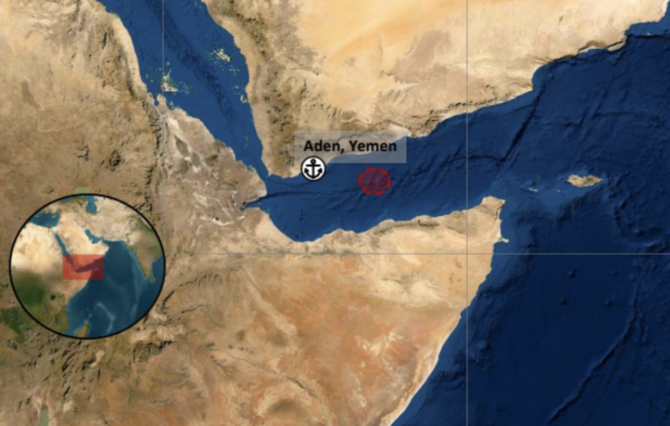
A likely missile attack by Yemen’s Houthis set a ship ablaze in the Gulf of Aden on Monday. (Screenshot/UKMTO)
Short Url
Updated 30 September 2025
Follow

Missile attack on cargo ship off Yemen wounds 2 and prompts crew to abandon vessel

  • “Following the attack, Minervagracht is suffering from a fire. As a result, two of the crew of Minervagracht have sustained injuries,” operator said
  • The Minervagracht had been targeted on Sept. 23 in an unsuccessful attack in the Gulf of Aden, which connects to the Red Sea via the Bab el-Mandeb Strait separating East Africa from the Arabian Peninsula

DUBAI, United Arab Emirates: A missile attack by Yemen’s Houthi rebels set a Dutch-flagged cargo ship ablaze in the Gulf of Aden on Monday, officials said, wounding two mariners and forcing its crew to abandon the damaged vessel.
It was the most serious attack in the Gulf of Aden, some distance from the Red Sea where the Iranian-backed Houthis sank two vessels in July.
While the rebels did not claim the assault on the Minervagracht, they had threatened to strike ships as part of their campaign over the Israel-Hamas war in the Gaza Strip, particularly as Israel squeezes in on Gaza City in a new ground offensive. Meanwhile, the Mideast also remains on edge after the United Nations reimposed sanctions on Iran over its nuclear program.

The Minervagracht had been targeted on Sept. 23 in an unsuccessful attack in the Gulf of Aden, which connects to the Red Sea via the Bab el-Mandeb Strait separating East Africa from the Arabian Peninsula. On Monday, a missile launch seen by some in Yemen apparently struck the Minervagracht.
Spliethoff, the ship’s owner, described the strike as “inflicting substantial damage to the ship.” A helicopter evacuated the ship’s 19 crew members, of which two were wounded, it added.
A European naval force operating in the region, known as Operation Aspides, said early Tuesday that the Minervagracht “is on fire and adrift” after the crew’s rescue. It identified the ship’s crew as coming from the Philippines, Russia, Sri Lanka and Ukraine, with one wounded and stable and another severely wounded and airlifted to Djibouti for medical care.
The French military’s Maritime Information, Cooperation and Awareness Center identified the Houthis as carrying out the attack.
The Houthis wait hours and even days to claim their assaults and have not yet done so.
The rebels have launched missile and drone attacks on over 100 ships and on Israel in response to the war in Gaza, saying they were acting in solidarity with the Palestinians.
However, the group’s past targets have had little or no connection to Israel. The US Navy-overseen Joint Maritime Information Center earlier said that the Minervagracht had “no Israeli affiliations.”
The Houthi attack widens the area of the rebels’ recent assaults, as the last recorded attack on a commercial vessel in the Gulf of Aden before the Minervagracht came in August 2024.
Their attacks over the past two years have upended shipping in the Red Sea, through which about $1 trillion of goods passed each year before the war.
The Houthis stopped their attacks during a brief ceasefire in the war. They later became the target of an intense weekslong campaign of airstrikes ordered by US President Donald Trump before he declared a ceasefire had been reached with the rebels. The Houthis sank two vessels in July, killing at least four on board, with others believed to be held by the rebels. They sank two others earlier in the campaign.


Palestinian coach gets hope, advice from mum in Gaza tent

Updated 5 sec ago
Follow

Palestinian coach gets hope, advice from mum in Gaza tent

DOHA: Coach Ehab Abu Jazar is guiding a national team that carries on its shoulders all the hopes and sorrows of Palestinian football, but it is his mother, forced by war to live in a Gaza tent, who is his main inspiration and motivation.
The war that broke out following Hamas’s unprecedented attack on Israel on October 7, 2023 put an end to Palestinian league matches, and left athletes in exile fearing for their loved ones in Gaza.
But Abu Jazar’s mother refuses to let the conflict overshadow the sporting dreams of her son, to whom she feeds tactical advice from the rubble of the Palestinian territory by phone.
“She talks to me about nothing but the team. She wants the focus to remain solely on the tournament,” the 45-year-old manager told AFP.
“My mother asks me about the players, who will play as starters and who will be absent, about the tactics, the morale of the players and the circumstances surrounding them.”
The manager, himself a former left-back, says he wants his players to convey the spirit of his mother and Gazans like her.
“We always say that we are a small Palestinian family representing the larger family,” he said.
“Undoubtedly, it puts pressure on us, but it’s positive pressure.”
The Palestinian team are 96th in the FIFA rankings, and their hope of playing in their first World Cup vanished this summer.
But the squad, most of whom have never set foot in Gaza, is within reach of the Arab Cup quarter-finals, keeping their message of resilience alive.
Palestine play Syria in their final Arab Cup group match Sunday, where a draw would be enough to achieve an unprecedented feat for the team.
He said progress would show the world that the Palestinians, if given the right conditions, can “excel in all fields.”

- ‘Genes of resilience’ -

Abu Jazar finished his playing career in 2017 before managing the Palestinian U-23 team and eventually taking the top job last year.
After the war broke out, his family home was destroyed, displacing his mother in Gaza, like most of the territory’s population during the height of the conflict.
He now feels pressure to deliver for them after witnessing from exile the horrors of the war, which came to a halt in October thanks to a fragile US-backed ceasefire.
“At one point, it was a burden, especially at the beginning of the war,” he said.
“We couldn’t comprehend what was happening. But we possess the genes of resilience.
“If we surrender and give in to these matters, we as a people will vanish.”
In her maternal advisory role, Abu Jazar’s mum, who goes by the traditional nickname Umm Ehab, is only contactable when she has power and signal.
But she works around the clock to find a way to watch the team’s matches from Al-Mawasi camp.
“My mother and siblings... struggle greatly to watch our matches on television. They think about how to manage the generator and buy fuel to run it and connect it to the TV,” he said.
This determination is pushing him to give Gazans any respite from the reality of war.
“This is what keeps us standing, and gives us the motivation to bring joy to our people,” he said.
“All these circumstances push us to fight on the field until the last breath.”