

Pakistan to direct bulk of $2 billion annual World Bank funds to population challenge

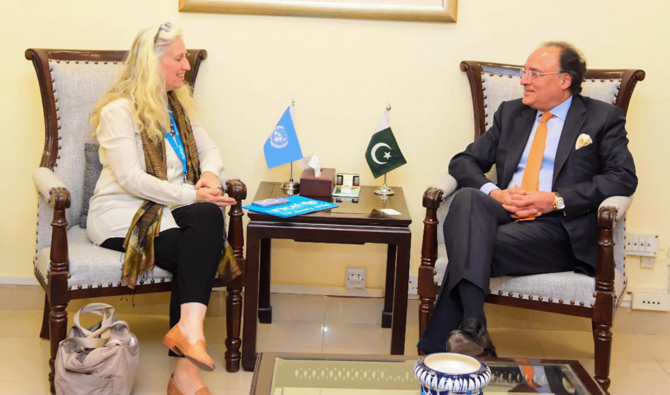
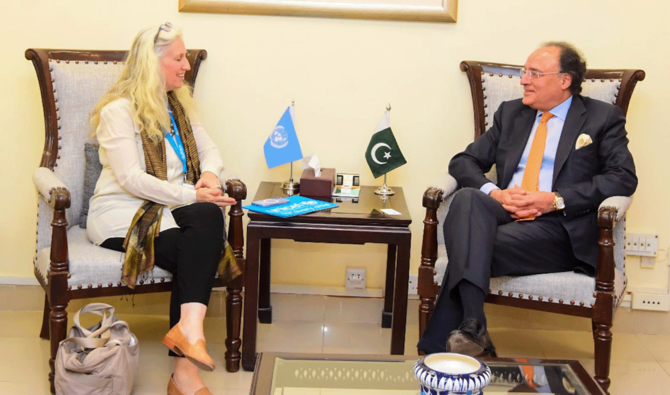
Pakistan's Finance Minister, Muhammad Aurangzeb (right) in conversation with Ms. Pernille Ironside, UNICEF Representative in Pakistan, in Islamabad on September 29, 2025. (Pakistan's Ministry of Finance)
Short Url
Updated 29 September 2025
Follow

Pakistan to direct bulk of $2 billion annual World Bank funds to population challenge

  • Pakistan, World Bank have signed $20 billion decade-long partnership to support climate and growth
  • UNICEF, Pakistan discuss collaboration on climate resilience, education and child stunting

ISLAMABAD: Pakistan will channel nearly two-thirds of the $2 billion expected annually from a new World Bank partnership into tackling population growth and its impact on children, Finance Minister Muhammad Aurangzeb told UNICEF’s representative during a meeting in Islamabad on Monday.

Earlier this year, Pakistan and the World Bank signed a Country Partnership Framework (CPF) for $20 billion in lending to the cash-strapped nation over the coming decade on development issues like the impact of climate change as well as boosting private-sector growth.

Officials say directing most of the funds to population-related interventions will help relieve strain on education, health care, and food systems, as well as improve long-term human capital outcomes.

“The Finance Minister highlighted the two existential challenges facing the country — climate change and population growth — particularly their impact on child stunting and learning poverty,” the Finance Division said in a statement. 

“He discussed the Country Partnership Framework signed with the World Bank, noting that nearly two-thirds of the USD 2 billion expected every year under the program over the next year would be directed toward addressing population-related challenges.”

Pakistan has one of the highest rates of child stunting in South Asia, while more than three-quarters of children cannot read or understand a simple text by age 10, according to UNICEF. These vulnerabilities are compounded by climate shocks, including devastating floods that have displaced millions and destroyed infrastructure.

Aurangzeb stressed the importance of making the best use of available resources and called for greater coordination among federal and provincial governments, UNICEF, and key ministries to identify priority areas and strengthen technical capacity. He said collaboration with partners such as UNICEF and ministries including Climate Change, Population Welfare, and National Health Services was essential for effective project delivery.

According to the statement, UNICEF Representative Pernille Ironside reaffirmed the agency’s commitment to Pakistan, saying UNICEF is “actively working with relevant ministries and stakeholders across a broad range of sectors, with a particular focus on child care and girls’ education.” 

She said the agency was following “a multi-sectoral approach to community welfare, prioritizing projects in education, health, and climate resilience,” and was exploring ways to further strengthen its role in Pakistan.

Both sides reiterated their resolve to work together to address the challenges facing children and communities and to deepen cooperation for sustainable development.


Pakistan, UAE review bilateral ties, economic and trade cooperation

Updated 7 sec ago
Follow

Pakistan, UAE review bilateral ties, economic and trade cooperation

  • UAE Ambassador Salem Mohammed Al Zaabi meets Pakistan’s deputy PM, ministers of defense, finance and IT
  • UAE is Pakistan’s third-largest trading partner after China and the US, and home to around 2 million Pakistani expats

ISLAMABAD: UAE Ambassador Salem Mohammed Al Zaabi met Deputy Prime Minister Ishaq Dar and other members of the Pakistani cabinet on Sunday to review bilateral ties and discuss trade and economic cooperation between the two countries, the UAE embassy said. 

Al Zaabi held separate meetings with Dar, Defense Minister Khawaja Muhammad Asif, Finance Minister Muhammad Aurangzeb, IT Minister Shaza Fatima Khawaja, Railways Minister Hanif Abbasi, Senate Chairman Yousaf Raza Gilani and National Assembly Speaker Ayaz Sadiq. 

“Views on the latest developments at the regional and international levels and matters of common interest between the two friendly countries were discussed and exchanged,” the UAE embassy in Islamabad wrote on social media platform X. 

Meanwhile, the embassy said Zaabi discussed bilateral relations and ways to enhance economic and trade cooperation in his meeting with Aurangzeb. 

Pakistan enjoys cordial ties with UAE rooted in shared values, faith, culture and economic relations. The Gulf nation is Pakistan’s third-largest trading partner after China and the US.

The UAE is also home to two million Pakistani expatriates, who make it the second-largest source of foreign remittances for cash-strapped Pakistan after Saudi Arabia. 

The UAE is also a major source of foreign investment in Pakistan, which have been valued at over $10 billion in the last 20 years, according to the Gulf state’s foreign ministry. 

Policymakers in Pakistan consider the UAE an optimal export destination due to its geographical proximity, which minimizes transportation and freight costs while facilitating commercial transactions.

Both nations have signed agreements worth billions of dollars recently as Pakistan eyes greater trade and economic ties with Gulf states. In January 2024, Pakistan and the UAE signed multiple agreements worth more than $3 billion for cooperation in railways, economic zones and infrastructure.