Pakistan PM urges Azad Kashmir protesters to withdraw ‘lockdown’ call — party official

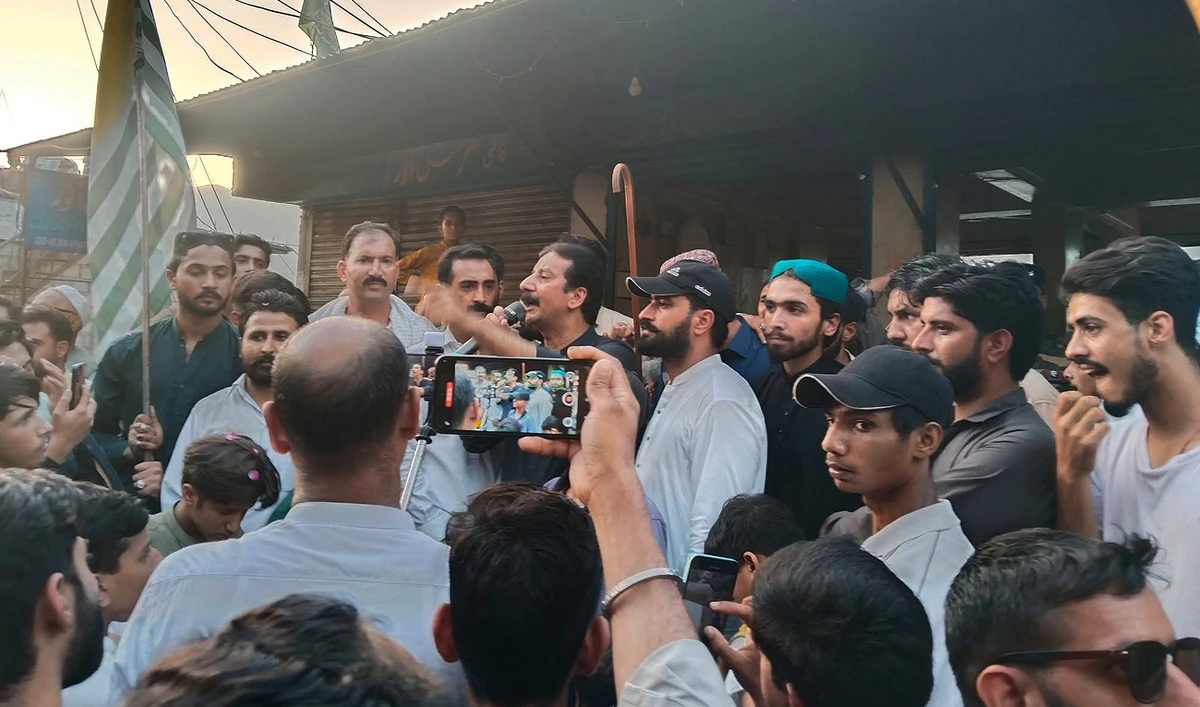
Shaukat Nawaz Mir, Member of Jammu Kashmir Joint Awami Action Committee, addresses protesters during a rally in Muzaffarabad, Azad Kashmir on September 27, 2025. (Photo courtesy: Facebook/Shaukat Nawaz Mir)
Short Url
Updated 28 September 2025
Follow

Pakistan PM urges Azad Kashmir protesters to withdraw ‘lockdown’ call — party official

  • The Jammu Kashmir Joint Awami Action Committee has called for an indefinite lockdown from Monday, seeking resolution of public issues
  • The development comes days after demonstrations demanding greater political autonomy turned violent in Ladakh, Indian-administered Kashmir

ISLAMABAD: Pakistan Prime Minister Shehbaz Sharif has urged the Jammu Kashmir Joint Awami Action Committee (JKJAAC) to withdraw its call for an indefinite “lockdown” in Azad Kashmir, a senior member of Sharif’s party said on Sunday.

The JKJAAC has laid a 38-point charter of demands before the Azad Kashmir government, which includes removal of perks of the ruling elites, ending 12 seats in the Azad Jammu and Kashmir Assembly reserved for Kashmiri migrants who came from the Indian-side of the territory, and royalty for hydel power projects in Azad Kashmir.

The committee has organized several protests in Azad Kashmir in recent years to demand resolution of public issues, some of which have even turned violent. In Nov. last year, the JKJAAC had staged a similar protest that continued for days and ended after assurances by the AJK government to meet their demands.

The action committee this year issued a call for an indefinite lockdown in Azad Kashmir starting Sept. 29, which prompted members of Sharif’s Pakistan Muslim League-Nawaz (PML-N) party from Pakistan and Azad Kashmir to hold consultations to defuse the demonstration that may continue for days if not weeks.

“’I will reach Pakistan within next two days’,” Mushtaq Minhas, a member of Sharif’s PML-N party, quoted the Pakistan premier as telling him at their meeting in London. “The prime minister said, ‘We will contact the Joint Action Committee, I will have its representatives invited’.”

Minhas said the prime minister promised to resolve the issues faced by all the Kashmiri people, not just the joint action committee.

“Whatever issues are being faced by the Kashmiris, he will, God willing, play his role regarding their resolution,” he added.

The development came amid reports of suspension of Internet and mobile phone services in Azad Kashmir.

Services were “closed on the direction of MoI [Pakistani ministry of interior],” Pakistan Telecommunication Authority spokesperson Zaibun Nisa told Arab News on Sunday.

In May 2024, at least three protesters and a police officer were killed and several others wounded in days of clashes between demonstrators demanding subsidies on wheat flour and electricity and law enforcement in Azad Kashmir, according to officials.

The protests were called off after Pakistan announced $83 million subsidies and prompted the regional government to notify a reduction in prices of wheat flour and electricity.

The Himalayan territory of Kashmir has been divided between Pakistan and India since their independence from British rule in 1947. Both sides claim it in full but rule in part and have fought multiple wars over the region.

The protest in Azad Kashmir comes days after demonstrations demanding greater political autonomy in Ladakh, Indian-administered Kashmir turned violent in the sparsely populated, high-altitude region bordering China and Pakistan.

New Delhi blamed the unrest on “provocative speeches” by prominent activist Sonam Wangchuk, who had been on a hunger strike demanding either full federal statehood for Ladakh or constitutional protections for its tribal communities, land and fragile environment.

Prime Minister Narendra Modi’s government split Ladakh off from Indian-administered Kashmir in 2019, imposing direct rule on both. New Delhi has yet to fulfil its promise to include Ladakh in the “Sixth Schedule” of India’s constitution, which allows people to make their own laws and policies.
Pakistan making diplomatic efforts to de-escalate Middle East tensions, FM says

Updated 4 sec ago
Follow

Pakistan making diplomatic efforts to de-escalate Middle East tensions, FM says

  • The statement came as Iran pressed on with a third day of strikes in the Gulf in response to US-Israeli air raids
  • Pakistan’s position is clear that all countries must abide by principles of UN Charter, international law, FM says

ISLAMABAD: Pakistan is making diplomatic efforts to de-escalate heightened tensions in the Middle East, Foreign Minister Ishaq Dar said on Monday, amid US-Israeli strikes on Iran and Tehran’s counterstrikes against US bases in Gulf countries.

Tensions escalated across the Middle East on Saturday after coordinated US-Israel strikes killed Supreme Leader Ali Khamenei among other senior Iranian officials. Tehran responded by targeting US military bases in the UAE, Bahrain, Qatar, Kuwait and Jordan. Saudi Arabia said Iran also launched attacks targeting Riyadh and the Eastern Province.

The Iranian missile and drone strikes continued on Monday in retaliation for the ongoing US-Israeli air raids, casting uncertainty over the future of the Islamic republic and heightening the risk of broader instability in the already volatile region.

Speaking at a press conference, FM Dar, who recently returned from Saudi Arabia where he attended an Organization of Islamic Cooperation OIC) meeting on Palestine, said Pakistan is very closely monitoring the evolving situation in Iran and the tensions which are building up in the region.

“These serious developments have taken place at a time when diplomatic efforts were underway to reach a peaceful and negotiated solution to [Iran nuclear program],” he said.

“We are making our full diplomatic efforts and, you know, requesting all parties to de-escalate and to refrain.”

Dar said Islamabad was concerned over a violation of the norms and international law, and the age-old tradition that the heads of state and the government should not be targeted.

“Post-World War II, we all know that these institutions were created to create some international, you know, law and order, and that’s why there was a UN Charter. There are certain conventions which we all are supposed to follow,” he said.

“But things are on ground moving very differently, which obviously is worrisome... The international law must prevail and the conventions must be respected.”

The statement came hours after the Ras Tanura oil refinery in Saudi Arabia sustained limited damage as a result of debris from the interception of two drones in its vicinity, the Saudi Press Agency reported, citing an official source at the Saudi Ministry of Energy.

Several American warplanes crashed in Kuwait on Monday morning but their crew survived, Kuwait’s defense ministry said, as Iran pressed on with a third day of strikes in the Gulf.

Dar said Pakistan’s position has been clear and persistent that all countries must abide by the principles of UN Charter and international law, including respect for the sovereignty and territorial integrity of other states as well as international humanitarian law.

“In my latest conversation with [Iranian] Foreign Minister Abbas Araqshi on 28th of February, I conveyed Pakistan’s condemnation of the attacks and called for restraint and diplomacy and dialogue, which he positively responded,” he shared.

“But on ground, we are seeing that things are not yet settling or easing out.”

Pakistan stands in full solidarity with all its brotherly countries and underscores the need to exercise maximum restraint, according to FM Dar.

“This is a message we have been giving to whosoever prime minister speaks, whosoever I speak, or whosoever Field Marshal Asim Munir speaks to, his counterparts on the defense side,” he said.