

Deep roots of rage as India’s Ladakh seeks self-rule

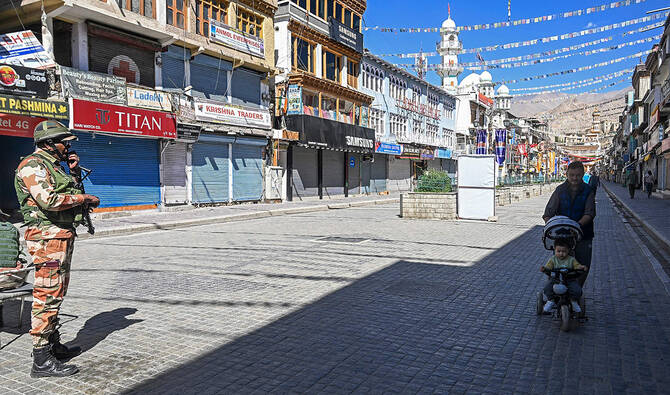
People walk along a road as an Indo-Tibetan Border Police (ITBP) personnel stands guard during a curfew in Leh on September 27, 2025. (AFP)
Short Url
Updated 28 September 2025
Follow

Deep roots of rage as India’s Ladakh seeks self-rule

  • Protests in high-altitude desert Ladakh region on Wednesday triggered deadly protests that killed four people 
  • Resentment has been growing in Ladakh over Delhi’s rule, with concerns about losing jobs, and land rights 

Leh, INDIA: India’s remote high-altitude desert region of Ladakh has been in turmoil since four people were killed in violent protests demanding greater political autonomy for the Himalayan territory.

Growing resentment with New Delhi’s direct rule over the territory, and fears of losing livelihoods boiled over on Wednesday as crowds took to the streets in the main city Leh, torching a police vehicle and the offices of Prime Minister Narendra Modi’s Hindu-nationalist Bharatiya Janata Party (BJP).

Initially police said five people had died but later revised the toll to four.

The sparsely populated region, home to some 300,000 people, borders both China and Pakistan and is a strategic enclave for India. Around half of Ladakh’s residents are Muslim and about 40 percent are Buddhist.

AFP looks at some of the issues.

WHY ARE PEOPLE PROTESTING?

Modi’s government split Ladakh off from Indian-administered Kashmir in 2019, imposing direct rule on both after canceling the region’s partial autonomy.

Since then, resentment has been growing in Ladakh over Delhi’s rule, with concerns about losing traditional livelihoods, land rights, and cultural identity.

Residents say the end of semi-autonomy stripped them of protections over land, jobs, and resources.

Decisions on development are made in Delhi and implemented by officials sent from outside, leaving the local elected council sidelined.

“All the protections we had within Jammu and Kashmir were all gone,” lawyer Mustafa Hajji told AFP.

WHO IS LEADING THE DEMONSTRATIONS?

The Apex Body Leh, led by veteran leader Chering Dorjay, has become the main voice of the protesters.

“We have been used like slaves,” Dorjay, 77, said, vowing to continue the struggle in the days to come.

Wednesday’s demonstrations were also organized in solidarity with prominent activist Sonam Wangchuk, who had been on hunger strike for two weeks.

New Delhi blamed the unrest on “provocative speeches” by Wangchuk who was detained by police on Friday.

WHAT ARE THE CORE DEMANDS?

The protesters are demanding protection of land rights and to stop outsiders from buying property in Ladakh.

They also want constitutional autonomy under the “Sixth Schedule” of India’s constitution, which would allow a local legislature to make laws on land use and jobs.

Constitutional protections sought by Ladakhis may seem far off, but sustained negotiations with New Delhi have yielded some “small victories,” Dorjay said.

The government has already reserved 85 percent of jobs for locals and frozen acquisition of domicile status for Indians from outside Ladakh until 2036.

But Dorjay says “there is a long way to go.”

WHY IS LAND A SENSITIVE ISSUE?

The government has announced large-scale solar projects and industrial plans in Ladakh that require thousands of acres of land.

Locals fear this will endanger grazing grounds critical for pashmina goat herding, already under pressure from climate change and military buffer zones established with China.

“The danger to this centuries-old livelihood undermining lives of thousands of pashmina goat herders is another issue now,” Dorjay said.

Ladakh is heavily militarized, with Indian troops guarding its disputed borders with Pakistan and China.

Tensions soared after deadly clashes with Chinese forces in 2020, and new buffer zones have further reduced land available to herders.

“A situation where you don’t have any protection for your land and identity is not a happy one,” lawyer Hajji said.

HOW DO LADAKHIS VIEW RELATIONSHIP WITH INDIA?

Unlike in Kashmir where opposition to Indian rule runs deep, Ladakhis have historically aligned with India, backing its troops in past conflicts with Pakistan and China.

But many now say they feel betrayed.

“For 70 years we have helped protect India’s borders,” Hajji told AFP.

“Now we want ourselves to be protected.”


Trump targets non-white immigrants in renewed xenophobic rants

Updated 43 min 38 sec ago
Follow

Trump targets non-white immigrants in renewed xenophobic rants

  • During a rally in Pennsylvania on Wednesday,  Trump doubled down on his tirade against Somali migrants
  • "Why is it we only take people from shithole countries,’ right? Trump told his cheering audience

WASHINGTON: Back in 2018, President Donald Trump disputed having used the epithet “shithole” to describe some countries whose citizens emigrated to the United States.
Nowadays, he embraces it and pushes his anti-immigrant and xenophobic tirades even further.
Case in point: during a rally in the northeastern state of Pennsylvania on Wednesday that was supposed to focus on his economic policy, the 79-year-old Republican openly ranted and reused the phrase that had sparked an outcry during his first term.
“We had a meeting and I said, ‘Why is it we only take people from shithole countries,’ right? ‘Why can’t we have some people from Norway, Sweden?’” Trump told his cheering audience.
“But we always take people from Somalia,” he continued. “Places that are a disaster. Filthy, dirty, disgusting, ridden with crime.”
Recently, he called Somali immigrants “trash.”
These comments are “more proof of his racist, anti-immigrant agenda,” Massachusetts Senator Ed Markey responded on X.

The Trump megaphone

Florida Republican lawmaker Randy Fine, on the other hand, defended Trump.
“Not all cultures are equal and not all countries are equal,” he said on CNN, adding “the president speaks in language that Americans understand, he is blunt.”
University of Albany history professor Carl Bon Tempo told AFP this type of anti-immigrant rhetoric has long thrived on the far-right.
“The difference is now it’s coming directly out of the White House,” he said, adding “there’s no bigger megaphone” in American politics.
On the campaign trail in 2023, Trump told a rally in New Hampshire that immigrants were “poisoning the blood of our country” — a remark that drew comparisons to Nazi dictator Adolf Hitler.
Now back in power, Trump’s administration has launched a sweeping and brutal deportation campaign and suspended immigration applications from nationals of 19 of the poorest countries on the planet.
Simultaneously, the president ordered white South African farmers to be admitted to the US, claiming their persecution.

No filter left

“Any filter he might have had is gone,” Terri Givens, a professor at the University of British Columbia in Canada and immigration policy expert, told AFP.
For Trump, it doesn’t matter whether an immigrant obeys the law, or owns a business, or has been here for decades, according to Syracuse University political science professor Mark Brockway.
“They are caught in the middle of Trump’s fight against an invented evil enemy,” Brockway told AFP.
By describing some immigrants as “killers, leeches, and entitlement junkies” — as Secretary of Homeland Security Kristi Noem did earlier this month — the White House is designating a target other than itself for American economic ire at a time when the cost of living has gone up and fears are growing over job security and loss of federal benefits.
But, Bon Tempo noted, “when immigration spikes as an issue, it spikes because of economics sometimes, but it also spikes because of these larger sort of foundational questions about what it means to be an American.”
On November 28, after an Afghan national attacked two National Guard soldiers in Washington, Trump took to his Truth Social network to call for “REVERSE MIGRATION.”
This notion, developed by European far-right theorists such as French writer Renaud Camus, refers to the mass expulsion of foreigners deemed incapable of assimilation.
Digging into the “Make America Great Again” belief system, many experts have noted echoes of the “nativist” current of politics from the 1920s in the US, which held that white, Anglo-Saxon, Protestant culture was the true American identity.
That stance led to immigration policies favoring Northern and Western Europe.
As White House senior adviser Stephen Miller recently wrote on X: “This is the great lie of mass migration. You are not just importing individuals. You are importing societies...At scale, migrants and their descendants recreate the conditions, and terrors, of their broken homelands.”
