

11 killed, 26 injured in two road accidents in Pakistan’s southwestern Balochistan

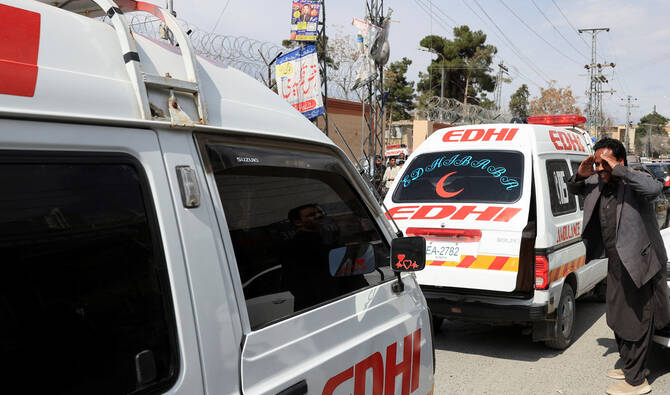
A man reacts next to ambulances carrying the bodies of victims, who were killed in Jaffar Express train hijacking, in Quetta, Pakistan on March 13, 2025. (REUTERS/File)
Short Url
Updated 27 September 2025
Follow

11 killed, 26 injured in two road accidents in Pakistan’s southwestern Balochistan

  • Passenger bus in Panjgur collided with a diesel-laden vehicle, sparking a fire that gutted the coach
  • In Khanozai, a bus going to Islamabad overturned after a head-on crash, injuring several people

QUETTA: At least 11 people were killed and 26 others injured on Saturday in two separate road accidents in Pakistan’s southwestern Balochistan province, government officials said.

The first crash occurred on the N-85 highway near Panjgur when a Khuzdar-Panjgur bound passenger bus collided with an Iranian Zamyad vehicle carrying smuggled diesel. The vehicle burst into flames on impact, setting the bus ablaze.

“Eight people were killed in the accident and three injured,” said Panjgur Deputy Commissioner Kabeer Zarkoon, adding that one critically injured passenger had been referred to Karachi for treatment.

Footage seen by Arab News showed the bus completely gutted by fire.

The second incident took place in Khanozai, about 35 kilometers from Pishin, when a Quetta-Islamabad bound bus overturned after colliding with another vehicle on the N-50 highway.

“The bus crashed into a vehicle coming from the opposite direction and overturned, killing three passengers and injuring 23,” said Amir Hamza, Assistant Commissioner Karezat.

He said eight critically injured passengers were shifted to the Trauma Center Quetta, while others with minor injuries were treated on the spot.

Fatal road accidents are frequent in Pakistan, where poor road conditions, aging vehicles and disregard for traffic rules often cause casualties.

Much of Balochistan lacks dual carriageways, making head-on collisions a persistent danger. The traffic police regularly warn drivers on social media against speeding and reckless driving.

Smuggled Iranian fuel has also played a role in major damage caused by accidents in the province.

Balochistan’s porous border with Iran makes it possible for people to bring diesel and petrol illegally, which are then sold across the province and parts of Sindh, despite the risks of transporting them in unsafe vehicles.


Pakistan’s finance chief says country shifting from aid to trade, investment with Gulf nations

Updated 5 sec ago
Follow

Pakistan’s finance chief says country shifting from aid to trade, investment with Gulf nations

  • Aurangzeb says remittances from the GCC topped $38 billion last fiscal year, projected at $42 billion this time
  • He tells an international media outlet discussions on a free trade agreement with the GCC are at an advanced stage

ISLAMABAD: Pakistan is no longer seeking aid-based support and is instead pivoting toward trade- and investment-led partnerships, Finance Minister Muhammad Aurangzeb said in an interview with an international media outlet circulated by the finance division on Monday, acknowledging longstanding economic backing from Gulf countries.

Aurangzeb spoke to CNN Business Arabia at a time when Pakistan seeks to consolidate macroeconomic stability after a prolonged crisis marked by soaring inflation, currency pressure and external financing gaps.

Aurangzeb said the government’s economic direction, articulated by Prime Minister Shehbaz Sharif, aims to replace reliance on external assistance with sustainable growth driven by investment and exports, particularly from partners in the Gulf Cooperation Council (GCC), which includes Saudi Arabia, the United Arab Emirates, Qatar, Kuwait, Oman and Bahrain.

“We are not looking for aid flows anymore,” he said. “For us, we are very clear ... that going forward is really trade and investment, which is going to bring sustainability and be win-win for our longstanding bilateral partners in GCC and for Pakistan.”

“This FDI [foreign direct investment] is going to help us in terms of GDP growth [and] more employment opportunities as we go forward,” he continued. “So, you know, all hands are on deck at this point in time to make this materialize.”

Aurangzeb said Pakistan’s shift was underpinned by improving macroeconomic indicators following an 18-month stabilization program.

He noted that inflation, which peaked at 38 percent in 2023, has fallen to single-digit levels, while the country has posted primary fiscal surpluses and kept the current account deficit within targeted limits, adding that foreign exchange reserves now cover about 2.5 months of imports.

The finance chief described recent international assessments as external validation of the government’s reform path.

“All three international credit rating agencies are now aligned in terms of their upgrades and outlook for Pakistan this year,” he said, adding that the successful completion of the second review under the International Monetary Fund’s loan program, approved by the lending agency’s executive board, reinforced confidence in Pakistan’s economic management.

The finance minister said reforms across taxation, energy, state-owned enterprises, public finance and privatization were central to consolidating stability and supporting growth.

He pointed out Pakistan’s tax-to-GDP ratio had risen to about 10.3 percent from 8.8 percent at the start of the reform program and is on track to reach 11 percent, driven by efforts to widen the tax base to include under-taxed sectors such as real estate, agriculture and wholesale and retail trade, while tightening compliance through technology-based monitoring.

Aurangzeb also highlighted the role of the GCC in supporting Pakistan’s external position, particularly through remittances.

He said inflows reached about $38 billion last fiscal year and are projected to rise to nearly $42 billion this time, with more than half originating from GCC states, reflecting the contribution of Pakistani nationals working in the region.

The finance chief said Pakistan was actively engaging Gulf partners to attract investment in sectors including energy, oil and gas, mining, artificial intelligence, digital infrastructure, pharmaceuticals and agriculture, while discussions on a free trade agreement with the GCC were at an advanced stage.