

Pakistan court hands man multiple life sentences over Indian intelligence links

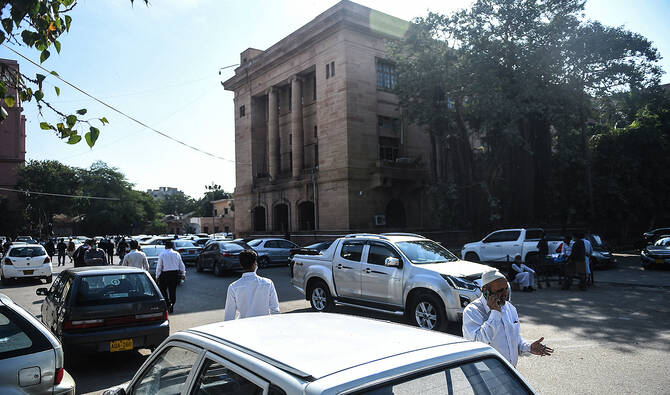
In this file photo, taken on December 24, 2020, people walk outside the Sindh High Court in Karachi. (AFP/File)
Short Url
Updated 26 September 2025
Follow

Pakistan court hands man multiple life sentences over Indian intelligence links

  • Muhammad Saleem convicted of espionage, terrorism and arms charges after 2024 arrest in Karachi
  • Conviction comes amid long-running Pakistani accusations of Indian intelligence activity, which Delhi denies

KARACHI: An anti-terrorism court in Karachi sentenced a man to multiple life terms on Thursday for illegally entering Pakistan, maintaining contact with intelligence agency RAW and possessing explosives and firearms, according to court documents seen by Arab News.

The case comes against the backdrop of longstanding accusations that India’s Research and Analysis Wing (RAW) sponsors militancy and espionage on Pakistani soil, a charge New Delhi denies. The most high-profile case was that of Kulbhushan Jadhav, a former Indian naval officer arrested in 2016 and sentenced to death by a Pakistani military court for alleged espionage. India disputes the conviction and has challenged it at the International Court of Justice.

Muhammad Saleem, who prosecutors said crossed into Pakistan illegally from India in 1989 and later obtained Pakistani identity documents, was arrested in October 2024 in Karachi’s Mauripur area. Police said they recovered a hand grenade with a detonator, a bomb launcher, a pistol with 10 live rounds and two Pakistani passports from his possession.

It was unclear if the man was an India national before 1989 and whether he still held Indian nationality. Anila Malik, the prosecutor of the case, said the prosecution proved that Saleem had illegally entered Pakistan, but his nationality was not discussed during the hearings. The court has also not used the word Indian national or Indian in its court order.

Judge Zeeshan Akhter Khan of Anti-Terrorism Court-XV wrote in the judgment that the prosecution had “successfully proved its case against the accused,” concluding that Saleem had been “caught red-handed” with explosives and weapons.

The court said testimony from police officers, forensic reports, and the Bomb Disposal Unit’s findings proved Saleem was planning attacks.

“There is no element of doubt in the present case,” the judgment said, adding that police statements were “confidence-inspiring” and supported by physical evidence and expert analysis.

Saleem, who told the court he was a social worker and denied working for RAW, argued that the case was fabricated and that the weapons were planted on him. He said in a recorded statement that “no document is on record to show that he is agent of RAW and all the articles were foisted upon him.”

The court rejected his defense, citing unexplained travel to India in 2012, 2013 and 2014.

The court sentenced Saleem to three life terms under sections 121-A and 122 of the Pakistan Penal Code, which relate to waging war against the state and collecting arms with the intent to wage war, as well as under section 4 of the Explosive Substances Act.

He was also handed 10 years under section 5 of the same act, 14 years under section 7 of the Anti-Terrorism Act — which addresses acts intended to spread terror — and 10 years under the Sindh Arms Act. All sentences will run concurrently.

Saleem, who had been on bail, was taken into custody and remanded to Karachi Central Prison after the sentencing. The court informed him of his right to appeal before the Sindh High Court.


Pakistan PM orders accelerated privatization of power sector to tackle losses

Updated 15 December 2025
Follow

Pakistan PM orders accelerated privatization of power sector to tackle losses

  • Tenders to be issued for privatization of three major electricity distribution firms, PMO says
  • Sharif says Pakistan to develop battery energy storage through public-private partnerships

ISLAMABAD: Pakistan’s prime minister on Monday directed the government to speed up privatization of state-owned power companies and improve electricity infrastructure nationwide, as authorities try to address deep-rooted losses and inefficiencies in the energy sector that have weighed on the economy and public finances.

Pakistan’s electricity system has long struggled with financial distress caused by a combination of factors including theft of power, inefficient collection of bills, high costs of generating electricity and a large burden of unpaid obligations known as “circular debt.” In the first quarter of the current financial year, government-owned distribution companies recorded losses of about Rs171 billion ($611 million) due to poor bill recovery and operational inefficiencies, official documents show. Circular debt in the broader power sector stood at around Rs1.66 trillion ($5.9 billion) in mid-2025, a sharp decline from past peaks but still a major fiscal drain. 

Efforts to contain these losses have been a focus of Pakistan’s economic reform program with the International Monetary Fund, which has urged structural changes in the energy sector as part of financing conditions. Previous government initiatives have included signing a $4.5 billion financing facility with local banks to ease power sector debt and reducing retail electricity tariffs to support economic recovery. 

“Electricity sector privatization and market-based competition is the sustainable solution to the country’s energy problems,” Prime Minister Shehbaz Sharif said at a meeting reviewing the roadmap for power sector reforms, according to a statement from the prime minister’s office.

The meeting reviewed progress on privatization and infrastructure projects. Officials said tenders for modernizing one of Pakistan’s oldest operational hubs, Rohri Railway Station, will be issued soon and that the Ghazi Barotha to Faisalabad transmission line, designed to improve long-distance transmission of electricity, is in the initial approval stages. While not all power-sector decisions were detailed publicly, the government emphasized expanding private sector participation and completing priority projects to strengthen the electricity grid.

In another key development, the prime minister endorsed plans to begin work on a battery energy storage system with participation from private investors to help manage fluctuations in supply and demand, particularly as renewable energy sources such as solar and wind take a growing role in generation. Officials said the concept clearance for the storage system has been approved and feasibility studies are underway.

Government briefing documents also outlined steps toward shifting some electricity plants from imported coal to locally mined Thar coal, where a railway line expansion is underway to support transport of fuel, potentially lowering costs and import dependence in the long term.

State authorities also pledged to address safety by converting unmanned railway crossings to staffed ones and to strengthen food safety inspections at stations, underscoring broader infrastructure and service improvements connected to energy and transport priorities.