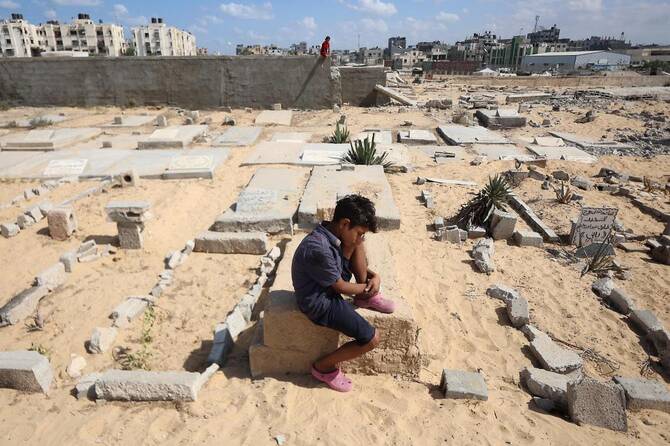
KHAN YUNIS, Palestinian Territories: Three children play with sand and pebbles among the tombstones in a southern Gaza cemetery, while a teenage boy, barefoot, carries two buckets of water through the graveyard before vanishing into a tent.
These macabre scenes are a daily reality for some displaced Palestinians, who, unable to find shelter elsewhere, have resorted to pitching tents in a cemetery in Khan Yunis, in the southern Gaza Strip.
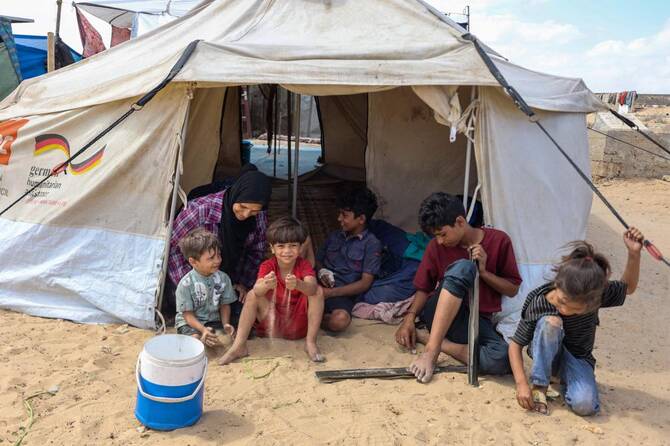
“We had no other choice,” said Randa Musleh from inside her tent, drinking tea along with some of her 11 children.
She told AFP landlords “were asking for high sums of money.”
A relatively small patch of land covering 50 square meters (540 square feet) can cost as must as 1,000 shekels ($300) a month, Musleh said — a prohibitive sum for most Gazans.
She fled to Khan Yunis with her children when Israeli military operations intensified near their home in Beit Hanun, in Gaza’s north.
“I walked and walked until I found land for my children in a livable place... People told us that we wouldn’t have to pay here, between the desert and the cemetery,” she said.
“So, we set up tents and stayed here.”
As the Israeli army presses its offensive inside Gaza City, growing numbers of residents have fled south in recent days, scrambling to find space in an already overcrowded area where hundreds of thousands are sheltering.
On Thursday, the Israeli army said 700,000 people had left Gaza City, the territory’s largest urban center.
Israel says it seeks to dismantle remaining Hamas groupings in one of the last strongholds of the militant group, whose October 2023 attack triggered the war.
The UN humanitarian agency OCHA reported a lower figure, saying 388,400 people have been displaced from Gaza’s north since mid-August, most of them from Gaza City.
With demand for transportation and shelter soaring, prices have skyrocketed. According to UN data, families may be charged over $3,000 for transport, a tent and land space.
Many cannot afford these costs and are forced to travel on foot, setting up tents wherever space is available.
Living conditions are often dire.
“There is no water here, and my children walk about four kilometers (2.5 miles)” to get water, said Musleh.
“And we are in the desert — there are scorpions and snakes.”
The proximity to graves adds to the families’ distress.
“We are in the middle of the cemetery, and we find no life,” said Umm Muhammad Abu Shahla, who evacuated from the northern town of Beit Lahia.
“We live with the dead and our condition has become like that of the dead,” she told AFP.
To Abu Shahla, there is little hope after nearly two years of war.
“Let them bomb us with a nuclear missile on the entire Gaza Strip so that we can rest,” she said.


![]()
![]()

‘We live with the dead’: Displaced Gazans shelter in cemetery
Short Url
https://arab.news/yem4n
‘We live with the dead’: Displaced Gazans shelter in cemetery
- “We had no other choice,” said Randa Musleh from inside her tent, drinking tea along with some of her 11 children
- “People told us that we wouldn’t have to pay here, between the desert and the cemetery”


Latest updates




© 2026 SAUDI RESEARCH & PUBLISHING COMPANY, All Rights Reserved And subject to Terms of Use Agreement.