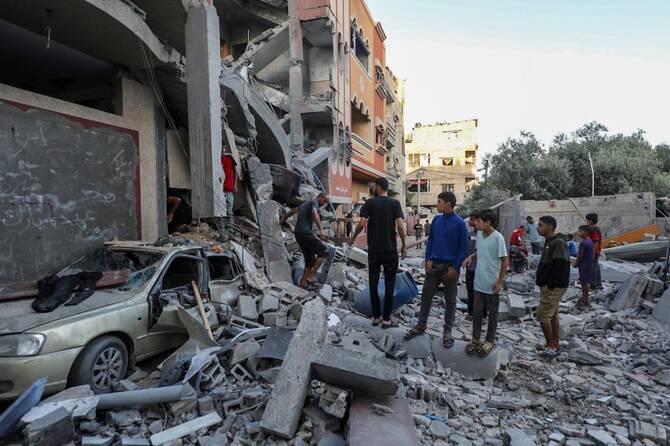
DEIR AL-BALAH, Gaza Strip: At least 17 people were killed Thursday in Israeli attacks in the Gaza Strip, according to local health officials, as international pressure for a ceasefire continued to grow.
On the sidelines of the United Nations General Assembly in New York, French President Emmanuel Macron told France 24 his country had recognized a Palestinian state on the conviction it “is the only way to isolate Hamas,” which has proved itself able to regenerate even after many of its leaders have been killed.
“Total war in Gaza is causing civilian casualties but can’t bring about the end of Hamas,” he said in the interview Wednesday. “Factually, it’s a failure.”
He said he had been lobbying US President Donald Trump to press Israel again for a ceasefire, telling him “you have an important role to play — you who supports peace, who wants to bring peace to the world.”
“You cannot stop the war if there is no path to peace,” the French president added.
Deadly strikes hit central and southern Gaza
Meanwhile in the Gaza Strip on Thursday, 12 people were killed in an Israeli attack on the central town of Zawaida that hit a tent and a house, according to the Al-Aqsa Martyrs Hospital in the nearby city of Deir Al-Balah. Eight children were among the victims, according to the hospital, and family members said another girl was still under the rubble.
The hospital said another girl was killed in an airstrike that hit a tent in Deir Al-Balah, and that it was caring for seven others injured in that attack.
In the southern city of Khan Younis, another Israeli attack hit an apartment building, killing four people, according to the Nasser Hospital where the bodies were taken.
Netanyahu denounces leaders who have recognized a Palestinian state
On Monday ahead of the opening of the UN General Assembly meetings, France, Andorra, Belgium, Luxembourg, Malta, and Monaco announced or confirmed their recognition of a Palestinian state in the hopes of galvanizing support for a two-state solution to the Mideast conflict.
Their announcements came a day after the United Kingdom, Canada, Australia and Portugal did the same, in defiance of Israel and the United States.
Israeli Prime Minister Benjamin Netanyahu lashed out at the idea early Thursday before heading to New York himself where he was to address the assembly on Friday.
“At the UN, General Assembly I will speak our truth,” he told reporters. “I will denounce those leaders who, instead of denouncing the murderers, the rapists, the child burners, want to give them a state in the heart of the land of Israel. It will not happen.”
At separate events in New York on Wednesday, US Secretary of State Marco Rubio and Trump’s lead negotiator Steve Witkoff both offered optimistic views about what Witkoff called a “Trump 21-point plan for peace” that was presented to Arab leaders on Tuesday.
The US has not released details of the plan or said whether Israel or Hamas accepts it, but Netanyahu suggested Israel’s position had not changed.
The Israeli leader said when he travels from New York on to Washington to meet with Trump, he would “discuss with him the great opportunities our victories have brought and also our need to complete the goals of the war: to return all our hostages, to defeat Hamas and to expand the circle of peace that is open to us.”
The US, along with Egypt and Qatar, have spent months trying to broker a Gaza ceasefire and hostage release. Those efforts suffered a major setback earlier this month when Israel carried out an airstrike targeting Hamas leaders in Qatar.
Israel launched another major ground operation earlier this month in Gaza City, which experts say is experiencing famine. More than 300,000 people have fled, but up to 700,000 are still there, many because they can’t afford to relocate.


![]()

At least 17 killed in Gaza Strip as leaders ramp up pressure for a ceasefire
Short Url
https://arab.news/gs7ak
At least 17 killed in Gaza Strip as leaders ramp up pressure for a ceasefire
- At least 17 people have been killed in Israeli attacks in the Gaza Strip, according to local health officials, as international pressure for a ceasefire continued to grow


Latest updates


© 2026 SAUDI RESEARCH & PUBLISHING COMPANY, All Rights Reserved And subject to Terms of Use Agreement.