Kyrgyzstan to stage snap election as president tightens grip

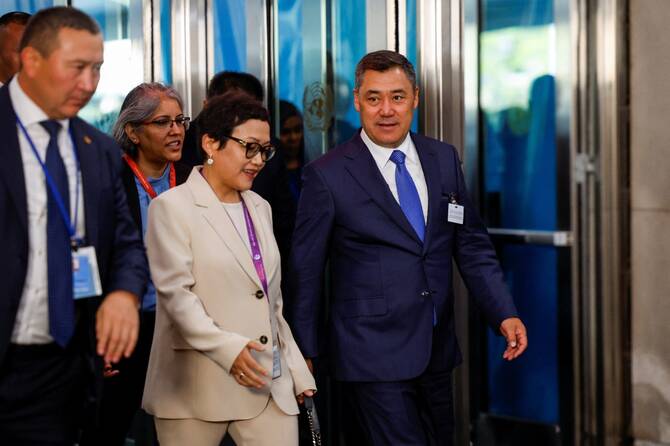
Kyrgyz President Sadyr Japarov arrives to attend the 80th United Nations General Assembly, in New York City, US. (Reuters)
Short Url
Updated 25 September 2025
Follow

Kyrgyzstan to stage snap election as president tightens grip

  • The mountainous former Soviet republic bordering China was long considered the most democratic in Central Asia but has seen a decline in civil liberties in recent years

BISHKEK: Kyrgyzstan’s parliament voted on Thursday to dissolve, paving the way for snap elections in November that critics say are aimed at consolidating President Sadyr Japarov’s power.
The mountainous former Soviet republic bordering China was long considered the most democratic in Central Asia but has seen a decline in civil liberties in recent years.
Japarov’s administration has taken steps to control Internet access since he was swept to power on the back of pro-democracy protests in 2020, while authorities have arrested politicians and journalists for what the president says are attempted coups.
Eighty-four of the 90 MPs in Kyrgyzstan’s Supreme Council voted for the dissolution, which would bring forward by one year parliamentary elections initially scheduled for November 2026.
Lawmaker Ulan Primov said the move was necessary to “strengthen the political system and stability in the country” and to avoid clashing with the run-up to the presidential election scheduled for early 2027.
Critics say the move will tighten Japarov’s control of parliament ahead of his re-election bid.
Kyrgyzstan adopted sweeping electoral reforms in June that abolished proportional party lists in favor of a winner-takes-all system and made it more expensive for smaller parties to field candidates.
Japarov rejects charges of eroding democracy and has accused his critics — including rights groups — of spreading false information.


North Korean leader Kim watches cruise missile tests with his daughter

A strategic cruise missile test launch conducted on the destroyer Choe Hyon at an undisclosed location in North Korea. (AFP)
Updated 11 March 2026
Follow

North Korean leader Kim watches cruise missile tests with his daughter

  • KCNA said the missiles hit target islands off North Korea’s west coast

SEOUL, South Korea: North Korean leader Kim Jong Un and his teenage daughter observed tests of strategic cruise missiles fired from a warship, state media reported Wednesday, as North Korea threatened responses to US-South Korean military drills.
Images sent by the Korean Central News Agency showed the two in a conference room looking at a screen showing weapons being fired from the Choe Hyon, a year-old naval destroyer.
Kim Jong Un watched the missiles launches via video on Tuesday and underscored the need to maintain “a powerful and reliable nuclear war deterrent,” KCNA reported in a dispatch that did not mention his daughter.
The girl, reportedly named Kim Ju Ae and about 13, has accompanied her father at numerous prominent events including military parades and weapons launches since late 2022. South Korea’s spy agency assessed last month Kim Jong Un was close to designating her as his heir.
KCNA said the missiles hit target islands off North Korea’s west coast. It quoted Kim Jong Un as saying the launches were meant to demonstrate the navy’s strategic offensive posture and get troops familiarized with weapons firings.
Kim Jong Un observed similar cruise missile launches from the Choe Hyon in person last week, but his daughter was not seen at that appearance.
Tuesday’s missile firings came after the start of the springtime US-South Korean military drills that North Korea views as an invasion rehearsal.
On Tuesday, Kim Jong Un’s sister and senior official, Kim Yo Jong, warned the drills reveal again the US and South Korea’s “inveterate repugnancy toward” North Korea. She said North Korea will “convince the enemies of our war deterrence.”
The 11-day Freedom Shield drill that began Monday is largely a computer-simulated command post exercise and will be accompanied by a field training program. North Korea often reacts to the two sets of training with its own weapons tests.