

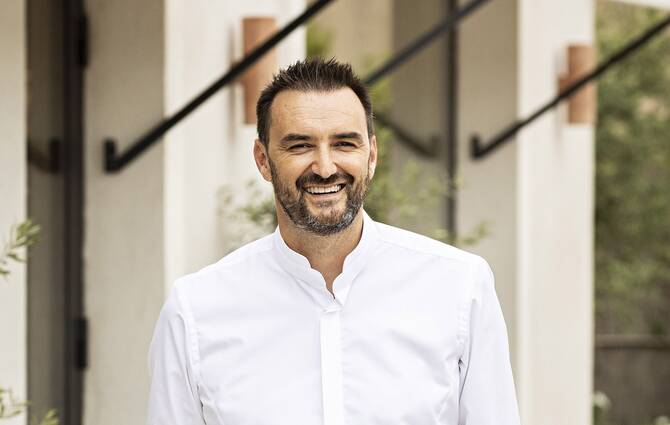

DUBAI: Cyril Lignac — the French chef, restaurateur and media personality — opened a Dubai branch of his acclaimed French-Asian fusion restaurant Bar des Prés earlier this year, following its success in Paris and London.
Originally from the Aveyron region in southern France, Lignac trained under several established chefs before opening his first Paris restaurant, Le Quinzième, in 2005. Since then, he has developed a diverse portfolio that includes restaurants, patisseries, a chocolatier and a cooking school.

Bar des Prés is a French-Asian fusion restaurant. (Supplied)
Lignac is also widely recognized for his work in television — he has appeared on several cooking and baking programs, including “Tous en Cuisine,” in which he cooked live from his home kitchen during the COVID-19 lockdowns — and for authoring several cookbooks.
When you started out, what was the most common mistake you made?
I’m not sure I ever repeated a mistake, but I remember the first time I cooked for my parents. I was 18 years old and had just started my culinary training a few weeks earlier. I told my parents I was going to prepare truite meunière (trout in meunière butter), a classic of French cuisine. I started browning the trout, basting them generously with butter. After about 10 minutes, I figured they were nicely colored and it was time to deglaze with lemon juice before adding the final touch: my Grenobloise-style croutons. With a confident gesture, I poured the lemon juice into the pan. And then… boom! A huge flame shot up in front of me. While I stood there stunned, my father quickly grabbed the pan off the heat, and everything calmed down. I nearly set the house on fire. Luckily, it didn’t discourage me from continuing.
What’s your top tip for amateur chefs?
Cook with joy and to bring joy to others. There is no need to show off. A dish made with generosity, something everyone will enjoy sharing, is more than enough.

Bar des Prés is a French-Asian fusion restaurant. (Supplied)
What one ingredient can instantly improve any dish?
Espelette pepper. I’ve always used it regularly in my cooking, probably because of my Aveyron roots. It can be used just like black pepper, in all kinds of dishes, in marinades, or simply as a finishing touch on grilled meat or fish.
What’s your favorite cuisine or dish to eat?
I love all kinds of cuisine. French, of course, but also Italian, Japanese and Indian. I choose a restaurant and a dish based on what I’m craving at the moment. It can be something very simple, like beautiful seasonal green asparagus or a smash burger, or something more complex, like a whole fish in a crust or a slow-cooked dish in sauce.
What’s your go-to dish if you have to cook something quickly at home?
I always enjoy a simple plate of pasta with tomato sauce.
What customer behavior most annoys you?
The restaurant industry is a profession of passion and service. It is made up of men and women who give a lot. So what gets me the most is the lack of respect that some people sometimes show toward the teams.
What’s your favorite dish to cook?
I love making côte de boeuf (beef rib), simply grilled and served with aligot — a mashed potato and fresh Tomme cheese dish from the south of France. It reminds me of my childhood, joyful family dinners or meals with friends. It’s a meal of warmth and indulgence.

Lignac is also widely recognized for his work in television. (Supplied)
What’s the most difficult dish for you to get right?
They often say, “The simplest things are the hardest to accomplish.” This is very true in cooking. A simple dish leaves no room for mistakes.
As a head chef, what are you like?
I’m very demanding. I scrutinize every dish, every detail. Everything must be perfect. But on the management side, I believe I’m very approachable. I’m close to my teams, and they know they can come to me if necessary.
Chef Cyril’s citrus and mint marinated sea bream recipe

Chef Cyril’s citrus and mint marinated sea bream. (Supplied)
Preparation time: 20 minutes
Serves four people
Ingredients:
4 sea bream fillets
1 zucchini
2 to 3 white asparagus spears
100 g cherries
A few fresh mint leaves
Sesame seeds
Sea salt flakes
For the citrus vinaigrette:
10 g ginger
1 g Thai chili
3 tbsp orange juice
2 tbsp lemon juice
1 tbsp cherry blossom or raspberry vinegar
2 tbsp soy sauce
1 tbsp grape seed oil
Method:
Step 1:
Prepare the vinaigrette. Peel and finely chop the ginger, deseed and chop the chili.
Pour into a bowl with the citrus juices, vinegar, soy sauce, and oil. Mix well and set the vinaigrette aside.
Step 2:
Remove the skin from the fish fillets, cut them in half along the central bone, then remove the red parts and any bones.
Rinse the fish under cold water and place them on paper towels.
Slice them into thin pieces and arrange them on plates.
You can keep the carpaccios covered in the fridge and finish assembling the plates just before serving.
Step 3:
Wash and slice the zucchini into thin strips, then cut each strip into 4 equal parts on the diagonal.
Peel the asparagus and slice them thinly using a vegetable peeler.
Wash, stem, and pit the cherries, then cut them into quarters.
Wash and finely chop the mint leaves.
Step 4:
On the carpaccio plates, delicately place the raw zucchini slices and asparagus shavings in the center of the fish slices.
Drizzle with citrus vinaigrette, season with sea salt flakes, add the cherry quarters, sprinkle with chopped mint, and finish with sesame seeds.


