

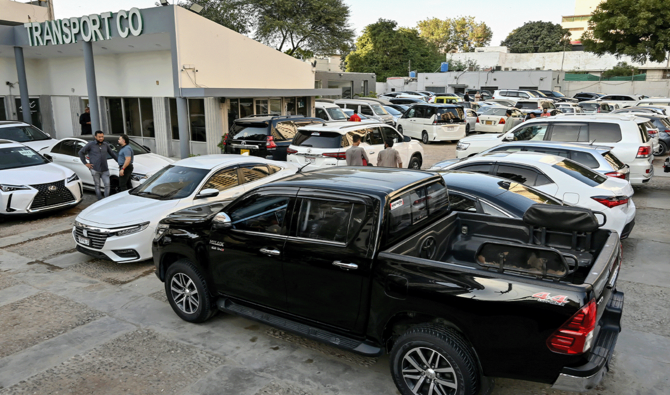

KARACHI: Pakistan’s top economic decision-making body on Wednesday approved the import of used cars, drawing sharp criticism from industry stakeholders, who warned the move would have a “devastating” effect on local manufacturing in the country.
The decision was taken after a meeting of the Economic Coordination Committee (ECC) which was chaired virtually by Finance Minister Muhammad Aurangzeb from New York. The ECC said initially only vehicles not older than five years will be allowed to be imported until Jun. 30, after which the age limit will be removed.
The decision comes on the eve of the IMF mission’s arrival in Pakistan for its second review of the country’s economy under a $7 billion loan program. The global lender, among various other stipulations, requires Islamabad to liberalize its trade and lift restrictions on the import of used cars.
“The ECC considered a summary regarding the commercial import of used vehicles and, after detailed discussion, accorded approval to the proposals,” the finance ministry’s statement said.
It said the ECC has approved changes to the Import Policy Order, 2022, to allow the commercial import of used vehicles subject to strict environmental and safety standards compliance.
The committee approved the imposition of a 40 percent regulatory duty (RD) in addition to existing customs duties on the import of vehicles less than five years old.
The additional duty will remain in place until June 2026 and will keep decreasing by 10 percentage points every year to become zero by fiscal year 2029-30, the statement added.
‘DEVASTATING IMPACT’
Auto manufacturers, assemblers and part makers in Pakistan like Toyota, Honda, Suzuki, Hyundai, Kia Motors and Changan Automobile fear the move would inflict heavy losses on their business and ultimately lead to the closure of their manufacturing plants.
“It is a major and fundamental change in the import policy of the country,” Abdul Waheed Khan, director general at Pakistan Automotive Manufacturers Association (PAMA), told Arab News.
“Notwithstanding 40 percent extra tariff, it would flood the market with used vehicles and destroy the local manufacturing,” he noted.
Pakistan’s dollar shortages and resultant inventory losses made recent years challenging for local car makers, whose production declined by 51 percent to 111,402 units in fiscal year 2025, from 226,433 units in fiscal year 2022, when production peaked to a three-decade high, according to PAMA’s data.
The Pakistan Association of Automotive Parts & Accessories Manufacturers (PAAPAM) said it is “extremely concerned” about the ECC decision.
“It will have a devastating impact on an industry which is providing jobs to 300,000 people directly and 1.83 million Pakistanis indirectly,” Shehryar Qadir, the association’s senior vice chairman, told Arab News.
PAAPAM fears the closure of 1,200 companies that have been manufacturing and supplying steel, plastic, rubber, copper, aluminum and auxiliary parts to all 13 car assemblers in Pakistan.
“It will negatively impact upcoming investments in localization and in assembly of electric vehicles in the country,” he warned.
The association said it would “wait for the conditions and rationale behind this decision.”
Topline Securities analyst Shankar Talreja said low-end cars or hatchbacks were primarily dominating Pakistan’s used car imports.
“This [approval] may result in higher imports of used cars, as currently cars are imported using baggage or gift schemes, which restrict bulk purchase,” he said. “Similarly, with the subsequent decline in RDs over the year, the imports of mid-end cars may also rise”.
The analyst said Pakistan’s dwindling foreign exchange reserves, which stood at $14 billion last week, will be strained as imports of used cars increase.
“(The) reserves will be used against this decision,” Talreja said.
However, he said that since the government has imposed some qualitative/non-tariff barriers, it would provide some respite to car makers and Pakistan’s forex reserves.
Khan, however, does not see any respite for the auto manufacturing industry.
“One vehicle’s import means one vehicle’s loss at the production line,” he said. “They are rivals.”


