BOGOTA, Colombia: Twenty-three workers were rescued Wednesday after spending 43 hours trapped in a collapsed underground gold mine in northern Colombia. The miners were met with applause as they emerged from the La Reliquia mine, located in the Antioquia department.
Colombia’s National Mining Agency reported that the main entrance to the mine had collapsed on Monday due to a “geomechanical failure.” A video released by the ANM shows the first rescued miners walking out under their own power, using a rope to climb the steep entrance to the shaft. Their health status was not immediately disclosed.
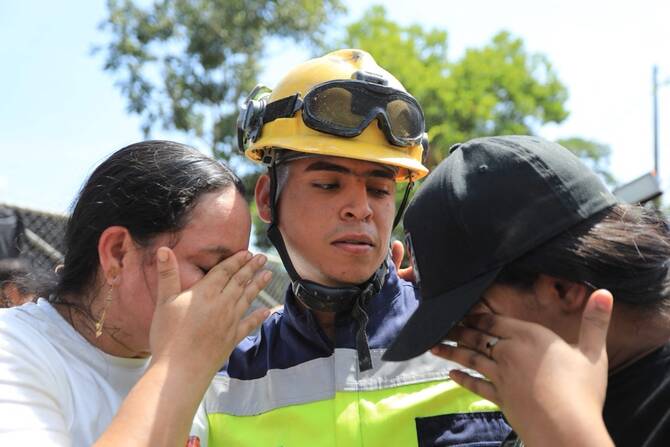
The miners’ families had been waiting for hours and celebrated their rescue with tears and applause.
The mine is on land belonging to Canada’s Aris Mining Corp. but is operated by a local mining cooperative. Aris Mining said earlier that it had provided the trapped workers with food, water and ventilation during the rescue efforts. The mine has about 60 employees and accounts for a “small portion” of the company’s total gold production in the area.
Aris runs two mining concessions in Colombia, which last year produced about 6.6 tons of gold. Colombia’s gold production climbed to 67 tons per year in 2024, supported by high prices for the precious metal.
A report published in 2023 by Colombia’s Human Rights Ombudsman said that more than 80 percent of Colombia’s gold is mined by informal operators with no licenses, including artisanal miners but also members of rebel groups.
The precarious conditions at some gold mines in Colombia have led to fatal accidents. On Saturday the bodies of seven miners were found at an illegal mine in Cauca province. Rescue teams took nine days to reach the trapped workers.

23 miners rescued after 43 hours trapped in Colombian gold mine
https://arab.news/25377
23 miners rescued after 43 hours trapped in Colombian gold mine
Cuba says a 5th person died after people on a Florida-flagged speedboat opened fire on soldiers
- Authorities in Cuba said that on Feb. 26 Cuban soldiers confronted a speedboat carrying 10 people as the vessel approached the island and opened fire on the troops
- The shooting threatened to increase tensions between US President Donald Trump and Cuban authorities
HAVANA: Cuba said a fifth person has died as a consequence of a fatal shootout last month involving a Florida-flagged speedboat that allegedly opened fire on soldiers in waters off the island nation’s north coast.
The island’s interior ministry said late Thursday in a statement that Roberto Álvarez Ávila died on March 4 as a result of his injuries. It added that the remaining injured detainees “continue to receive specialized medical care according to their health status.”
Authorities in Cuba said that on Feb. 26 Cuban soldiers confronted a speedboat carrying 10 people as the vessel approached the island and opened fire on the troops. They said the passengers were armed Cubans living in the US who were trying to infiltrate the island and “unleash terrorism”. Cuba said its soldiers killed four people and wounded six others.
“The statements made by the detainees themselves, together with a series of investigative procedures, reinforce the evidence against them,” the Cuban interior ministry said in its statement, adding that “new elements are being obtained that establish the involvement of other individuals based in the US”
Earlier this week, Cuba said it had filed terrorism charges against six suspects that were on the speedboat. The government unveiled items said to have been found on the boat, including a dozen high-powered weapons, more than 12,800 pieces of ammunition and 11 pistols.
Cuban authorities have provided few details about the shooting, but said the boat was roughly 1.6 kilometers (1 mile) northeast of Cayo Falcones, off the country’s north coast. They also provided the boat’s registration number, but The Associated Press was unable to readily verify the details because boat registrations are not public in the state of Florida.
The shooting threatened to increase tensions between US President Donald Trump and Cuban authorities. The island’s economy was until recently largely kept economically afloat by Venezuela’s oil, which is now in doubt after a US military operation deposed then-Venezuelan President Nicolás Maduro.


