DUBAI: Iran has begun rebuilding missile-production sites targeted by Israel during its 12-day war in June, satellite images analyzed by The Associated Press show, but a key component is likely still missing — the large mixers needed to produce solid fuel for the weapons.
Reconstituting the missile program is crucial for the Islamic Republic, which believes another round of war with Israel may happen. The missiles are one of Iran’s few military deterrents after the war decimated its air defense systems — something that Tehran long has insisted will never be included in negotiations with the West.
Missile experts told AP that obtaining the mixers is a goal for Tehran, particularly as it prepares for possible United Nations sanctions to be reimposed on the country later this month. The sanctions would penalize any development of the missile program, among other measures. Iranian President Masoud Pezeshkian is due to address the United Nations General Assembly on Wednesday.
Known as planetary mixers, the machines feature blades that revolve around a central point, like orbiting planets, and offer better mixing action than other types of equipment. Iran could purchase them from China, where experts and US officials say they’ve purchased missile fuel ingredients and other components in the past.
“If they’re able to reacquire some key things like planetary mixers, then that infrastructure is still there and ready to get rolling again,” said Sam Lair, a research associate at the James Martin Center for Nonproliferation Studies who studied Iranian missile sites.
Iran’s mission to the United Nations did not respond to questions about the country’s efforts to rebuild its missile program.
Israeli war targeted solid-fuel missile sites
Solid-fuel missiles can be fired faster than those using liquid fuel, which must be loaded just before launch. That speed can make the difference between launching a missile and having it destroyed in a launcher — something that happened during the war with Israel.
Iran has solid-fuel missile manufacturing bases at Khojir and Parchin, two sites just outside Tehran, as well as at Shahroud, some 350 kilometers (215 miles) northeast of the capital. Even before the most recent war, all of those sites came under Israeli attack in October 2024 during hostilities between the countries.
Attacks during the war in June appeared aimed at destroying buildings that housed the mixers, which are needed to ensure the missile fuel is evenly combined, according to experts. Other sites struck by Israel included manufacturing facilities that likely could be used to make the mixers.
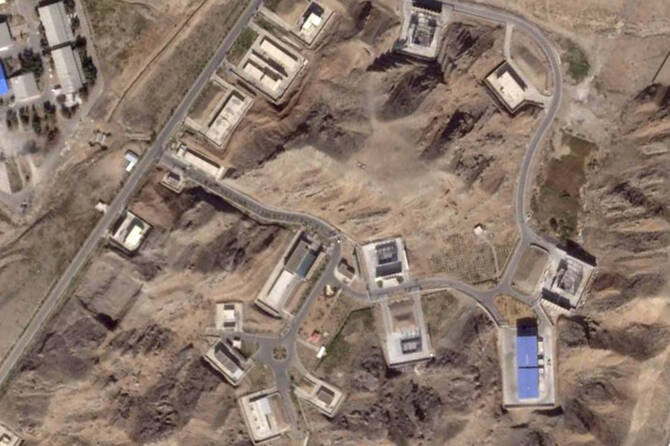
Satellite images from Planet Labs PBC taken this month and analyzed by AP show construction at both the Parchin and Shahroud facilities.
At Parchin, mixing buildings appear to be under repair, Lair said, and similar rebuilding is happening at Shahroud involving mixing buildings and other structures.
The speed at which Iran is rebuilding shows the importance Tehran puts on its missile program. Iran’s bombed nuclear sites so far have not seen the same level of activity.
During the war, Iran fired 574 ballistic missiles at Israel, according to the Washington-based Jewish Institute for National Security of America, which has a close relationship with the Israeli military. In two exchanges of fire before the war, Iran launched another 330 missiles, the think tank said.
The Israeli military had estimated Iran’s total arsenal at around 2,500 missiles, meaning that over a third of its missiles were fired.
Before the war, Iran was on track to be able to produce more than 200 solid-fuel missiles a month, said Carl Parkin, a summer fellow at the James Martin Center. That drew Israeli strikes to missile-building facilities.
“Israel’s targeting indicates that they believed mixing was a bottleneck in Iran’s missile production,” he said. “If Iran is able to overcome their mixing limitations, they’ll have all the casting capacity that they need to start producing at high volumes again.”
The Israeli military declined to respond to questions over its strategy. Iran’s defense minister, Gen. Aziz Nasirzadeh, recently claimed Tehran now has new missiles with more advanced warheads.
“The 12-day war with Israel has altered some of our priorities,” he said on Aug. 22. “We are now focused on producing military equipment with higher precision and greater operational capabilities.”
Chinese mixers seen at Syria missile site affiliated with Iran
Iran may choose to rely on China to obtain mixers and the chemicals to make solid fuel.
Such chemicals may have caused a massive explosion in April that killed at least 70 people at a port in Iran. Iran still has not explained the blast, which happened as its diplomats met with Americans in Oman over its nuclear program.
Just days after the explosion, the US State Department sanctioned Chinese firms it said provided the Islamic Republic with “ballistic missile propellant ingredients.”
Meanwhile, Iran’s Revolutionary Guard likely supplied a planetary mixer to an underground ballistic missile construction facility in Syria near the town of Masyaf, some 170 kilometers (105 miles) north of the capital, Damascus, near the Lebanese border. Footage released by the Israeli military months after the September 2024 raid on the facility showed the mixer, which bore a resemblance to others sold online by Chinese firms.
Iran’s president and military officials visited Beijing earlier this month for China’s Victory Day parade. Iran’s government has provided no detailed readout on what Pezeshkian said to Chinese President Xi Jinping, and China’s state-run media offered no indications that Tehran asked for help.
The Chinese Foreign Ministry, asked about possibly supplying Tehran mixers and fuel ingredients, told AP that Beijing is “willing to continue leveraging its influence to contribute to peace and stability in the Middle East.”
“China supports Iran in safeguarding its national sovereignty, security and national dignity,” the ministry said. “At the same time, China is deeply concerned about the continued escalation of tensions in the Middle East.”
Can Kasapoğlu, a senior fellow with the Washington-based Hudson Institute, said Beijing could supply guidance systems and microprocessors as well for Iran’s ballistic missiles.
“If Iran uses its relationship with China to bolster its disruptive military capabilities, the 12-day war could be a mere speed bump for the Iranian regime, rather than a decisive defeat,” he wrote.
Lair, the analyst, said if Iran restarts its production at prewar levels, the sheer number of missiles produced will make it harder for the Israelis to preemptively destroy them or shoot them down.
“They are clearly very invested in their missile program, and I don’t think that they’re going to negotiate it away, ever,” he said.


![]()
![]()

Iran starts rebuilding missile sites hit by Israel, but experts say a key component is missing

Short Url
https://arab.news/vh4wj
Iran starts rebuilding missile sites hit by Israel, but experts say a key component is missing
- Iran has begun rebuilding missile-production sites targeted by Israel during its 12-day war in June that’s according to satellite images analyzed by The Associated Press
- The missiles are one of Iran’s few military deterrents after the war decimated its air defense systems


Latest updates


Recommended


© 2026 SAUDI RESEARCH & PUBLISHING COMPANY, All Rights Reserved And subject to Terms of Use Agreement.