

India’s Kolkata hit by heaviest rainfall in four decades

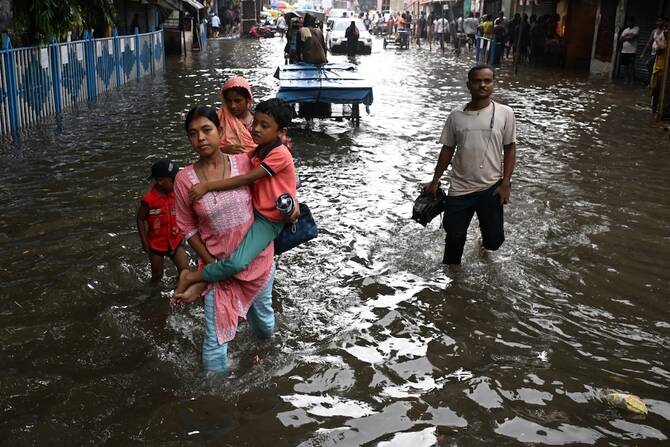
Commuters wade across a waterlogged street after heavy monsoon rains in Kolkata on Sept. 23, 2025. (AFP)
Short Url
Updated 24 September 2025
Follow

India’s Kolkata hit by heaviest rainfall in four decades

  • City received more than 251.6 mm of rainfall in under 24 hours
  • Elder residents have not seen such downpours since 1980s

NEW DELHI: The capital of India’s West Bengal state, Kolkata, was on alert on Wednesday after the worst rainfall in four decades left parts of the city submerged.

Residential areas and businesses across the city and its suburbs have struggled with severe waterlogging since Monday night. Key roads have been flooded and public transportation disrupted, bringing Kolkata to a standstill and forcing people to wade through water.

On Tuesday, the city received more than 251.6 mm of rainfall in fewer than 24 hours — the worst since 1986.

“That was also in the month of September. When you have 25 cm more rainfall in Kolkata it is quite unusual,” Dr. Habibur Rahman Biswas, the head of India Meteorological Department in Kolkata, told Arab News.

The heavy rainfall was caused by low pressure over the northeast Bay of Bengal.

“In such case, a large city like Kolkata, the impact on the public is greater,” added Biswas. “Had this low-pressure convergence happened in villages and other areas outside of the city, the impact could have been lesser.”

West Bengal Chief Minister Mamata Banerjee said on local TV she had “never seen such rain” and promised compensation for the families of at least eight people killed in flood-related incidents in the city.

The local media reported the number of casualties was likely higher.

“I learnt 10 people have died due to electrocution,” said Kaushik Das, a student at the University of Calcutta.

“Major parts of Kolkata are deep in water, with people not able to move. Though there is no rain today, water is still there on the streets ... It was something new for so much rain to fall. Kolkata looked like a big river.”

Older residents like retired government officer Debashis Bhattacharyya do not recall seeing such downpours since the 1980s.

“That time, heavy rain lashed not only Kolkata but the whole Bengal. This time, the rain was largely confined to the city,” he told Arab News.

“In the morning, when I looked outside, everything was flooded and part of the ground floor was also underwater ... The suburban areas are still waterlogged, and the city is struggling to regain its normalcy.”


Trump’s new tariffs shift focus to balance of payments; economists see no crisis

Updated 2 sec ago
Follow

Trump’s new tariffs shift focus to balance of payments; economists see no crisis

President Donald Trump’s temporary 15 percent tariffs to replace those struck down by the US Supreme Court are meant to resolve a problem that many economists say ​does not exist: a US balance of payments crisis, making them potentially vulnerable to new legal challenges.
Hours after the high court on Friday struck down a huge swath of tariffs Trump had imposed under the International Emergency Economic Powers Act, the president announced the new duties under Section 122 of the Trade Act of 1974 — a never-used statute that even his own legal team dismissed as irrelevant months ago.
Collections of the new 15 percent tariffs began at midnight on Tuesday as IEEPA tariff collections of 10 percent to 50 percent halted.
The Section 122 law allows the president to impose duties of up to 15 percent for up to 150 days on any and all countries to address “large and serious” balance-of-payments deficits and “fundamental international payments problems.”
Trump’s tariff order argued that a serious balance of payments deficit existed in the form of a $1.2 trillion annual US goods trade ‌deficit and a current ‌account deficit of 4 percent of GDP and a reversal of the US primary income surplus.
Some ​economists, ‌including ⁠former International ​Monetary Fund ⁠First Deputy Managing Director Gita Gopinath, disagreed with the Trump administration’s alarm.
“We can all agree that the US is not facing a balance of payment crisis, which is when countries experience an exorbitant increase in international borrowing costs and lose access to financial markets,” Gopinath told Reuters.
Gopinath rejected the White House’s claim that a negative balance on the US primary income for the first time since 1960 was evidence of a large and serious balance of payment problem.
She attributed the negative balance to a large increase in foreign purchases of US equities and risky assets over the past decade, which outperformed foreign equities over this period.
Mark Sobel, a former US Treasury and IMF official, said that balance of payments crises are more associated with countries that have ⁠fixed exchange rates, and noted that the floating-rate dollar has been steady, the 10-year Treasury yield fairly ‌stable, with US stocks performing well.
Josh Lipsky, chair of international economics at the Atlantic Council ‌think tank, agreed, noting that a balance of payments crisis occurred when a country ​could not pay for what it was importing or was unable to ‌service foreign debt. That was fundamentally different from a trade deficit, he added.
Brad Setser, a currency and trade expert at the ‌Council on Foreign Relations who served as a senior adviser to the US Trade Representative in the Biden administration, took a somewhat contrarian view, arguing in lengthy X posts on Sunday that the Trump administration may have a reasonable case that there is a “large and serious” balance of payments deficit.
He noted that the current account deficit was far higher than when then-president Richard Nixon erected tariffs in 1971 to address a balance of payments crisis, and the US net international investment ‌position is much worse. This “gives the administration a real argument,” in favor of its tariffs, Setser wrote.
The White House, US Treasury and US Trade Representative did not immediately respond to requests for comment about ⁠the use of Section 122.

WRONG STATUTE ⁠FOR THE JOB
Despite the Trump administration’s new focus on balance of payments, the Justice Department had previously argued that Section 122 was the wrong statute to handle a national emergency over the trade deficit.
In court filings in its defense of IEEPA tariffs, the Justice Department said Section 122 would not have “any obvious application here, where the concerns the president identified in declaring an emergency arise from trade deficits, which are conceptually distinct from balance-of-payments deficits.”
Neal Katyal, who argued at the Supreme Court on behalf of plaintiffs challenging the IEEPA tariffs, told CNBC that the Trump administration’s stance against the use of Section 122 for a trade deficit will make those tariffs vulnerable to litigation.
“I’m not sure it will necessarily even need to get to the Supreme Court, but if the president adheres to this plan of using a statute that his own Justice Department has said he can’t use, yeah, I think that’s a pretty easy thing to litigate,” Katyal said.
It is unclear who might take the lead in challenging the Section 122 tariffs.
Sara Albrecht, chair of the Liberty Justice Center, a nonprofit, public-interest law firm representing several small businesses that challenged the IEEPA ​tariffs, said the group would closely monitor any new statutes ​being invoked.
Albrecht did not reveal any future litigation strategy, adding: “Our immediate focus is simple: making sure the refund process begins and that checks start flowing to the American businesses that paid those unconstitutional duties.”
In its ruling, the Supreme Court did not give instructions regarding refunds, instead remanding the case to a lower ​trade court to determine next steps.