

Pakistan PM meets IMF, World Bank leaders in New York on reforms, recovery

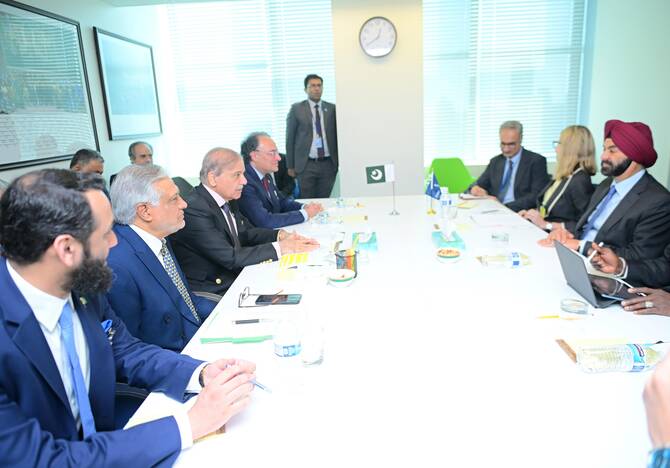
Pakistan Prime Minister Shehbaz Sharif meets President World Bank Ajay Banga on the sidelines of 80th Session of the United Nations General Assembly in New York on September 24, 2025. (Handout/PMO)
Short Url
Updated 24 September 2025
Follow

Pakistan PM meets IMF, World Bank leaders in New York on reforms, recovery

  • Sharif discusses $40 billion World Bank framework, ongoing IMF programs on UNGA sidelines
  • Pakistani statements highlight support for reform agenda, climate resilience and flood recovery

KARACHI: Prime Minister Shehbaz Sharif this week met the heads of the International Monetary Fund (IMF) and the World Bank on the sidelines of the 80th United Nations General Assembly in New York, where discussions focused on Pakistan’s economic reform program, long-term development agenda and recovery plan from recent floods, the premier’s office said on Wednesday.

The meetings build on Pakistan’s engagement with both institutions: the World Bank’s Country Partnership Framework (CPF) for 2026–2035, under which the Bank has committed $40 billion in financing, and the IMF’s $3 billion Stand By Arrangement, which has been concluded, and the ongoing $7 billion Extended Fund Facility (EFF) and $1.4 billion Resilience & Sustainability Facility (RSF).

Sharif briefed World Bank Group President Ajay Banga on reforms covering resource mobilization, energy sector restructuring, privatization and climate measures. His office said these policies had steered the economy toward stabilization, restored investor confidence and promoted inclusive growth.

“President World Bank appreciated the reform measures being undertaken by Pakistan and reaffirmed the Bank’s commitment to Pakistan’s development agenda,” Sharif’s office in Islamabad said in a statement.

“He emphasized the Bank’s readiness to extend continued support for advancing economic reforms and undertaking long-term initiatives on climate resilience under the new CPF.”

Sharif also praised Banga’s leadership in reshaping the World Bank into a faster and more effective development partner, highlighting its response during the COVID-19 pandemic and devastating 2022 floods in Pakistan that killed 1,700 people and caused over $30 billion in economic losses. Both sides reaffirmed their resolve to strengthen cooperation under the CPF.

Pakistan has received over $48.3 billion in World Bank assistance since joining the institution in 1950. Its current portfolio includes 54 projects with commitments totaling $15.7 billion.

In a separate meeting, Sharif thanked IMF Managing Director Kristalina Georgieva for what he described as the Fund’s longstanding partnership, citing its timely support under multiple facilities.


Pakistan Prime Minister Shehbaz Sharif meets IMF Managing Director Kristalina Georgieva on the sidelines of 80th Session of UNGA in New York on September 24, 2025.(Handout/PMO)

While emphasizing Pakistan’s progress toward IMF program targets, he stressed that “the impact of the recent floods on Pakistan’s economy must be factored into the IMF’s review.”

According to the Prime Minister’s Office, Georgieva “commended the Prime Minister’s commitment to pursuing sound macro-economic policies and reiterated the IMF’s continued support as Pakistan advances the necessary economic reforms to ensure sustainable long term economic growth.”

The IMF chief also expressed sympathy for flood-affected communities and underscored the importance of damage assessments to underpin recovery priorities.


Pakistan says it is moving toward phased crypto regulation after Binance, HTX approvals

Updated 8 sec ago
Follow

Pakistan says it is moving toward phased crypto regulation after Binance, HTX approvals

  • The country is among the world’s largest crypto adoption markets, with nearly 40 million users
  • Bilal bin Saqib says the government is not promoting crypto but moving to regulate the sector

ISLAMABAD: Pakistan’s top virtual asset regulatory official said on Sunday the country was laying the foundation for a phased and tightly supervised crypto framework after granting conditional approvals to two global exchanges, signaling a shift from years of regulatory ambiguity toward formal oversight of digital assets.

The Pakistan Virtual Assets Regulatory Authority (PVARA) said this week it had issued no objection certificates (NOCs) to global crypto exchanges Binance and Huobi (HTX). Pakistan has also signed a memorandum of understanding with them to explore what the finance ministry described as the “tokenization” of up to $2 billion in sovereign bonds, treasury bills and commodity reserves, an initiative aimed at boosting liquidity and attracting investors.

“The no objection certificate given to Binance and Huobi is the first practical step of this new thinking,” PVARA chief Bilal bin Saqib said at a briefing. “Let me make it clear that this NOC is not a shortcut. This is not a blanket approval.”

He said the approvals marked the start of a risk-mitigated, phased and supervised entry framework, adding that platforms would be subject to strict anti-money laundering and counter-terrorism financing requirements, ownership transparency checks and enforcement-linked licensing timelines.

“This is not a new experiment,” he said, pointing to phased regulatory approaches adopted in financial centers such as Dubai, the United Kingdom and Singapore, where firms are first brought under supervision before being allowed to expand operations.

Pakistan is among the world’s largest crypto adoption markets, with estimates putting the number of users between 30 and 40 million, despite the absence of a comprehensive regulatory framework. Saqib said ignoring the sector was no longer viable, warning that unregulated adoption posed greater risks to the economy and consumers.

“We don’t want to promote crypto,” he said. “We want to regulate crypto. Adoption is already there.”

​He said the framework was designed to prepare Pakistan for longer-term developments in digital finance, including tokenized assets, compliance technology, blockchain analytics and digital payment infrastructure, while ensuring that local talent is channeled into regulated and productive use.

“For the international community, the message is clear,” Saqib said. “Pakistan is not running away from innovation. Pakistan is welcoming innovation. Pakistan is regulating innovation.”