

Pakistan joins Arab-Islamic consultations to forge unified stance on key issues at UNGA

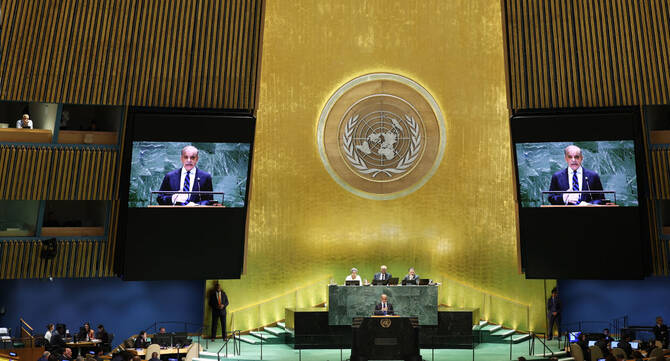
Pakistan's Prime Minister Muhammad Shehbaz Sharif speaks during the 79th Session of the United Nations General Assembly at the United Nations headquarters in New York City on September 27, 2024.
Short Url
Updated 22 September 2025
Follow

Pakistan joins Arab-Islamic consultations to forge unified stance on key issues at UNGA

  • The consultations were hosted by Qatari PM, which also included deputy PMs and FMs from Jordan, UAE, Saudi Arabia, Egypt and Indonesia
  • Deputy PM Ishaq Dar assures Islamabad’s support for all efforts aimed at fostering peace, stability and prosperity in Middle East, beyond

ISLAMABAD: Leaders from Pakistan, Arab Gulf nations and other Muslim states met on Monday in New York to ponder a unified approach on key regional and global issues at the 80th session of the United Nations General Assembly (UNGA), the Pakistani foreign office said.

Prime Minister Shehbaz Sharif led the Pakistan delegation to New York as the General Assembly High-level Week 2025 kicked off on Monday, with global leaders in attendance and Tuesday, Sept. 23 set to be the first day of the high-level General Debate at the 80th session.

On Monday, Deputy PM and Foreign Minister, Ishaq Dar, represented Pakistan in consultations hosted by Qatari PM Sheikh Mohammed bin Abdulrahman Al-Thani in New York, which also included deputy prime ministers of Jordan and the United Arab Emirates (UAE), and foreign ministers of Saudi Arabia, Egypt, Indonesia and Turkiye.

Dar underscored that the people of Pakistan had great affinity for their Muslim brethren in the Middle East and would support all constructive endeavours aimed at fostering peace, stability and prosperity in the region and beyond.

“The ministers exchanged views and coordinated positions for unified approach on some of the key issues at the UN General Assembly session,” the Pakistani foreign office said.

The UNGA session comes in the backdrop of Israel’s nearly two-year war on Gaza and the recent strikes against Hamas leaders in the Qatari capital of Doha, which raised fears of a wider military conflict in an already volatile region and drew condemnations from the Muslim world.

The 80th session of the United Nations General Assembly is being held under the theme “Better together: 80 years and more for peace, development and human rights.”

From Sept. 23 till Sept. 29, the session will feature speeches from presidents, prime ministers and monarchs who will deliver national statements, set out visions for peace, development, human rights and collective action at the iconic green marble podium.

Pakistan PM Sharif as well as various world leaders will also take part in the “High-level International Conference for the Peaceful Settlement of the Question of Palestine and the Implementation of the Two-State Solution,” which will be co-chaired by Saudi Arabia and France.

In a statement on Sunday, Pakistan’s foreign ministry said Sharif will urge the international community to resolve the crises in Palestine and disputed Kashmir territory and grant the people there the right to self-determination. The Pakistani prime minister will call for decisive action to end the suffering of the Palestinians.

“He will also highlight Pakistan’s perspective on the regional security situation as well as other issues of international concern, including climate change, terrorism, Islamophobia, and sustainable development,” the statement said.

“The prime minister will also participate in a meeting of select Islamic leaders with US President [Donald] Trump to exchange views on issues pertaining to regional and international peace and security.”

Sharif is expected to hold bilateral meetings with several world leaders and senior UN officials to discuss matters of mutual interest, according to the Pakistan foreign ministry. He will also underline Pakistan’s resolve to work with all UN member states to uphold the UN Charter, prevent conflict, foster peace and promote global prosperity in Pakistan’s current role as a member of the Security Council.


Pakistan’s Afghan salvo risks turning ‘open war’ into long crisis

Updated 3 sec ago
Follow

Pakistan’s Afghan salvo risks turning ‘open war’ into long crisis

  • Nuclear-armed Pakistan has a formidable military of 660,000 active personnel, backed by a fleet of 465 combat aircraft
  • But the Taliban have the option to lean on insurgent groups like the TTP and the BLA to move beyond border skirmishes

KARACHI: Weeks after the Taliban’s lightning offensive in 2021 wrested control of Afghanistan from a US-led military coalition, Pakistan’s then intelligence chief flew into the capital Kabul for talks, where the serving lieutenant general told a reporter: “Don’t worry, everything will be okay.”

Five years on, Islamabad — long seen as a patron of the Taliban — is locked in its heaviest fighting with the group, which Pakistan’s Defense Minister Khawaja Muhammad Asif described on Friday (February 27) as an “open war.”

The turmoil means that a wide swathe of Asia — from the Gulf to the Himalayas — is now in flux, with the United States building up a military deployment against Afghanistan’s neighbor Iran even as relations between Pakistan and arch rival India remain on edge after four days of fighting last May.

At the heart of the conflict with Afghanistan is Pakistan’s accusation that the Afghan Taliban provides support to militant groups, including the Tehreek-e-Taliban Pakistan (TTP), that have wreaked havoc across inside the South Asian country.

The Afghan Taliban, which has previously fought alongside the TTP, denies the charge, insisting that Pakistan’s security situation is its internal problem.

The disagreement is a reflection of starkly incompatible positions taken by both sides, as Pakistan expected compliance after decades of support to the Taliban, which did not see itself beholden to Islamabad, analysts said.

“We all know that the government in Pakistan supported the Taliban, the Afghan Taliban for many years, in the 90s and the 2000s, and provided havens to them during the period where the US and NATO were in Afghanistan.

So there’s a very close relationship between the Taliban and Pakistan,” said Jennifer Brick Murtazashvili, a political scientist at the University of Pittsburgh and an Afghanistan expert.

“It’s really surprising and shocking to many of us to see how quickly this relationship deteriorated,” she said.

Although tensions have simmered along their rugged 2,600-km (1,615-mile) frontier for months, following clashes last October, Friday’s fighting is notable because of Pakistan’s use of warplanes to hit Taliban military installations instead of confining the attacks to the militants it allegedly harbors.

These include targets deep inside the country in Kabul, as well as the southern city of Kandahar, the seat of Taliban supreme leader Hibatullah Akhundzada, according to Pakistan military spokesman Lt. Gen. Ahmed Sharif Chaudhry.

The clashes are unlikely to end there.

“I think in the immediate aftermath, I think hostilities will subside. There will be, I hope there will be a ceasefire through mediation. But I do not see these tensions subsiding in the foreseeable future,” said Abdul Basit,  an expert on militancy and violent extremism at Singapore’s S. Rajaratnam School of International Studies.

Nuclear-armed Pakistan has a formidable military of 660,000 active personnel, backed by a fleet of 465 combat aircraft, several thousand armored fighting vehicles and artillery pieces.

Across the border, the Afghan Taliban has only around 172,000 active military personnel, a smattering of armored vehicles and no real air force.

But the battle-hardened group, which took on a phalanx of Western military powers in 2001 and outlasted them, has the option to lean on insurgents like the TTP and the Baloch Liberation Army (BLA), moving beyond border skirmishes.

Based in Pakistan’s largest and poorest province of Balochistan that borders both Iran and Afghanistan, the BLA has been at the center of a decades-long insurgency, which in recent years has staged large coordinated attacks.

Pakistan has long accused India of backing the insurgents, a charge repeatedly denied by New Delhi, which has retained a robust military deployment along the border since last May.

Although a raft of countries with influence — including China, Russia, Turkiye and Qatar — have indicated an openness to help mediate the conflict, all such efforts have been met with limited success so far.