

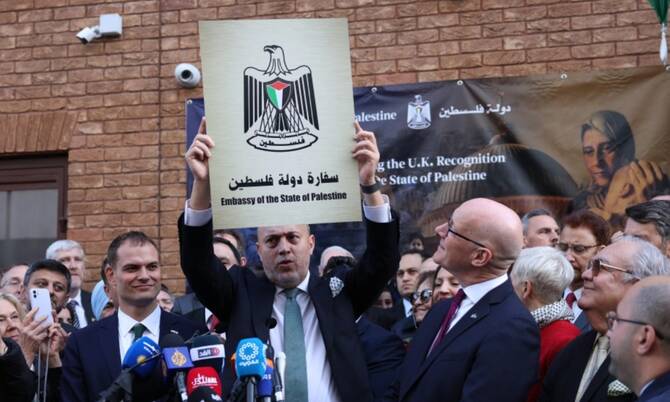

LONDON: Palestinians marked the announcement of the UK government’s formal recognition of the State of Palestine with a flag-hoisting ceremony attended by senior UK officials, members of Parliament, ambassadors, and members of the Palestinian community on Monday.
The official ceremony in the London borough of Hammersmith featured a speech by Husam Zomlot, the Palestinian ambassador, outside the Palestine Mission to the UK, soon to be upgraded into an embassy.
“In the same capital of the Balfour Declaration, after more than a century of ongoing denial, dispossession and erasure, the UK government has finally taken the long overdue step of recognizing the State of Palestine,” Zomlot began his speech.
Palestine, a former British colony for nearly 30 years, was never recognized when the mandate ended, despite the UK’s recognition of the fledgling State of Israel in 1950, an entity that was envisioned in the Balfour Declaration of 1917, which promised to establish a homeland for the Jewish people in Palestine.
This moment stands as a defiant act of truth, a refusal to let genocide be the final word; a refusal to accept that occupation is permanent
Husam Zomlot, Palestinian ambassador
The historic and long-awaited decision was announced on Sunday by Prime Minister Keir Starmer, who described it as “a pledge to the Palestinian and Israeli people that there can be a better future.”
It marks a shift in policy in the UK and some European countries, which have long stated that recognizing Palestine will occur only at the conclusion of peace negotiations. Hamas attacks in October 2023, followed by an ongoing campaign of vengeance by Israeli forces in the Gaza Strip, signaled to Starmer that “the hope for a two-state solution is fading.”
Zomlot said that British recognition comes at a critical time of “unimaginable pain and suffering” for Palestinians, a population of 5.5 million in Gaza and the occupied West Bank.
Since August, Israeli forces have conducted a demolition campaign targeting high-rise buildings in Gaza City, continuing nearly two years of assaults on the coastal enclave, where over 65,000 people have been killed. Officials from the UN and the EU, along with the mayor of London, have recently described Israeli actions in Gaza as genocide. In the West Bank, the Israeli government announced its approval of the E1 settlement, which would divide the territory in half and severely undermine any hope for a Palestinian state.

The Palestinian Mission to the UK in London held a special ceremony on Monday to mark British recognition of Palestinian statehood. (AN Photo/Mustafa Abu Sneineh)
“It comes as our people in Gaza are being starved, bombed, and buried under the rubble of their homes; as our people in the West Bank are being ethnically cleansed, brutalized by daily state-sponsored terrorism, land theft and suffocating oppression,” Zomlot said.
Palestinians hope that the UK’s recognition will be more than merely “symbolic” and will contribute to a resolution of the Israeli-Palestinian conflict that has embroiled the Middle East since 1948.
The UK, a permanent member of the Security Council and a G7 country, joined Canada, Australia, and Portugal on Sunday in recognizing Palestinian statehood, while France is expected to follow suit this week at the UN General Assembly.
“This moment stands as a defiant act of truth, a refusal to let genocide be the final word; a refusal to accept that occupation is permanent; a refusal to be erased and a refusal to be dehumanized,” Zomlot said.
“(It is) righting historic wrongs and committing together to a future based on freedom, dignity and fundamental human rights.”
A defining moment in securing self-determination for Palestine and peace through a two-state solution
John Swinney, Scotland’s first minister
The impassioned speech quoted the famous lines, “On This Land, There Are Reasons to Live,” a poem by the national poet Mahmoud Darwish.
“Please join me as we raise the flag of Palestine with its colors representing our nation: black for our mourning, white for our hope, green for our land and red for the sacrifices of our people,” Zomlot concluded.
John Swinney, the first minister of Scotland, attended the event along with former Labour leader Jeremy Corbyn. Swinney wrote on X that it was “a defining moment in securing self-determination for Palestine and peace through a two-state solution.”
Corbyn, an independent MP, congratulated those “who have tirelessly campaigned for the recognition of Palestine,” which he described as an “inalienable right” of the Palestinian people, in a post on the X platform.
He called on the UK government to “recognize the genocide in Gaza, end its complicity in crimes against humanity, and stop arming Israel.”
Saudi Arabia and France are co-hosting a one-day event at the UN in New York this week to advance the two-state solution, as more countries are expected to recognize the State of Palestine.

keywords


