Pakistan calls for alternative dispute resolution methods with 2.4 million cases pending

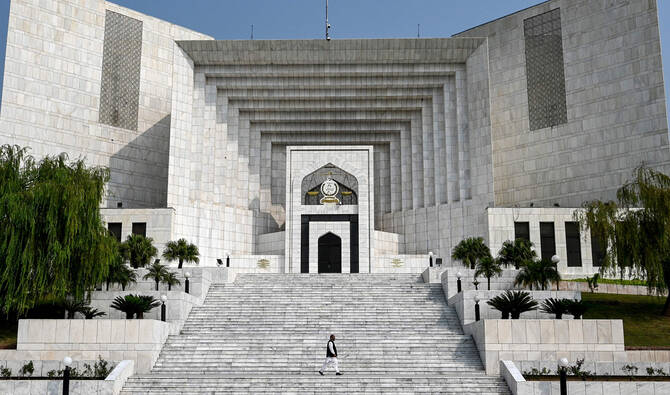
A man walks past the Pakistan’s Supreme Court building in Islamabad on October 23, 2024. (AFP/File)
Short Url
Updated 21 September 2025
Follow

Pakistan calls for alternative dispute resolution methods with 2.4 million cases pending

  • Law minister says some civil disputes often take up to 15 years to conclude, while alternative methods provide resolution in an average 75 days
  • Azam Nazeer Tarar emphasizes plans to scale up mediation centers nationwide and to strengthen Pakistan’s role as alternative dispute resolution hub

ISLAMABAD: Pakistan’s Law Minister Azam Nazeer Tarar on Sunday called for the adoption of alternative dispute resolution (ADR) methods to speed up settlement of disputes, with 2.4 million cases pending in courts across the country.

The statement came at a ceremony in Islamabad on the conclusion of a six-day internationally accredited Civil and Commercial Mediation Training Programme by the International Mediation & Arbitration Center (IMAC), established by the Pakistani law ministry.

The program, led by internationally renowned experts Mr. Rahim Shamji, Ms. Sarah Tarar, and Dr. Khalid Hamid Chowdhury, trained judges of the high courts, lawyers, government officers, academicians, and business professionals from across Pakistan.

Speaking at the ceremony, Tarar noted that there is a backlog of 2.4 million cases in Pakistan’s courts, including over 300,000 in the high courts and 1.8 million in district courts, where civil disputes often take up to 15 years to conclude.

“In contrast, ADR provides resolution in an average of just 75 days,” he was quoted as saying by Pakistan’s Press Information Department.

ADR refers to a method of resolving disputes outside of courts to help parties reach a voluntary, consensual agreement. Key ADR methods include mediation, where a mediator facilitates communication and settlement of disputes, and arbitration, where an arbitrator makes a binding or non-binding decision.

These methods offer advantages like lower costs, faster resolution and improved communication compared to traditional litigation.

Tarar emphasized plans to scale up mediation centers nationwide and strengthen Pakistan’s role as a credible ADR hub, according to the PID. The minister appreciated the IMAC team for not only creating widespread awareness but also training professionals across the country in mediation and arbitration.

Pakistan has introduced a number of judicial reforms in recent months and the country’s top judge, Yahya Afridi, this month said the Supreme Court was working to expand cooperation with judicial bodies in Muslim countries, including Saudi Arabia’s Muslim World League, to strengthen its institutional capacity.

Speaking at the ceremony in Islamabad, Justice Shahid Waheed of Pakistan’s Supreme Court underscored mediation as a vital tool to reduce case backlogs, strengthen access to justice, and foster harmony.

He outlined Pakistan’s policy direction on ADR, including the preparation of a ‘Model Law, establishment of court-annexed mediation centers and awareness campaigns

“ADR must be institutionalized, expanded nationwide, and integrated with technology to transform Pakistan’s justice landscape,” the judge said, commending the IMAC’s role in capacity building through internationally accredited training.


Saudi-backed Wafi Energy Pakistan announces 7.5 percent increase in profits last year

Updated 8 sec ago
Follow

Saudi-backed Wafi Energy Pakistan announces 7.5 percent increase in profits last year

  • Wafi Energy Pakistan operates one of country’s largest fuel retail, lubricants networks
  • The company is also planning a Dubai-based subsidiary to expand its commercial activities

KARACHI: Wafi Energy Pakistan Limited, a subsidiary of Saudi Arabia-based Wafi Energy Holding, on Friday announced a Rs3.54 billion ($12.6 million) profit last year, marking a 7.5 percent increase from the previous year.

In 2025, Wafi Energy acquired Shell Pakistan and added 35 new retail sites to its network, including a second eco-friendly Shell site built with recycled plastic, bringing the Shell retail network to over 680 sites nationwide.

The lubricants business continued strong performance across both consumer and industrial segments and Wafi Energy said had continued its growth in indirect and process oil segments, besides expanding its mining portfolio.

“We delivered a strong business performance in 2025 and importantly, we did so while investing to grow. Our focus through the year was clear – to expand in priority growth areas, establish Wafi Energy in Pakistan and strengthen the Shell customer experience,” Zubair Shaikh, Wafi Energy Pakistan’s chief executive officer, said in a statement.

“In 2026, our ambition is to accelerate growth, build shareholder value and continue investing in the energy future for Pakistan.”

Wafi Energy Pakistan Limited, formerly Shell Pakistan Limited, operates one of the country’s largest fuel retail and lubricants networks. Shell plc divested its majority stake in 2024, after which the company was rebranded under Saudi ownership while continuing to market fuels and lubricants under the Shell brand.

The company said it remains focused on operational excellence and growth.

“The company is also advancing its investment strategy by planning a Dubai-based subsidiary to expand commercial activities and strengthen its regional presence,” it said.

“This strategic move underscores Wafi Energy’s commitment to sustainable growth and expanding its footprint.”