US deal on Bagram base ‘not possible’ says Afghan Taliban official

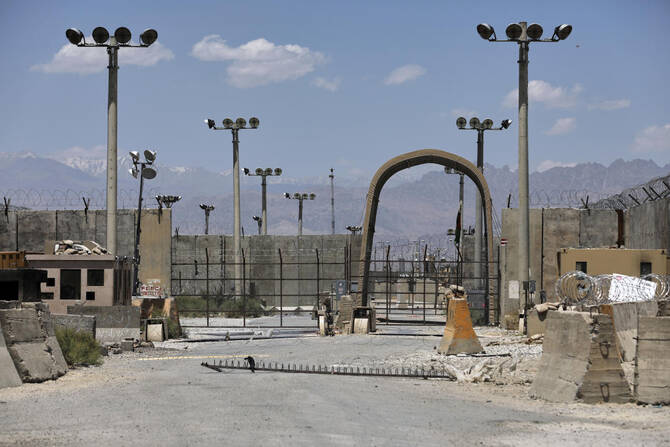
An Afghan Taliban government official said Sunday that a deal over Bagram air base was “not possible,” after US President Donald Trump said he wanted the former US base back. (AP)
Short Url
Updated 21 September 2025
Follow

US deal on Bagram base ‘not possible’ says Afghan Taliban official

  • An Afghan Taliban government official said Sunday that a deal over Bagram air base was “not possible,” after US President Donald Trump said he wanted the former US base back

KABUL: An Afghan Taliban government official said Sunday that a deal over Bagram air base was “not possible,” after US President Donald Trump said he wanted the former US base back.
Trump threatened the country Saturday with unspecified punishment, just days after he raised the idea of the United States retaking control of the base while on a state visit to the United Kingdom.
“If Afghanistan doesn’t give Bagram Airbase back to those that built it, the United States of America, BAD THINGS ARE GOING TO HAPPEN!!!” the 79-year-old leader wrote on his Truth Social platform.
On Sunday, Fasihuddin Fitrat, Chief of Staff of the Ministry of Defense, said “some people” want to take back the base through a “political deal.”
“Recently, some people have said that they have entered negotiations with Afghanistan for taking back Bagram Air base,” he said in comments broadcast by local media.
“A deal over even an inch of Afghanistan’s soil is not possible. We don’t need it.”
Bagram, the largest air base in Afghanistan, was a linchpin of the US-led war effort against the Taliban, whose government Washington toppled following the September 11, 2001 attacks on the United States.
US and NATO troops chaotically pulled out of Bagram in July 2021 as part of a Trump-brokered deal with Taliban insurgents.
The loss of crucial air power saw the Afghan military collapse just weeks later and the Taliban sweep back to power.


Poland slow to counter Russia’s ‘existential threat’: general

Updated 4 sec ago
Follow

Poland slow to counter Russia’s ‘existential threat’: general

  • The general highlighted a low “pace of technical modernization,” compared to increases in the army’s size
  • Kukula said the Polish army should reach 500,000 soldiers by 2039

WARSAW: Russia poses an “existential threat” to Poland and its military is lagging, the country’s armed forces chief warned senior officials on Wednesday.
Poland, the largest country on NATO’s eastern flank and a neighbor of Russia, Belarus, and Ukraine, is the western alliance’s largest spender in relative terms.
This year, the country is allocating 4.8 percent of its GDP to defense, just shy of the alliance’s five percent target to be met by 2035.
However, that record defense spending was not enough to “make up for nearly three decades of chronic underfunding of the armed forces,” General Wieslaw Kukula, chief of the general staff, argued at the meeting, which included top officers, the defense minister and Poland’s president.
The general highlighted a low “pace of technical modernization,” compared to increases in the army’s size.
Kukula said the Polish army should reach 500,000 soldiers by 2039, compared with around 210,000 at present.
As a result of a lack of updates, some new Polish units “are not achieving combat readiness,” due to insufficient equipment, rather than a personnel shortage, the general argued.
Meanwhile, he added, “the Russian Federation remains an existential threat to Poland.”
Russia “is constantly reorganizing its forces, drawing on the lessons from its aggression in Ukraine, and building up the capacity for a conventional conflict with NATO countries,” he stressed.
Poland is to receive 43.7 billion euros ($51,5 billion) in loans under the European Union’s Security Action For Europe (SAFE) scheme, designed to strengthen Europe’s defensive capabilities.
Warsaw plans to use these funds to boost domestic arms production.
The Polish government claims that Poland will be able to access SAFE finance even if President Karol Nawrocki — backed by Poland’s conservative-nationalist opposition — vetos a law setting out domestic arrangements for its implementation.
Law and Justice (PiS) — the main opposition party — argues that SAFE could become a new tool for Brussels to place undue pressure on Poland, thanks to a planned mechanism for monitoring the funds, which they claim risks undermining Polish sovereignty.