

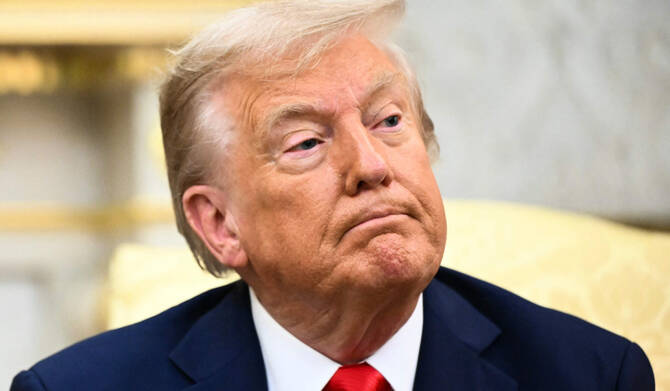

WASHINGTON: A month after an Alaskan summit with Russian leader Vladimir Putin, President Donald Trump still seems surprised that his gambit did not pay off with peace in Ukraine.
“He’s let me down,” Trump said this week. “He really let me down.”
There has been no more progress in the Middle East, where Israeli Prime Minister Benjamin Netanyahu is beginning a new offensive in Gaza City and lashing out across the region.
“They have to be very, very careful,” Trump said after Israel targeted Hamas inside Qatar, a US ally that has been hosting diplomatic negotiations.
Trump’s disappointment and frustration is much different from the confidence and dominance he tries to project on the international stage, especially as he trumpets his diplomatic efforts and campaigns for the Nobel Peace Prize. Asked about his goals for the upcoming UN General Assembly, the president said “world peace.” But the most high-profile conflicts appear to be escalating instead of winding down.
“This whole last nine months of peace efforts was just a merry-go-round,” said Max Bergmann, a State Department official under Democratic President Barack Obama who now works at the Center for Strategic and International Studies in Washington.
Bold gestures, but reaching peace deals is hard
Although Trump prizes bold gestures — a stealth bomber strike in Iran, a sweeping tariff announcement — solving a global jigsaw puzzle is a far bigger struggle.
The fundamental truth, Bergmann said, is “trying to reach peace agreements is very hard,” and that Trump has not surrounded himself with experienced diplomats and foreign policy experts.
“It’s like if you were to tell me, ‘Go do a hotel deal,’” Bergmann said. “It would be a terrible deal. I would lose a lot of money.”
In Trump’s defense, the White House has pointed to comments from European leaders who have praised his efforts working to forge peace agreements. Trump often notes that he hires “only the best people.”
Matt Kroenig, a senior policy adviser at the Pentagon during Trump’s first term, said the president’s brashness can get results, such as when he demanded increased defense spending from European allies.
Trump, however, can end up spinning his wheels on more challenging issues and eventually give up, such as when he tried to persuade Kim Jong Un to end North Korea’s nuclear program.
When it comes to making peace in Ukraine and Gaza, Kroenig wondered, “At what point does he say, ‘This is too hard, let’s move on to other issues.’”
Foreign policy is usually a team sport for presidential administrations, requiring extensive coordination among agencies through the National Security Council. But Trump has dramatically slashed the council’s staff, and Marco Rubio serves as both secretary of state and national security adviser.
“It’s one person setting the strategy and everyone else is waiting to see,” Kroenig said.
Mideast is increasingly in turmoil
In the Middle East, Trump is getting caught in the middle of an increasingly combustible situation. He has visited Arab nations, including Qatar, this year to strengthen ties, and he has backed Israel’s military operations in Gaza and Iran.
But now Israel, emboldened by its battlefield success, is striking more widely throughout the region, including the recent attack targeting Hamas officials in Qatar. That jeopardized negotiations that the United States has been trying to push along and rattled Arab leaders’ faith in Trump’s ability to influence, let alone rein in, Netanyahu.
Some of them now view Israel, not Iran, as their primary security threat, according to three Arab diplomats familiar with conversations at the last summit of the Gulf Cooperation Council in Doha. It’s a noticeable shift after Israel and Arab nations grew closer during Trump’s first term, when the Republican president championed the Abraham Accords. The diplomats were not authorized to publicly discuss the private conversations and spoke on condition of anonymity.
US officials have tried to assuage doubts by pointing to Trump’s expressions of displeasure with Netanyahu’s latest moves, to recent meetings held with Qatar’s prime minister and to discussions of enhanced security arrangements.
During next week’s annual high-level gathering at the General Assembly, Rubio and Trump special envoy Steve Witkoff can expect to hear a chorus of criticism, with Arab nations seeking a more fundamental shift in how the US approaches the region.
For example, the US has tried to ensure that Israel has a military edge over its Arab neighbors. But now that Israel has attacked Qatar with US-supplied weapons — a strike that Qatar was unable to counter with its own US-supplied defenses — Arab diplomats are considering demanding stronger support.
Such a move would likely be politically untenable, at least for now, with support for Israel strong among Republicans who control Congress.
Trump’s equivocal approach to Putin
In Europe, Trump has frustrated his critics with his equivocal approach to Putin, sometimes suggesting that Ukrainian President Volodymyr Zelensky is just as responsible for the war that Moscow started with its 2022 invasion.
Trump recently insisted that his meeting with Putin “accomplished a lot,” but “it takes two to tango.”
“You know those are two people, Zelensky and Putin, that hate each other,” he said.
Fears that the war in Ukraine could spill over have been heightened by recent Russian military incursions into the airspace of NATO members Poland and Estonia. After three Russian fighter jets entered Estonian airspace on Friday, Trump said it could signal “big trouble.”
During a news conference in the United Kingdom on his state visit, Trump said he was dedicated to stopping the conflicts in Gaza and Ukraine. Then he turned philosophical.
“You never know in war. You know, war is a different thing,” he said. “Things happen that are very opposite of what you thought.”


