


WASHINGTON: The White House issued a major clarification Saturday to its new H-1B visa policy that had rattled the tech industry a day earlier, saying a $100,000 fee will be a “one-time” payment imposed only on new applicants.
US Commerce Secretary Howard Lutnick had repeatedly said on Friday that the fee would be applied annually, but a White House official said Saturday it is “a one-time fee that applies only to the petition.”
“It ONLY applies to new visas, not renewals or current visa holders,” the official said on condition of anonymity, after the text of the executive order left many current visa-holders confused about whether it applied to them.
The executive order, which is likely to face legal challenges, comes into force Sunday at 12:01 am (0401 GMT), or 9:01 p.m. Saturday on the Pacific Coast.
Prior to the White House’s clarification, US companies were scrambling to figure out the implications for their foreign workers, with several reportedly warning their employees not to leave the country.
Some people who were already on planes preparing to leave the country on Friday de-boarded over fears they may not be allowed to re-enter the country, the San Francisco Chronicle reported.
H-1B visas allow companies to sponsor foreign workers with specialized skills --- such as scientists, engineers, and computer programmers — to work in the United States, initially for three years but extendable to six.
Such visas are widely used by the tech industry. Indian nationals account for nearly three-quarters of the permits allotted via lottery system each year.
The United States approved approximately 400,000 H-1B visas in 2024, two-thirds of which were renewals.
- India, US business concerns -
US President Donald Trump announced the change in Washington on Friday, arguing it would support American workers.
The H-1B program “has been deliberately exploited to replace, rather than supplement, American workers with lower-paid, lower-skilled labor,” the executive order said.
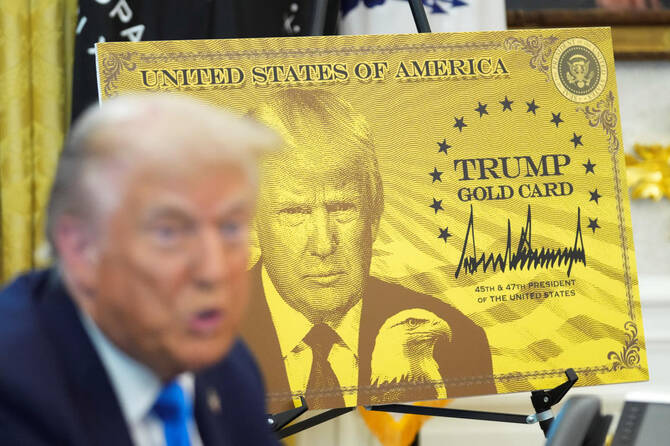
Trump also introduced a $1 million “gold card” residency program he had previewed months earlier.
“The main thing is, we’re going to have great people coming in, and they’re going to be paying,” Trump told reporters as he signed the orders in the Oval Office.
Lutnick, who joined Trump in the Oval Office, said multiple times that the fee would be applied annually.
“The company needs to decide... is the person valuable enough to have $100,000 a year payment to the government? Or they should head home and they should go hire an American,” he told reporters.
Though he claimed that “all the big companies are on board,” many businesses were left confused about the details of the H-1B order.
US bank JPMorgan confirmed that a memo had been sent to its employees with H-1B visas advising them to remain in the United States and avoid international travel until further guidance was issued.
Tech entrepreneurs — including Trump’s former ally Elon Musk — have warned against targeting H-1B visas, saying that the United States does not have enough homegrown talent to fill important tech sector job vacancies.
India’s top IT industry body Nasscom said the new measure would hit “business continuity” and was also concerned by the short timeline.
“A one-day deadline creates considerable uncertainty for businesses, professionals, and students across the world,” Nasscom said in a statement.
India’s foreign ministry said the mobility of skilled talent had contributed to “technology development, innovation, economic growth, competitiveness and wealth creation” in both countries and that it would assess the changes.
It said in a statement the new measure would likely have “humanitarian consequences by way of the disruption caused for families,” which it hoped would be addressed by US authorities.


