

Pakistan says UNSC vote against lifting Iran sanctions risks Middle East instability

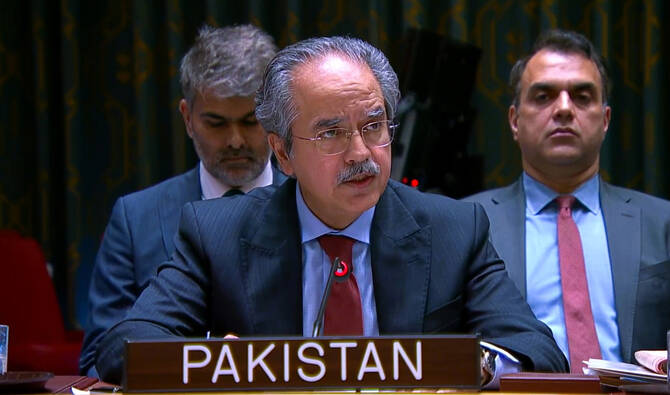
Pakistan’s permanent representative to the United Nations, Ambassador Asim Iftikhar Ahmad, speaks during a UN Security Council session at the United Nations in New York on September 20, 2025. (X/@PakistanUN_NY)
Short Url
Updated 20 September 2025
Follow

Pakistan says UNSC vote against lifting Iran sanctions risks Middle East instability

  • A UNSC resolution aimed at halting reimposition of sanctions on Iran over its nuclear program failed Friday after weeks of diplomatic talks
  • Pakistan’s envoy Asim Iftikhar Ahmad says the Middle East region cannot afford further tensions and that diplomacy should be given a chance

ISLAMABAD: Pakistan has said that it does not favor the United Nations Security Council (UNSC) decision against lifting of Iran sanctions as it risks destabilizing a region that is already mired in multiple crises, Pakistan’s UN envoy said on Friday.

A UNSC resolution aimed at halting the reimposition of sanctions on Iran over its nuclear program failed Friday after weeks of last-ditch diplomatic talks appeared to break down days before the annual UN gathering of world leaders.

The resolution put forth by South Korea, the current president of the 15-member council, did not garner the support of the nine countries required to halt the series of sanctions from taking effect at the end of the month, as outlined in Iran’s 2015 nuclear deal with world powers.

Only four countries, China, Russia, Pakistan and Algeria, supported the effort, with some using the meeting to blast the European leaders for what they called an unjustified and illegal action against Iran.

“We do not favor any action which risks destabilizing a region that is already mired in multiple crises. This region cannot afford further tensions,” Pakistan’s permanent representative to the UN, Ambassador Asim Iftikhar Ahmad, told the council.

“We believe that even at this stage, diplomacy should be given a chance.”

Last month, France, Germany and the United Kingdom moved to trigger the “snapback mechanism,” which automatically reimposes all UN sanctions that were in effect before the nuclear deal.

Those penalties included a conventional arms embargo, restrictions on ballistic missile development, asset freezes, travel bans and a ban on producing nuclear-related technology. Iran is already reeling from a 12-day war with Israel and a decades-long financial crisis.

Using the snapback mechanism will likely heighten tensions between Iran and the West. It’s unclear how Iran will respond, given that in the past, officials have threatened to withdraw from the Nuclear Nonproliferation Treaty, potentially following North Korea, which abandoned the treaty in 2003 and then built atomic weapons.

Iran’s Foreign Ministry, in a statement on Friday, emphasized its commitment to safeguarding its interests and rights, including through diplomacy, and said it reserves the right to respond appropriately to any unlawful action.

The Pakistani envoy stressed the need to continue diplomatic engagement with Iran to address any outstanding issues in a “cooperative manner, in accordance with the rights, obligations and responsibilities of the parties.

“We must prioritize this approach and never give up on a peaceful negotiated settlement. Diplomacy and intimidation do not go together,” he added.


Pakistan to sign preferential trade agreement with Russia during Sharif’s upcoming visit — envoy

Updated 28 February 2026
Follow

Pakistan to sign preferential trade agreement with Russia during Sharif’s upcoming visit — envoy

  • Pakistan Prime Minister Shehbaz Sharif plans to visit ‌Russia ​on ‌March ⁠3-5, ​Russian state news ⁠agency RIA reported this month
  • Islamabad will also organize Russia-Pakistan Business Forum, which will have participation from more than 100 Pakistani firms

ISLAMABAD: Pakistan is seeking to sign a preferential trade agreement (PTA) with Russia to boost bilateral trade volume during Prime Minister Shehbaz Sharif’s upcoming visit to Moscow, Pakistan’s ambassador to Moscow has said.

Pakistani Ambassador Faisal Niaz Tirmizi said this during the Moscow-Islamabad media forum, which was hosted by Sputnik ahead of Sharif’s scheduled visit to Moscow next month.

Pakistan and Russia, once Cold War rivals, have strengthened ties in recent years. In 2023, Islamabad began purchasing discounted Russian crude oil banned from European markets over Ukraine war, and also received first shipment of liquefied petroleum gas from Moscow.

The volume of Russia-Pakistan trade rose more than 100 percent to $1.81 billion from July 2023 till June 2024, though it experienced slight contraction in the last fiscal year, according to officials.

“Once the prime minister is here, we will start the process of signing PTA with the Eurasian Economic Union and the Russian Federation,” Tirmizi said at the forum.

Pakistan and Russia are members of the Shanghai Cooperation Organization (SCO), a Eurasian political, economic and security organization, and have had sustained high-level interactions and institutional mechanisms in recent years.

PM Sharif plans to visit ‌Russia ​on ‌March ⁠3-5, ​Russian state news ⁠agency RIA reported this month, citing ⁠a ‌Pakistani ‌official.

Tirmizi said Russia-Pakistan ties were not only strategic or bilateral, but they had commercial, people-to-people and business dimensions as well.

“I am very happy to announce that Pakistan is also organizing the second Russia-Pakistan Business Forum during this visit,” he said.

“Over a hundred companies, hundred leading companies are coming from Pakistan to interact with the Russian partners.”