

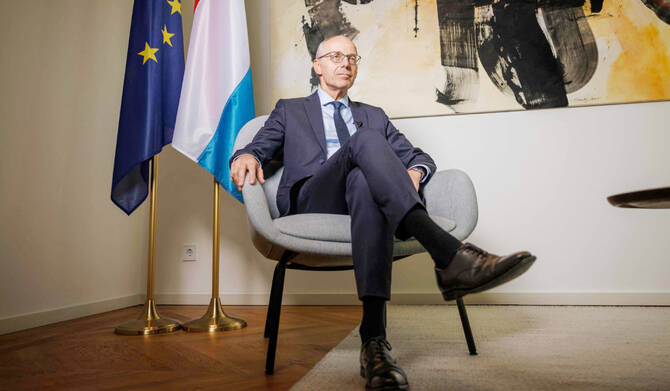
Recognizing a Palestinian state ‘key’ for peace: Luxembourg PM

Luxembourg's Prime Minister Luc Frieden looks on during an interview with AFP in Luxembourg on September 18, 2025. (AFP)
Short Url
Updated 20 September 2025
Follow

Recognizing a Palestinian state ‘key’ for peace: Luxembourg PM

  • UN votes to let Palestinian president address General Assembly by video after US visa denial

LUXEMBOURG: Recognizing a Palestinian state will help keep alive the peace process in the Middle East, Luxembourg’s Prime Minister Luc Frieden said as his country prepares to take the step next week.

Of the UN’s 193 member states, 147 already recognize a Palestinian state, but none of the Group of Seven major economies did so until now.
The Luxembourg Grand Duchy is among a raft of nations including Australia, Belgium, Canada, France and the UK that plan to join their ranks at a UN summit in New York on Sept. 22.
“I would like the Israeli and Palestinian peoples to keep hope alive that one day they will be able to live in peace,” Frieden said in an interview.
The recognition will be “a key moment in this process ... an important step in a long march toward peace and stability in the region,” said the 62-year-old center-right leader, who will be in New York to represent his country.
Last week, the General Assembly overwhelmingly adopted a text supporting a future Palestinian state, albeit without Hamas.
“We will see on Monday what the Arab countries have to say. The fact that they condemn Hamas is new. Hamas must go and Arab countries must help us to achieve this,” Frieden said.
The US has also opposed recognition and denied US visas to the Palestinian delegation to the UN.
The UN General Assembly on Friday voted to allow President Mahmoud Abbas to address its annual meeting of world leaders by video. 
The motion passed by a vote of 145-5, with six abstentions.
“The state of Palestine may submit a pre-recorded statement of its president, which will be played in the General Assembly Hall,” said the resolution.
“Everything we do is not against the Israeli people but is intended to stop the atrocities we are seeing in Gaza,” said Frieden.
Luxembourg, one of the EU’s founding members, supports proposed EU sanctions against Israel including curbing trade ties, he added.
“If they don’t listen to us, unfortunately we will have to move toward sanctions,” he said of Netanyahu’s government.


Iran war unsettles India’s packaged water makers as bottles, caps get pricey

Updated 55 min 10 sec ago
Follow

Iran war unsettles India’s packaged water makers as bottles, caps get pricey

  • Higher polymer ‌prices hurt bottled water industry
  • Industry worth $5 billion has big multinational players like Pepsi, Coca-Cola

NEW ​DELHI: The Iran war is rattling India’s $5 billion packaged water market just ahead of the sweltering summer season.
One of the world’s fastest growing bottled water markets is seeing some manufacturers hike prices for distributors, as supply disruptions linked to the war fuel higher costs in everything from plastic bottles to caps, labels and cardboard boxes.
Though retail prices are yet to feel the heat and bigger companies are absorbing the pain, about 2,000 smaller bottled water makers have increased rates for their resellers by around 1 rupee per ‌bottle, a ‌5 percent hike, which will rise by a further 10 percent in ​coming ‌days, ⁠according ​to the ⁠Federation of All India Packaged Drinking Water Manufacturers’ Association.
Consumers usually pay less than 20 rupees, or around 20 US cents, for a one-liter bottle.
“There is chaos and within the next 4-5 days, this will start impacting customer prices,” said Apurva Doshi, the federation’s secretary general.
Rising oil prices have increased the cost of polymer, which is made from crude oil and is a key material for the industry’s plastic bottles. The cost of material used in making ⁠plastic bottles has risen by 50 percent to 170 rupees per kilogram, ‌while the price of the caps has more than ‌doubled to 0.45 rupees apiece. Even corrugated boxes, labels and ​adhesive tape are costing much more, ‌industry letters showed.
Clean water is a privilege in the country of 1.4 billion people where ‌researchers say 70 percent of the groundwater is contaminated, leaving people reliant on bottled water. Companies including Bisleri, Coca-Cola’s Kinley, Pepsi’s Aquafina, billionaire Mukesh Ambani’s Reliance and Tata all compete for a share of the $5 billion market. The companies did not respond to Reuters request for comment.
PREMIUM WATER FACES HEAT ‌TOO
Within the broad bottled water market, natural mineral water is a $400 million business in India and a new, fast-growing wellness product for ⁠India’s wealthy.
The premium ⁠water segment accounted for 8 percent of the bottled water market last year in India, compared to just 1 percent in 2021, Euromonitor says.
Aava, which sells mineral water sourced from the foothills of the Aravalli mountains, has increased prices of its water bottles by 18 percent for resellers, Shiroy Mehta, CEO of the company, told Reuters.
“Most manufacturers are absorbing 40-50 percent of the cost to ensure that they don’t lose clients. It’s a poor situation for the beverage industry ahead of the summer season,” he said.
The mass market, however, is dominated by companies that produce “drinking water” to be sold in 1-liter bottles to customers. Clear Premium Water, a brand of India’s Energy Beverages, said in a notice to its distributors there ​had been an “unprecedented and continuous surge” in ​prices of key raw materials used in packaging and production.
“It is no longer possible for us to absorb the escalating costs while maintaining existing product prices,” the notice said.