

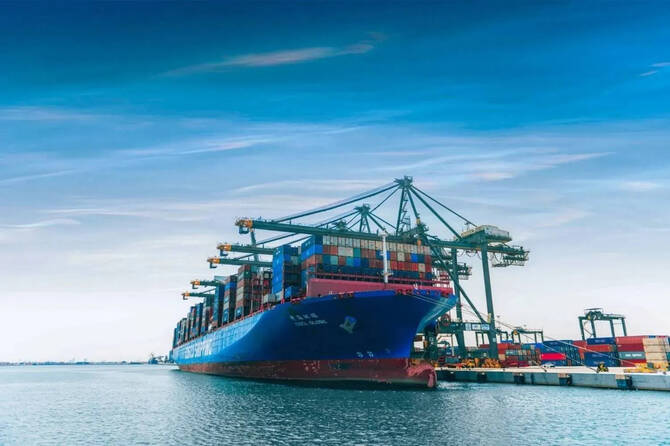
Saudi port exports rise 9.3% as total cargo hits 334.5m tonnes


The surge in cargo aligns with Saudi Arabia’s National Transport and Logistics Strategy under Vision 2030, which seeks to position the Kingdom as a global logistics hub connecting Asia, Europe, and Africa. File
Short Url
Updated 18 September 2025
Follow

Saudi port exports rise 9.3% as total cargo hits 334.5m tonnes


RIYADH: Saudi Arabia’s ports saw robust growth in 2024, with exports climbing 9.3 percent to 222.4 million tonnes, pushing total cargo volumes to 334.5 million tonnes and reinforcing the Kingdom’s expanding role in global trade.

Data from the General Authority for Statistics showed that King Fahad Industrial Port in Yanbu led in exports, handling 114 million tonnes — or 51 percent of the total. Imports also rose 3.6 percent to 108.9 million tonnes last year.

The surge in cargo aligns with Saudi Arabia’s National Transport and Logistics Strategy under Vision 2030, which seeks to position the Kingdom as a global logistics hub connecting Asia, Europe, and Africa.

GASTAT’s report highlighted container activity, noting that more than 2.5 million inbound and outbound containers were handled in 2024, including 1.3 million outbound and over 1.2 million inbound units. Of these, 20-foot containers exceeded 1.3 million, while 40-foot containers surpassed 1.1 million, alongside roughly 1,400 containers of other sizes.

In terms of port throughput, Yanbu led with 39.8 percent, followed by King Fahad Industrial Port in Jubail at 19 percent. King Abdulaziz Port in Dammam accounted for 15.5 percent, Jeddah Islamic Port handled 14.1 percent, and the remaining 11.6 percent was distributed among other ports nationwide.

King Abdulaziz Port in Dammam also received the largest share of imports, totaling 38 million tonnes (35 percent of inbound cargo), while Yanbu dominated exports with 114 million tonnes (51 percent of outbound shipments).

Liquid bulk cargo topped all categories, exceeding 177 million tonnes, underscoring the continued importance of oil and petrochemical trade. Transshipment cargo surpassed 21 million tonnes, including nearly 11 million tonnes loaded and 10.4 million tonnes unloaded — equivalent to around 2 million standard containers.

Vessel traffic remained strong, with 8,693 ships docking at Saudi ports. Jeddah Islamic Port received the highest volume at 3,805 vessels, followed by King Abdulaziz Port with 1,980, Neom Port with 951, and Yanbu with 554.

Passenger traffic, however, fell 19.6 percent from 2023, totaling 912,800 travelers. Jazan Port recorded the highest passenger activity at over 485,000, followed by Jeddah Islamic Port with 217,600 and Neom Port with 205,100.

Compiled using data from the Saudi Ports Authority and related entities, the annual maritime report provides valuable insights into the flow of goods, passengers, and vessels, offering a foundation for future transport sector planning and development.


Saudi firms sign agreements to develop Syrian oil and gas fields 

Updated 4 sec ago
Follow

Saudi firms sign agreements to develop Syrian oil and gas fields 

RIYADH: Under the supervision of the Ministry of Energy, four Saudi companies signed agreements on Dec. 10 with the Syrian Petroleum Co. covering technical support, development, and production in Syria's oil and gas fields. 

The Saudi companies are: TAQA, ADES Holding Co., Arabian Drilling Co., and Arabian Geophysical & Surveying Co. 

These agreements come as an extension of the existing cooperation between the Kingdom and the Syrian Arab Republic in the energy sector, and within the framework of implementing the memoranda of understanding signed on Aug. 28, and the resulting workshops and field visits to related fields and facilities. 

The agreements signed include an agreement between ADES Holding Co. and the Syrian Petroleum Co., which defines the fundamental principles for the development, operation, and production of gas fields.  

It aims to establish the principles and terms that will form the basis for the final technical service contract, and the development and operation of gas fields and associated facilities in the contract area to increase current production.  

This includes five gas fields: Abu Rabah, Qumqum, North Al-Faidh, Tayyas, and Zamlah Al-Mahr, and any other area agreed upon by both parties later. 

A master services agreement between TAQA and the Syrian company was also forged to provide advanced and integrated solutions and services for building and maintaining oil and gas fields and wells in Syria. 

This agreement aims to enhance operational efficiency and increase oil and gas production through integrated and advanced solutions for well construction and maintenance, following the latest global technologies and using the latest equipment. 

Another master services agreement with the ARCAS was signed, aiming to provide technical services in the field of 2D and 3D seismic surveying services to support exploration and drilling efforts in the oil and gas sector.  

It also aims to establish a long-term strategic cooperation framework to support and propel oil exploration and develop the Syrian energy industry, ensuring rapid response and flexibility, as well as facilitating the swift commencement of technical projects. 

The last agreement on fundamental principles was signed with the Arabian Drilling Co. to provide oil and gas well drilling and maintenance services in Syria, through the leasing and operation of platforms for drilling and maintaining onshore oil and gas wells. 

Under this agreement, the Arabian Drilling Co. will provide platforms for drilling onshore wells, platforms for providing related maintenance services, as well as providing necessary maintenance services, operational support, and training and development of the national workforce.