

Pakistan warns fresh rains may cause Punjab rivers to swell as monsoon toll crosses 1,000 

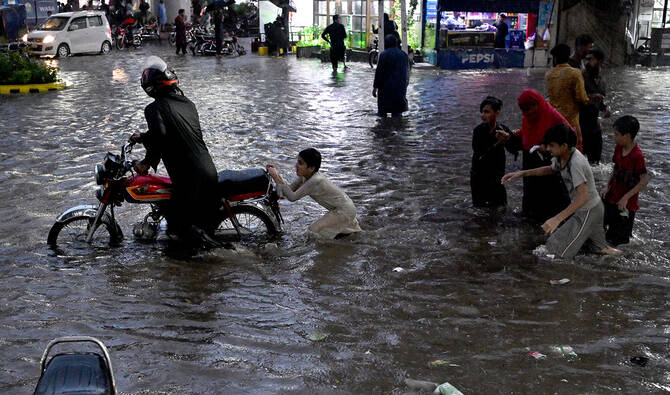
Commuters wade through a flooded street after heavy rainfall in Lahore on September 8, 2025. (AFP)
Short Url
Updated 18 September 2025
Follow

Pakistan warns fresh rains may cause Punjab rivers to swell as monsoon toll crosses 1,000 

  • Pakistan’s NDMA has forecast heavy rains in Rawalpindi, Islamabad, Gujrat, Gujranwala, and Lahore divisions in next two days 
  • Disaster management authority’s warning comes as water levels in Punjab’s river recedes as floods head toward southern Sindh 

ISLAMABAD: Pakistan’s National Disaster Management Authority (NDMA) warned on Thursday that widespread rains in several districts of the eastern Punjab province, already reeling from catastrophic floods, may cause river levels to rise to dangerous levels again as the nationwide death toll since Jun. 26 surged to 1,006. 

The warning from the NDMA comes as the Punjab Disaster Management Authority (PDMA) said that water levels in Punjab’s rivers are returning to “normal,” as floods flow downstream into the southern Sindh province. 

Heavy rains and excess water released from Indian dams have caused three major rivers — the Chenab, Ravi and Sutlej — in the eastern Punjab province to swell late last month, inundating more than 4,700 villages in the country’s agricultural heartland, destroying crops and homes and forcing millions to flee. Over 110 people were killed while at least 300,000 people across Pakistan remain in tents, according to official figures. Over 2,000 relief camps are reported operational nationwide, with rescue operations continuing in Punjab and Sindh in coordination with the Pakistan Army and Navy.

“The National Disaster Management Authority (NDMA) on Thursday warned of widespread rain with thunderstorms across several districts in Punjab over the next two days, increasing the risk of river swelling in vulnerable areas due to rising water levels in upper catchments,” state broadcaster Radio Pakistan reported. 

The NDMA’s National Emergency Operations Center (NEOC) predicted heavy rain and thunderstorms in Rawalpindi, Islamabad, Gujrat, Gujranwala, and Lahore divisions in the next two days. The authority said intermittent showers were also likely in northwestern Peshawar, Kohat, Bannu districts and eastern Sargodha, Faisalabad, and southwestern Zhob divisions. 

“Heavy rainfall is expected to trigger a significant surge in hill torrent flows, posing additional risks to low-lying and flood-prone regions,” Radio Pakistan said. 

In response, NDMA said it has directed all relevant institutions to take proactive measures to manage potential emergency situations.

“Authorities are closely monitoring developments and implementing timely interventions to mitigate hazards and ensure public safety,” the state-run media said.

The NDMA urged citizens to avoid crossing swollen streams, bridges, and flooded roads. It called upon residents in high-risk areas to stay informed of the latest weather situation through official announcements on television and mobile alerts.

FLOODS IN SINDH

Concerns for riverine floods increased in the downstream southern Sindh province since earlier this month as water levels in Punjab receded and headed toward the southern province.
“The River Indus at Guddu is in medium flood, Sukkur is in high flood and Kotri is in low flood level,” the Pakistan Meteorological Department said in a statement on Thursday, referring to three major barrages in Sindh.
“River Sutlej at Ganda Singh Wala is in medium flood whereas at Sulemanki and Islam it is at low flood level,” it continued. “The River Indus at Kotri is likely to remain in medium flood level up to the end of this month.
Pakistan, which contributes only one percent of global greenhouse gas emissions, is among the countries most severely affected by climate change.

Catastrophic floods in 2022 killed 1,700 people, affected 33 million and caused over $30 billion in damage.


Pakistan, global crypto exchange discuss modernizing digital payments, creating job prospects 

Updated 05 December 2025
Follow

Pakistan, global crypto exchange discuss modernizing digital payments, creating job prospects 

  • Pakistani officials, Binance team discuss coordination between Islamabad, local banks and global exchanges
  • Pakistan has attempted to tap into growing crypto market to curb illicit transactions, improve oversight

ISLAMABAD: Pakistan’s finance officials and the team of a global cryptocurrency exchange on Friday held discussions aimed at modernizing the country’s digital payments system and building local talent pipelines to meet rising demand for blockchain and Web3 skills, the finance ministry said.

The development took place during a high-level meeting between Finance Minister Muhammad Aurangzeb, Pakistan Virtual Assets Regulatory Authority (PVARA) Chairman Bilal bin Saqib, domestic bank presidents and a Binance team led by Global CEO Richard Teng. The meeting was held to advance work on Pakistan’s National Digital Asset Framework, a regulatory setup to govern Pakistan’s digital assets.

Pakistan has been moving to regulate its fast-growing crypto and digital assets market by bringing virtual asset service providers (VASPs) under a formal licensing regime. Officials say the push is aimed at curbing illicit transactions, improving oversight, and encouraging innovation in blockchain-based financial services.

“Participants reviewed opportunities to modernize Pakistan’s digital payments landscape, noting that blockchain-based systems could significantly reduce costs from the country’s $38 billion annual remittance flows,” the finance ministry said in a statement. 

“Discussions also emphasized building local talent pipelines to meet rising global demand for blockchain and Web3 skills, creating high-value employment prospects for Pakistani youth.”

Blockchain is a type of digital database that is shared, transparent and tamper-resistant. Instead of being stored on one computer, the data is kept on a distributed network of computers, making it very hard to alter or hack.

Web3 refers to the next generation of the Internet built using blockchain, focusing on giving users more control over their data, identity and digital assets rather than big tech companies controlling it.

Participants of the meeting also discussed sovereign debt tokenization, which is the process of converting a country’s debt such as government bonds, into digital tokens on a blockchain, the ministry said. 

Aurangzeb called for close coordination between the government, domestic banks and global exchanges to modernize Pakistan’s payment landscape.

Participants of the meeting also discussed considering a “time-bound amnesty” to encourage users to move assets onto regulated platforms, stressing the need for stronger verifications and a risk-mitigation system.

Pakistan has attempted in recent months to tap into the country’s growing crypto market, crack down on money laundering and terror financing, and promote responsible innovation — a move analysts say could bring an estimated $25 billion in virtual assets into the tax net.

In September, Islamabad invited international crypto exchanges and other VASPs to apply for licenses to operate in the country, a step aimed at formalizing and regulating its fast-growing digital market.