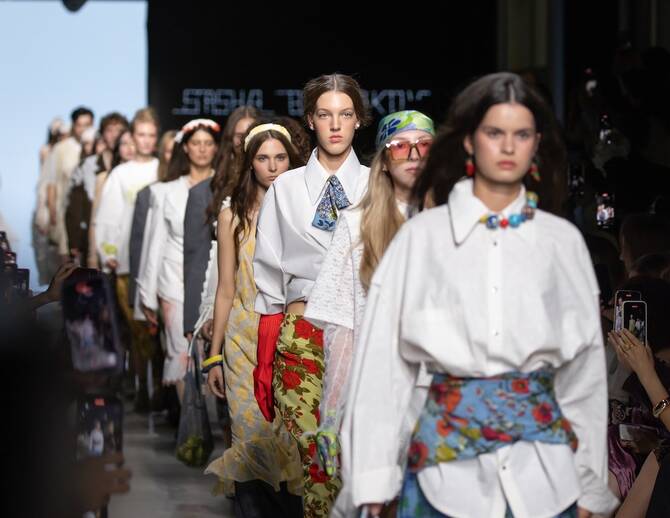

MOSCOW: Arab News was one of several Middle Eastern companies present at the recent Moscow Fashion Week and its accompanying BRICS+ Fashion Summit — a sign of the Russian capital’s potential as an alternative to the traditional fashion capitals of the West.
Shirene Rifai, CEO of Jordan Fashion Week, told Arab News in Moscow: “For too long, fashion was centered only in Paris, Milan, London, and New York. Now, platforms like BRICS+ are creating space for non-Western voices to be seen as equal players. For me, representing Jordan and the Middle East here means more than showing collections — it’s about cultural diplomacy.”
We spoke to several of the designers who showed collections at Moscow Fashion Week about their inspirations and aspirations.
Alexander Karamyshev, co-founder of 139DEC
On fashion
For us, fashion is not only about clothing — it is a language, a way to communicate ideas, emotions, and cultural codes. Each collection is a dialogue between our inner world and the audience.
On 139DEC

On 139DEC. (Supplied)
Our background is deeply rooted in retail. We began as buyers, curating brands for stores, and later introduced our own label. This experience shaped our approach: every piece we create must combine quality, fit, and function. While our runway looks carry a strong artistic vision, many of them can effortlessly transition into daily life — from the office to nightlife. Our collections are not driven by trends or external references. Instead, they are shaped by a search for authenticity — a reflection of our own thoughts at the moment of creation. This process infuses the garments with exclusivity and energy. Clients often tell us they can feel this vitality, and for us, that is the most valuable recognition.
On 139DEC’s Moscow Fashion Week collection
This collection is a true collaboration: the show’s film was crafted by our friend and director Tony Shiro, the soundtrack was composed by Alexey Shlykov (Mr. Pepper), sculptor Piotr Diakov created the masks, and artist Sergey Konrazhkin designed the prints. Together, these voices form a symphony of cultures, creating a global vision that extends far beyond fashion.
On the inspiration behind the collection
Inspiration is never singular. It is a current — something the designer channels in a given moment. For us, it emerges from the touch of fabric, the flow of form, and above all, the flawless synergy of our team. That spirit of creation, alive and immediate, is the essence of our aesthetic.
Olesya Kosopletkina, founder of Addicted_to…
On Moscow Fashion Week’s future

Addicted_to… (Supplied)
I think that in 10 years Moscow Fashion Week will take on a completely different format — one that we can’t even imagine yet. Of course, this is connected to the deep integration of AI into our lives and, as a result, humanity’s global shift toward consuming digital content. I believe that physical fashion weeks will become less extensive but more valuable. This will only increase the worth of craftsmanship and handmade work in general.
On balancing creativity and functionality

Addicted_to… (Supplied)
I’m a mother of three and lead a very active lifestyle. Because of this, creating clothing that is highly functional and adaptable to different daily tasks comes easily to me. At the same time, fashion shows are a wonderful opportunity to bring fantasies to life.
On her Moscow Fashion Week collection
This collection tells a story about addiction but a creative kind of addiction. It’s about how people truly obsessed with their ideas can make great discoveries, discoveries that may help make the world a better place. The collection is like a path toward a better world - a path of creation, love, harmony, and peace.
Alexander Arutyunov, founder of Alexander Arutyunov
On fashion’s future

Alexander Arutyunov. (Supplied)
I feel everything is moving toward individuality. Identical, blank items will no longer be in demand. Everyone will want brighter self-expression. I have always created individual fashion. Even in the hardest times, I never made “simple” things.
On balancing creativity and functionality
Already, at the sketching stage, I can see how a complex garment will behave in real life — how it will be worn, fastened, how it will sit on the body, even how it will look after washing. So, from the very beginning, I think about functionality.
On sustainability
This season, for the first time, I stepped into sustainable fashion. Every look in the collection was created from the brand’s archival fabrics. It wasn’t a direct gesture toward sustainability, nor a way to optimize the process, but when I walked into my fabric storage and saw hundreds of beautiful rolls lying unused after years, I told myself: “Stop.” And so the entire new collection was made from our stock and archival textiles. It’s an attempt to pause the flow of “new,” to look inward, to work with what has already been created.
On inspiration
One part of my new collection reveals the main theme of the show — a jewelry box of childhood memory. When my brother and I were little, our father often took us to the circus in Tbilisi. Acrobats, clowns, tricks... but nothing stayed with me as strongly as the gift he would buy for us in the circus foyer every time: a geometric paper ball, or sometimes a pompom that unfolded from a flat fan; a magical object that filled us with wonder. My father rarely appears in my dreams. But recently, he came to me in a dream, and we went to the circus together, where he once again bought me that same paper ball.
Aleksandr Barbakov, designer for Sasha Barbakov
On balancing creativity and functionality

Sasha Barbakov. (Supplied)
Everything comes from the concept, for us this is paramount. Then, when we develop products, we pay special attention to commercial models, trying to make wearable items (that convey the) idea.
On Sasha Barbakov’s Moscow Fashion Week collection

Sasha Barbakov. (Supplied)
The collection is called “Gardens Bloom in the Soul.” For eight years, I have continued to appreciate the warmth that my late grandmother gave me. This collection has become a personal form of therapy for me — a reminder of those warm moments that I experienced in her garden and vegetable garden every summer. I collected these memories that I return to in moments of sadness and silence. The collection reflects the idea that over time, some memories fade, but remain an important part of the inner world. It’s also about those moments that can only be captured in photographs. In an attempt to keep them alive, I am nostalgic for my own experiences, which sometimes only emerge in memory or in photographs. It’s a reminder that, even if something physically disappears, gardens still bloom in the soul.
Fati Shogenova, founder of Hatsibana
On the future of fashion weeks

Hatsibana. (Supplied)
Fashion Weeks will evolve from being seasonal showcases into multidimensional cultural platforms. In the next decade, we’ll see them becoming more inclusive, tech-driven, and globally connected, where fashion intersects with art, sustainability, and digital innovation.
On balancing creativity and functionality
At Hatsibana, creativity begins with cultural heritage-embroidery, symbolism, and storytelling, but functionality ensures these pieces live beyond the runway. We use modern silhouettes, versatile cuts, and premium fabrics so each garment becomes not only a statement but also wearable art for everyday life.
On fashion’s role in culture

Hatsibana. (Supplied)
This season we highlight inclusivity by showcasing diverse female identities through silhouettes inspired by the Caucasus. Sustainability is reflected in limited, handcrafted production — we create fewer but more meaningful pieces. Cultural awareness remains our DNA: every detail celebrates and reinterprets North Caucasian traditions for a global audience.
On Hatsibana’s Moscow Fashion Week collection
This collection tells the story of the resilience and elegance of both women-warriors and dreamers. Through traditional embroidery reimagined in contemporary couture, we narrate how heritage can empower women today and inspire them to embrace their roots while walking confidently into the future. The main inspiration was the strength and grace of women from my homeland. The collection was also influenced by the painting “Amazonka” by Ruslan Shameev, which symbolizes female independence and inner fire. I hope the audience feels this energy and connects emotionally — seeing not just garments, but a living story about identity, power, and beauty.