

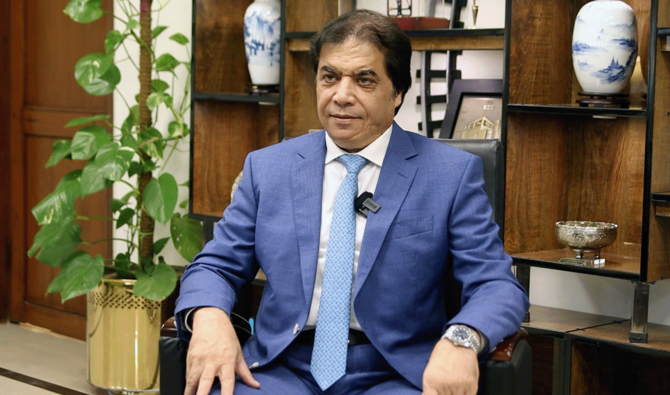

ISLAMABAD: Pakistan has secured Chinese approval to proceed with a $2 billion Asian Development Bank (ADB)-financed upgrade of the Karachi–Rohri railway line, a critical link needed to transport copper and gold from the giant Reko Diq mine to export hubs, Railways Minister Hanif Abbasi told Arab News this week.
Abbasi’s remarks confirm details of a financing arrangement earlier announced by Islamabad and Beijing as part of a wider $7 billion consortium for the Main Line-1 (ML-1) project, covering Pakistan’s 1,726-kilometer colonial-era railway from Karachi to Peshawar.
The ML-1 upgrade is the largest infrastructure scheme under the over $60 billion China-Pakistan Economic Corridor (CPEC), itself part of President Xi Jinping’s Belt and Road Initiative. China originally pledged $6.67 billion for the project in 2016, but financing has stalled for nearly a decade.
On Sept. 8, Planning Minister Ahsan Iqbal said Pakistan and China had agreed to form a consortium including ADB, the Asian Infrastructure Investment Bank (AIIB), and the two governments to fund ML-1. Reuters separately reported last month, citing unnamed sources, that ADB was in advanced talks to lead a $2 billion Karachi–Rohri upgrade after prolonged Chinese delays.
Speaking to Arab News, Abbasi confirmed that Beijing had given its consent for Pakistan to move forward with ADB financing for the Karachi–Rohri section, a key artery for transporting copper and gold from the Reko Diq mine in the southwestern Balochistan province to the main Port Qasim in Karachi.
“Yes, of course. Chinese are our brothers. We could not have moved forward without asking the Chinese first,” Abbasi said. “So, we took permission from the Chinese and then we proceeded with this, that we are going to do it with Asian Development Bank [funding].”
Abbasi said that regardless of where financing comes from, China would ultimately execute the project, arguing that no other country matched its expertise in railway and track construction.
Abbasi stressed that China had not withdrawn from ML-1 but that Pakistan would seek approval on a section-by-section basis as alternative funding was secured.
“We have just taken their permission for one part of ML-1. As we get more funding, we will keep taking permission [for more sections]. And we have no problem in seeking permission from them, they are our brothers.”
KARACHI-ROHRI UPGRADE AND REKO DIQ
The 500-kilometer Karachi–Rohri section is seen as essential to the Reko Diq venture, a joint project between Canada’s Barrick Gold and Pakistan, that could generate tens of billions of dollars in exports over coming decades.
The railways minister described the Karachi–Rohri stretch as “the main artery of Pakistan Railways,” currently in a “very pathetic condition” with trains crawling at 40 km/h.
The upgrade will allow speeds of up to 120 km/h.
He said talks with ADB were in the final stages, with feasibility studies to be completed by December this year and groundbreaking targeted for mid-2026.
“The prime minister wants the groundbreaking to be in June 2026. They [ADB] want to do it in December 2026. So, this difference will also be worked out,” Abbasi said.
Financing terms were still under discussion, but Abbasi said the interest rate would be “minor,” declining to compare it with past Chinese loans.
“No matter wherever the funding comes from, it is the Chinese who will do it,” he repeated.
Abbasi also disclosed that the Reko Diq Mining Company (RDMC), a joint venture between Canada’s Barrick Gold and Pakistan’s federal and Balochistan governments, had agreed to provide $390 million bridge financing for a 780-km stretch from Rohri to Nokundi in Balochistan.
“I hope that it [the agreement] will be signed with them by Oct. 10,” he said, adding that the project would transport one million tons of copper annually, which otherwise would require over 28,000 truckloads each year.
Abbasi acknowledged the security risks in Baluchistan, where separatist and religiously motivated militants frequently attack infrastructure, foreigners and security forces.
In March, militants hijacked the Jaffar Express passenger train in Balochistan, killing at least 25 people before security forces retook control.
“If we are doing it [providing security] for Jaffar Express, we will do it for that [trains carrying minerals] as well,” Abbasi said.
“As far as the security is concerned, we have an agreement with RDMC as well. Track security will be the responsibility of the state. The [promilitary] Federal Constabulary will be deployed on these trains.”
REGIONAL CONNECTIVITY
Abbasi said Pakistan also planned to restore international rail links, including the Islamabad–Tehran–Istanbul (ITI) freight service, set to resume in December after being suspended in 2019. The service had previously been used to export rice and pink salt to Turkiye and Europe.
“We already have the track for this service. We have taken the decision to restore it,” he confirmed.
Additionally, Pakistan is pushing ahead with the proposed Uzbekistan–Afghanistan–Pakistan (UAP) railway project, valued at around $10 billion, to connect Termez in Uzbekistan with Kabul and Pakistan’s Kurram district, the railways minister said.
Local media have reported that China may finance the 640-km line.
“If we succeed in doing this, then [we will get market access] for the whole of Europe, for the whole of Russia, for Central Asia,” Abbasi said.
“And the landlocked countries, like Afghanistan, Uzbekistan, they will get access to the port.”


