

Israel to defund national awards after film about Palestinian boy wins

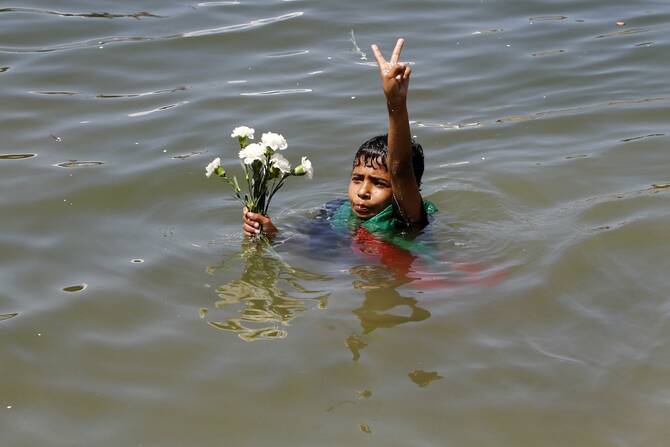
‘The Sea’ follows a Palestinian boy whose school trip to Tel Aviv’s beach is blocked at the border, prompting him to embark on a dangerous journey to sneak into Israel. Above, a Palestinian boy swims near the port of Gaza City on May 31, 2010. (AFP file photo)
Short Url
Updated 18 September 2025
Follow

Israel to defund national awards after film about Palestinian boy wins

  • Culture minister slams Ophir Awards as ‘pathetic ceremony’ after film about a 12-year-old Palestinian boy won a top prize
  • ‘The Sea,’ directed and written by filmmaker Shai Carmeli-Pollak, is poised to be Israel’s entry for the best international film Oscar

LONDON: Israeli Culture Minister Miki Zohar intends to end funding for the country’s national film awards starting in 2026, after a film featuring the story of a Palestinian boy won the best feature film prize.

Zohar, who recently described the Oscar-winning documentary “No Other Land” as a “sabotage” against Israel, said on Wednesday that the Ophir Awards held in Tel Aviv was a “pathetic ceremony” after “The Sea,” a film about a 12-year-old Palestinian boy, won the prize.

“There is no greater slap in the face of Israeli citizens than the embarrassing and detached annual Ophir awards ceremony. Starting with the 2026 budget, this pathetic ceremony will no longer be funded by taxpayers’ money,” he said on X.

He added: “Under my watch, Israeli citizens will not pay from their pockets for a ceremony that spits in the faces of our heroic soldiers.”

Israeli rights groups are investigating whether the Culture Ministry has the authority to withdraw funding from the Ophir Awards, which members of the Israeli Academy of Film and Television vote on.

“The Sea,” directed and written by Israeli filmmaker Shai Carmeli-Pollak, is poised to be the country’s entry for the best international film Oscar. Baher Agbariya is a producer of the film and one of the 1.6 million Arab citizens of Israel, representing 20 percent of the population. He thanked the Israel Film Fund for supporting the film.

“The Sea” follows a Palestinian boy whose school trip to Tel Aviv’s beach is blocked at the border, prompting him to embark on a dangerous journey to sneak into Israel. Mohammad Gazawi, 13, who stars as Khaled, won the Ophir for best actor, while co-star Khalifa Natour received the award for best supporting actor.

Assaf Amir, chair of the Israeli Academy of Film and Television, said that “the selection of ‘The Sea’ is a powerful and resounding response” to the culture minister’s statement and to the recent boycott calls from the international film community.

Last week, more than 3,000 actors and directors signed a pledge to boycott Israeli film institutions, which they said are “implicated in genocide and apartheid against the Palestinian people” in Gaza and the West Bank. Signatories include filmmakers Yorgos Lanthimos, Ava DuVernay, Asif Kapadia, Boots Riley and Joshua Oppenheimer, among others.

Workers in the Israeli film industry criticized the boycott as “deeply troubling,” while Paramount, a Hollywood studio, said it “does not promote better understanding or advance the cause of peace.”


Riyadh celebrates Sudanese heritage in cultural week finale

Updated 15 December 2025
Follow

Riyadh celebrates Sudanese heritage in cultural week finale

  • Visitors experience sounds of dalooka, rababa in lively spectacle
  • Global Harmony 2 initiative has offered an integrated cultural experience highlighting 14 cultures

RIYADH: The Sudanese Culture Week continues in Riyadh until Dec. 20, attracting visitors from a variety of nationalities to diverse cultural performances, the Saudi Press Agency reported.

The Ministry of Media has organized the events as part of the Global Harmony 2 initiative, in cooperation with the General Entertainment Authority and the Quality of Life Program.

Held at Al-Suwaidi Park, one of Riyadh Season’s zones, the week began with a celebratory parade featuring traditional Sudanese music which included the sounds of the dalooka and the rababa. A traditional Sudanese bridal procession was the subject of a tableau that also engaged visitors.

Sudanese Culture Week also includes musical concerts, entertainment sections, and cultural pavilions, with participation from Sudanese singers and influencers presenting activities that reflect the cultural diversity of the country’s regions and communities.

The event’s stage hosted the opening concerts, which were attended by thousands who enjoyed rababa performances and popular Sudanese songs.

Citizens and residents explored Sudanese culture through its folk arts, traditional music, and customs.

The celebration marks the final week of the Global Harmony 2 initiative’s cultural events. These have built on the program’s success in promoting cultural exchange and showcasing the cultures of communities residing in the Kingdom, reflecting the values of coexistence and cultural openness.

Over more than 40 days the Global Harmony 2 initiative has offered an integrated cultural experience highlighting 14 cultures.

Indian Culture Week was the first in a series featuring countries from Asia, Africa, and the Arab world.

Other weeks have placed the spotlight on regions such as the Philippines, Egypt, Pakistan, Jordan, Lebanon, Palestine, Bangladesh, Yemen, Uganda, and Ethiopia, providing traditional arts and music, cuisine, and social activities.

The initiative has included more than 100 artists and creators presenting artistic and musical performances, along with areas showcasing traditional cuisine, clothing, handicrafts, and family-friendly interactive activities.

It has received wide acclaim for highlighting the lives of residents in the Kingdom and the services provided to them.