Meta unveils AI-powered smart glasses with display and neural wristband at Connect event

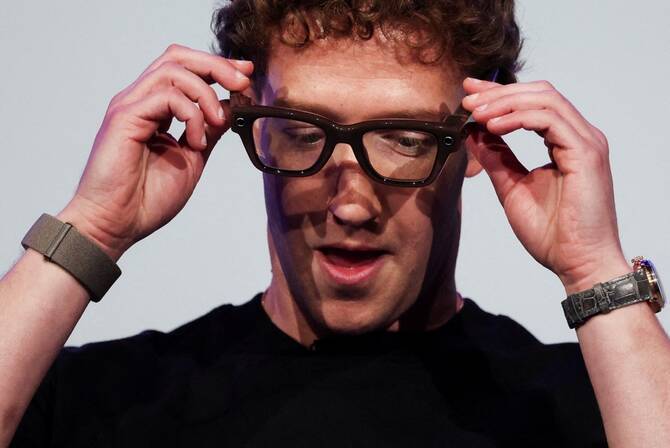
Meta CEO Mark Zuckerberg wears the Meta Ray-Ban Display glasses. (Reuters)
Short Url
Updated 18 September 2025
Follow

Meta unveils AI-powered smart glasses with display and neural wristband at Connect event

MENLO PARK, California: Meta’s newest artificial-intelligence powered smart glasses include a tiny display and can be controlled by a neural wristband that lets you control it with “barely perceptible movements,” CEO Mark Zuckerberg announced Wednesday.
Zuckerberg continues to evangelize the glasses as the next step in human-computer interactions — beyond keyboards, touch screens or a mouse.
“Glasses are the only form factor where you can let AI see what you see, hear what you hear,” and eventually generate what you want to generate, such as images or video, Zuckerberg said, speaking at the tech giant’s Menlo Park, California, headquarters.
The glasses, called Meta Ray-Ban Display, will be available Sept. 30 and cost $799.
Mike Proulx, research director at Forrester, said Meta’s latest reveal is “reminiscent of when the Apple Watch first debuted as an alternative to the smartphone.”
“But what these glasses do is bring more utility to consumers in a single device. Unlike VR headsets, glasses are an everyday, non-cumbersome form factor,” the analyst added. “However, the onus is on Meta to convince the vast majority of people who don’t own AI glasses that the benefits outweigh the cost. The good news? There’s a lot of runway to earn market share.”
Meta also updated its original, display-less Ray-Ban glasses to have a better battery life, which Meta says lasts eight hours with typical use, nearly twice as long as the previous model. An upcoming feature, called “conversation focus,” will amplify the voice of the person the user is speaking to and help drown out background noise. This will be available on the older version of the glasses too, as a software update, Zuckerberg said. Meta also added German and Portuguese to the gadget’s live translation capabilities. The new model costs $379, and the previous model now costs $299.
The company also unveiled a new set of AI-powered glasses for athletes, called the Oakley Meta Vanguard, which Meta says is specifically for “high-intensity sports” and can be integrated with Garmin devices to give users feedback about their workouts such as heart rate and stats. For instance, a runner could ask “Hey Meta, what’s my heart rate?” and get a voice response through the glasses. It also auto-captures video clips when the user hits key milestones or ramps up their heart rate, speed or elevation. The glasses will cost $499 and go on sale Oct. 21.
While the company has not disclosed sales figures of the glasses, it said they have been more popular than expected.
“For more than a decade, Zuckerberg’s long-term vision with Oculus and the Metaverse has been that glasses and headsets will blur the lines between physical and digital worlds,” Forrester analyst Thomas Husson said. “After many false starts, the momentum to move beyond an early adopter niche is now.”
Meta teased a prototype for Orion, which Zuckerberg called “the most advanced glasses the world has ever seen,” last year — but these holographic augmented reality glasses are still years away from being on the market.
Like other tech companies, Meta has been making massive investments in AI development and hiring top talent at eye-popping compensation levels.
In July, Zuckerberg posted a note detailing his views on “personal superintelligence” that he believes will “help humanity accelerate our pace of progress.” While he said that developing superintelligence is now “in sight,” he did not detail how this will be achieved or exactly what “superintelligence” means. The abstract idea of “superintelligence” is what rival companies call artificial general intelligence, or AGI.
Zuckerberg has said he believes AI glasses are going to be “the main way we integrate superintelligence.”


How Netflix won Hollywood’s biggest prize, Warner Bros Discovery

Updated 06 December 2025
Follow

How Netflix won Hollywood’s biggest prize, Warner Bros Discovery

  • Board rejected Paramount’s $30 a share bid amid funding concerns, sources say
  • Warner Bros board met daily before accepting Netflix’s binding offer

LOS ANGELES/NEW YORK: What started as a fact-finding mission for Netflix culminated in one of the biggest media deals in the last decade and one that stands to reshape the global entertainment business landscape, people with direct knowledge of the deal told Reuters. Netflix announced on Friday it had reached a deal to buy Warner Bros Discovery’s TV, film studios and streaming division for $72 billion. Although Netflix had publicly downplayed speculation about buying a major Hollywood studio as recently as October, the streaming pioneer threw its hat in the ring when Warner Bros Discovery kicked off an auction on October 21, after rejecting a trio of unsolicited offers from Paramount Skydance .
Details of Netflix’s plan and the Warner Bros board’s deliberations, based on interviews with seven advisers and executives, are reported here for the first time.
Initially motivated by curiosity about its business, Netflix executives quickly recognized the opportunity presented by Warner Bros, beyond the ability to offer the century-old studio’s deep catalog of movies and television shows to Netflix subscribers. Library titles are valuable to streaming services as these movies and shows can account for 80 percent of viewing, according to one person familiar with the business.
Warner Bros’ business units — particularly its theatrical distribution and promotion unit and its studio — were complementary to Netflix. The HBO Max streaming service also would benefit from insights learned years ago by streaming leader Netflix that would accelerate HBO’s growth, according to one person familiar with the situation. Netflix began flirting with the idea of acquiring the studio and streaming assets, another source familiar with the process told Reuters, after WBD announced plans in June to split into two publicly traded companies, separating its fading but cash-generating cable television networks from the legendary Warner Bros studios, HBO and the HBO Max streaming service.
Netflix and Warner Bros did not reply to requests for comment.
The work intensified this autumn, as Netflix began vying for the assets against Paramount and NBCUniversal’s parent company, Comcast.
Warner Bros kicked off the public auction in October, after Paramount submitted the first of three escalating offers for the media company in September. Sources familiar with the offer said Paramount aimed to pre-empt the planned separation because the split would undercut its ability to combine the traditional television networks businesses and increase the risk of being outbid for the studio by the likes of Netflix.
Around that time, banker JPMorgan Chase & Co. was advising Warner Bros Discovery CEO David Zaslav to consider reversing the order of the planned spin, shedding the Discovery Global unit comprising the company’s cable television assets first. This would give the company more flexibility, including the option to sell the studio, streaming and content assets, which advisers believed would draw strong interest, according to sources familiar with the matter.
Executives for the streaming service and its advisory team, which included the investment banks Moelis & Company, Wells Fargo and the law firm Skadden, Arps, Slate, Meagher & Flom, had been holding daily morning calls for the past two months, sources said. The group worked throughout Thanksgiving week — including multiple calls on Thanksgiving Day — to prepare a bid by the December 1 deadline.
Warner Bros’ board similarly convened every day for the last eight days leading up to the decision on Thursday, when Netflix presented the final offer that sources described as the only offer they considered binding and complete, sources familiar with the deliberations said.
The board favored Netflix’s deal, which would yield more immediate benefits over one by Comcast. The NBCUniversal parent proposed merging its entertainment division with Warner Bros Discovery, creating a much larger unit that would rival Walt Disney. But it would have taken years to execute, the sources said.
Comcast declined to comment.
Although Paramount raised its offer to $30 per share on Thursday for the entire company, for an equity value of $78 billion, according to sources familiar with the deal, the Warner Bros board had concerns about the financing, other sources said.
Paramount declined comment.
To reassure the seller over what is expected to be a significant regulatory review, Netflix put forward one of the largest breakup fees in M&A history of $5.8 billion, a sign of its belief it would win regulatory approval, the sources said. “No one lights $6 billion on fire without that conviction,” one of the sources said.
Until the moment late on Thursday night when Netflix learned its offer had been accepted — news that was greeted by clapping and cheering on a group call — one Netflix executive confided that they thought they had only a 50-50 chance.