

Gold worth $700,000 stolen in Paris museum heist

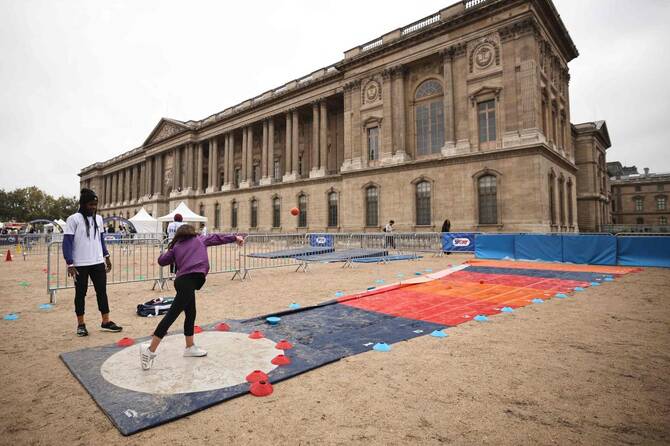
A girl performs a shot put in front of the Louvre Museum during Sports Day in Paris on Sept. 14, 2025. (AFP)
Short Url
Updated 18 September 2025
Follow

Gold worth $700,000 stolen in Paris museum heist

  • The National Natural History Museum in the chic 5th district of the French capital also houses a geology and mineralogy gallery.
  • Native gold is a metal alloy containing gold and silver in their natural, unrefined form

PARIS: Thieves have broken into Paris’s Natural History Museum, making off with gold samples worth €600,000 ($700,000) in the latest of a series of robberies from cultural institutions, according to the museum.
Famed for its dinosaur skeletons and taxidermy, the National Natural History Museum in the chic 5th district of the French capital also houses a geology and mineralogy gallery.
A break-in was detected on Tuesday morning, with the intruders reportedly using an angle grinder and a blow torch to force their way into the riverside complex that is popular with Parisians and tourists.
“The theft concerns several specimens of native gold from the national collections held by the museum,” the museum’s press office told AFP late on Tuesday.
“While the stolen specimens are valued at around €600,000 based on the price of raw gold, they nevertheless carry an immeasurable heritage value,” it added.
Native gold is a metal alloy containing gold and silver in their natural, unrefined form.
An unnamed police source told the Parisien newspaper that the museum’s alarm and surveillance systems had been disabled by a cyberattack in July, but it was unclear if they were working when the theft took place.
“We are dealing with an extremely professional team, perfectly aware of where they needed to go, and with professional equipment,” museum director Emmanuel Skoulios told the BFM TV channel.
“It is absolutely not by chance that they went for these specific items,” he added.

‘Critical time’

The museum closed its mineralogy gallery on Tuesday and was checking its collection for other losses.
One of its treasures is a native gold and quartz sample measuring nine by 8.5 centimeters (3.3-3.5 inches) which originated in the Donatia mine in California and was gifted to the museum by a wealthy French collector, according to its website.
The robbery “comes at a critical time for cultural institutions and museums in particular. Several public collections have indeed been targeted by thefts in recent months,” the museum added.
It did not elaborate on the other robberies, but the Adrien Dubouche National Museum in Limoges in central France is known to have suffered a break-in earlier this month.
Thieves stole two dishes and a vase in Chinese porcelain classed as national treasures, with the losses estimated at 6.5 million euros.
Last November, four men with axes and baseball bats smashed the display cases in broad daylight at the Cognacq-Jay museum in Paris, making off with several 18th-century works.
The next day, jewelry valued at several million euros was stolen during an armed robbery at a museum in Saone-et-Loire in central France.
The most notorious museum heist of recent times occurred at the Musee d’Art Moderne in Paris in May 2010.
Vjeran Tomic, a Croatian burglar nicknamed “Spiderman,” made off with masterpieces by Henri Matisse, Pablo Picasso, Georges Braque, Fernand Leger and Amedeo Modigliani valued at more than 100 million euros.
The case revealed extraordinary security lapses at the museum, including that motion-detection alarms had been out of order for two months and three guards failed to spot him.
Tomic was sentenced to eight years in prison in 2017.


Nowhere to pray as logs choke flood-hit Indonesian mosque

Updated 9 sec ago
Follow

Nowhere to pray as logs choke flood-hit Indonesian mosque

  • Before the disaster, the mosque bustled with worshippers — locals and students alike — attending daily and Friday prayers
  • Indonesia consistently ranks among the countries with the highest annual deforestation rates

ACEH TAMIANG, Indonesia: Almost two weeks on from devastating floods, Muslim worshippers in Indonesia’s Sumatra who gathered at their local mosque on Friday for prayers were blocked from entering by a huge pile of thousands of uprooted trees.
The deadly torrential rains had inundated vast tracts of rainforest nearby, leaving residents of the Darul Mukhlisin mosque and Islamic boarding school to search elsewhere for places of worship that had been less damaged.
“We have no idea where all this wood came from,” said Angga, 37, from the nearby village of Tanjung Karang.
Before the disaster, the mosque bustled with worshippers — locals and students alike — attending daily and Friday prayers.
“Now it’s impossible to use. The mosque used to stand near a river,” said Angga. “But the river is gone — it’s turned into dead land.”
Village residents told AFP the structure likely absorbed much of the impact of trees and logs carried by the torrents, preventing even greater destruction downstream.
When AFP visited the site, the mosque was still encircled by a massive heap of timber — a mix of uprooted trees and felled logs, likely from nearby forests.
By Friday, the death toll from one of northern Sumatra’s worst recent disasters — including in Aceh, where a tsunami wreaked havoc in 2004 — had reached 995 people, with 226 still missing and almost 890,000 displaced, according to the National Disaster Mitigation Agency.

- Uncontrolled logging -

Authorities have blamed the scale of devastation partly on uncontrolled logging.
Environmentalists say widespread forest loss has worsened floods and landslides, stripping the land of tree cover that normally stabilizes soil and absorbs rainfall.
Indonesia consistently ranks among the countries with the highest annual deforestation rates.
President Prabowo Subianto, visiting Aceh Tamiang district on Friday, assured victims the government was working to restore normalcy.
“We know conditions are difficult, but we will overcome them together,” he said, urging residents to “stay alert and be careful.”
“I apologize for any shortcomings (but) we are working hard,” he said.
Addressing environmental concerns, Prabowo called for better forest protection.
“Trees must not be cut down indiscriminately,” he said.
“I ask local governments to stay vigilant, to monitor and safeguard our nature as best as possible.”
But frustrations were growing, with flood victims complaining about the pace of relief efforts.
Costs to rebuild after the disaster could run up to 51.82 trillion rupiah ($3.1 billion) and the Indonesian government has so far shrugged off suggestions that it call for international assistance.
Back in nearby Babo Village, Khairi Ramadhan, 37, said he planned to seek out another mosque for prayers.
“I’ll find one that wasn’t hit by the flood,” he said. “Maybe some have already been cleaned. I don’t want to dwell on sorrow anymore.”