

Gold worth $700,000 stolen in Paris museum heist

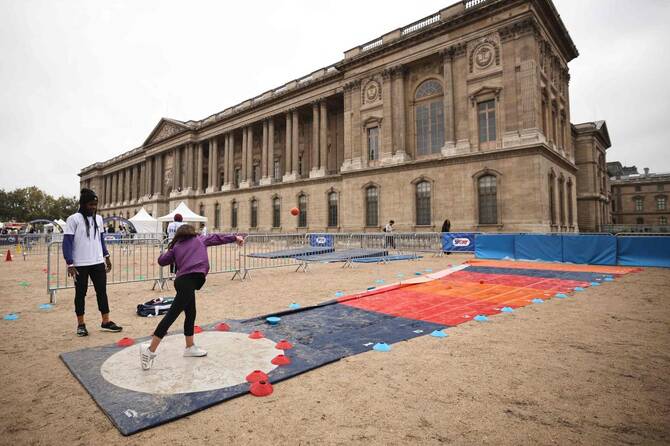
A girl performs a shot put in front of the Louvre Museum during Sports Day in Paris on Sept. 14, 2025. (AFP)
Short Url
Updated 18 September 2025
Follow

Gold worth $700,000 stolen in Paris museum heist

  • The National Natural History Museum in the chic 5th district of the French capital also houses a geology and mineralogy gallery.
  • Native gold is a metal alloy containing gold and silver in their natural, unrefined form

PARIS: Thieves have broken into Paris’s Natural History Museum, making off with gold samples worth €600,000 ($700,000) in the latest of a series of robberies from cultural institutions, according to the museum.
Famed for its dinosaur skeletons and taxidermy, the National Natural History Museum in the chic 5th district of the French capital also houses a geology and mineralogy gallery.
A break-in was detected on Tuesday morning, with the intruders reportedly using an angle grinder and a blow torch to force their way into the riverside complex that is popular with Parisians and tourists.
“The theft concerns several specimens of native gold from the national collections held by the museum,” the museum’s press office told AFP late on Tuesday.
“While the stolen specimens are valued at around €600,000 based on the price of raw gold, they nevertheless carry an immeasurable heritage value,” it added.
Native gold is a metal alloy containing gold and silver in their natural, unrefined form.
An unnamed police source told the Parisien newspaper that the museum’s alarm and surveillance systems had been disabled by a cyberattack in July, but it was unclear if they were working when the theft took place.
“We are dealing with an extremely professional team, perfectly aware of where they needed to go, and with professional equipment,” museum director Emmanuel Skoulios told the BFM TV channel.
“It is absolutely not by chance that they went for these specific items,” he added.

‘Critical time’

The museum closed its mineralogy gallery on Tuesday and was checking its collection for other losses.
One of its treasures is a native gold and quartz sample measuring nine by 8.5 centimeters (3.3-3.5 inches) which originated in the Donatia mine in California and was gifted to the museum by a wealthy French collector, according to its website.
The robbery “comes at a critical time for cultural institutions and museums in particular. Several public collections have indeed been targeted by thefts in recent months,” the museum added.
It did not elaborate on the other robberies, but the Adrien Dubouche National Museum in Limoges in central France is known to have suffered a break-in earlier this month.
Thieves stole two dishes and a vase in Chinese porcelain classed as national treasures, with the losses estimated at 6.5 million euros.
Last November, four men with axes and baseball bats smashed the display cases in broad daylight at the Cognacq-Jay museum in Paris, making off with several 18th-century works.
The next day, jewelry valued at several million euros was stolen during an armed robbery at a museum in Saone-et-Loire in central France.
The most notorious museum heist of recent times occurred at the Musee d’Art Moderne in Paris in May 2010.
Vjeran Tomic, a Croatian burglar nicknamed “Spiderman,” made off with masterpieces by Henri Matisse, Pablo Picasso, Georges Braque, Fernand Leger and Amedeo Modigliani valued at more than 100 million euros.
The case revealed extraordinary security lapses at the museum, including that motion-detection alarms had been out of order for two months and three guards failed to spot him.
Tomic was sentenced to eight years in prison in 2017.


How a Syrian refugee chef met Britain’s King Charles

Imad Alarnab, a chef and restaurant owner who fled Syria in 2015, works at one of his restaurants in central London. (AFP)
Updated 55 min 2 sec ago
Follow

How a Syrian refugee chef met Britain’s King Charles

  • Alarnab, 48, said he had asked the king to come to the popular eatery when he met him at Buckingham Palace

LONDON: Pots clanged and oil sizzled inside the London kitchen of Syrian chef Imad Alarnab, as the former refugee who fled his country’s civil war recalled hosting King Charles III.
When the chef left his war-torn homeland in 2015, he never imagined that one day he would watch as cameras flashed and wide-eyed crowds greeted the monarch arriving at his Soho restaurant last year.
Alarnab, 48, said he had asked the king to come to the popular eatery when he met him at Buckingham Palace before an event honoring humanitarian work in 2023.
“I told him ‘I would love for you to visit our restaurant one day’ and he said: ‘I would love to’... I was over the Moon to be honest.”
The chef has come a long way since he arrived in London after an arduous journey from Damascus with virtually no money in his pocket.
Fearing for his life, he had escaped Syria after his family was uprooted again and again by fighting.
His culinary empire — restaurants, cafes, and juice bars peppered across the Syrian capital — had been destroyed by bombing in just six days in 2013.
Alarnab spent three months crisscrossing Europe in the back of lorries, aboard trains, on foot and even on a bicycle before he reached the UK.
“When I left, I left with nothing,” he told AFP, as waiters whirled past carrying steaming plates of traditional Syrian fare.
Starving and exhausted, he spent the last of his money on a train ticket to Doncaster where his sister lived.
“Love letter from Syria”
To make a living, Alarnab initially picked up any odd jobs, such as washing and selling cars, saving enough to bring his wife and three daughters over after seven months.
His love of cooking never left him though. In France, while he was sleeping on the steps of a church, Alarnab had often cooked for hundreds of other refugees.
“I always dreamed of going back to cooking,” he said.
So it wasn’t long before he found himself back in the kitchen, cooking up a storm across London with his sold-out supper clubs, bustling pop-up cafes, and crowded lunchtime falafel bars.
Alarnab’s friends gave him the initial boost for his first pop-up in 2017, and profits from his new catering business then covered the costs of later events.
He now runs two restaurants in the city — one in Soho’s buzzing Kingly Court and another nestled in a corner of the vibrant Somerset House arts center.
“I was looking for a city to love when I found London,” Alarnab said, adding it had offered him “space to innovate” and add his own modern twist to classic Syrian dishes.
Far from home, Alarnab said his word-of-mouth success had grown into a “love letter from Syria to the world” that needs no translation.
“You don’t really need to speak Arabic or Syrian to know that this is the best falafel ever,” he said, pointing to a row of colorful plates.
“There is hope”
For Alarnab, spices frying, dough rising and cheese melting inside a kitchen offered an unlikely escape from the real world.
“All my problems, I leave them outside the kitchen and walk in fresh.”
When he fled Syria, Alarnab thought going back to Damascus was forever off the table.
Yet he returned for the first time in October, almost a year to the day after longtime leader Bashar Assad was toppled in a lightning rebel offensive — ending almost 14 years of brutal civil war.
He walked the familiar streets of his old home, where his late mother taught him to cook many years ago.
“To return to Damascus and for her not to be there, that was extremely difficult.”
Torn between the two cities, Alarnab said he longed to one day rebuild his home in Damascus.
“I wish I could go back and live there. But at the same time, I feel like London is now a part of me. I don’t know if I could ever go back and just be in Syria,” he said.
Although Syrians still bear the scars of war, Alarnab said he had seen “hope in people’s eyes which was missing when I left in 2015.”
“The road ahead is still very long, and yes this is only the beginning — but there is hope.”