
PARIS: France on Tuesday repatriated three women and 10 children from Syrian prisons for alleged militants, anti-terror prosecutors said, in the first such operation in two years.
Repatriation is a deeply sensitive issue in France, which has been a target of Islamists over the last decade, notably in 2015, when militant gunmen and suicide bombers staged the worst attack on Paris since World War II, killing 130 people.
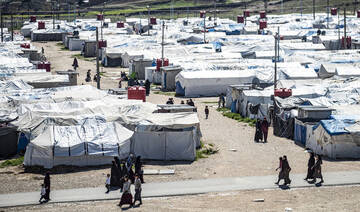
More than five years after the Daesh group’s territorial defeat in Iraq and Syria, tens of thousands of people are still held in Kurdish-run camps and prisons in northeastern Syria, many with alleged or perceived links to Daesh.
The women repatriated early Tuesday morning are aged between 18 and 34.
Two of them have been taken into police custody, while the third faces possible indictment, according to France’s anti-terror unit PNAT.
The 10 children were handed over to child care services and will be monitored by the anti-terror unit and local prosecutors, it added.
France’s foreign ministry thanked “the Syrian transitional authorities and the local administration in northeastern Syria for making the operation possible.”
Since 2019, France has repatriated 179 children and 60 women, according to a diplomatic source.
The country halted such operations two years ago.
- ‘Immense relief’ -
Matthieu Bagard, the head of the Syria unit at Lawyers Without Borders, said that Tuesday’s repatriation showed France “has the capacity to organize such operations.”
Marie Dose, a lawyer who represents the repatriated women, hailed the move.
“For families who have waited more than six years for the return of their grandchildren, nephews and nieces, this is an immense and indescribable relief,” Dose said in a statement to AFP.
But she added that 110 French children remained detained in the Roj camp controlled by Kurdish forces, describing France’s repatriation policy as “arbitrary.”
Dose accused France of seeking “to make these children pay for their parents’ choices.”
As of June, some 120 children “guilty of nothing” and 50 French women remained in the camps, according to the United Families Collective, which represents their families.
In February, the semi-autonomous Kurdish administration in northern Syria said that in coordination with the United Nations, it aimed to empty camps by the end of the year.
- International pressure -
Several European countries, such as Belgium, Germany and the Netherlands, have recovered many of their citizens from the Syrian camps.
International organizations have for years called on France to take back the wives and children of suspected Daesh fighters held in the camps since the group was ousted from its self-declared “caliphate” in 2019.
France has refused blanket repatriation, saying the return of potentially radicalized Daesh family members would pose security risks in France.
In 2022, Europe’s top human rights court condemned France’s refusal to repatriate two French women who were being held in Syria after joining their Islamist partners.
The following year, the United Nations Committee Against Torture said that in refusing to repatriate women and minors, France was violating the UN Convention against torture and other cruel, inhuman or degrading treatment or punishment.
On Monday, three French women went on trial in Paris, accused of traveling to the Middle East to join Daesh and taking their eight children with them.
One of the women is a niece of Jean-Michel and Fabien Clain, who claimed responsibility on behalf of the Daesh group for the 2015 attacks in Paris.