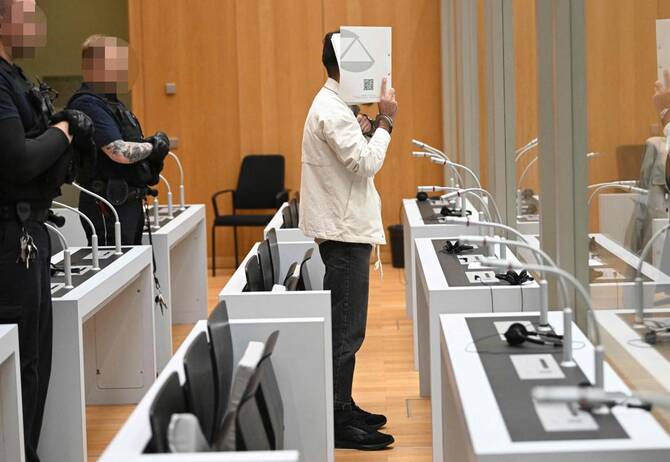
Afghan man handed life sentence in Germany after fatal stabbing at anti-Islam rally

Sulaiman A attacked a speaker and several demonstrators at the event before stabbing a police officer who rushed in to help. The officer later succumbed to his injuries. (AFP)
Short Url
Updated 16 September 2025
Follow

Afghan man handed life sentence in Germany after fatal stabbing at anti-Islam rally

  • Sulaiman A attacked a speaker and several demonstrators at the event before stabbing a police officer who rushed in to help. The officer later succumbed to his injuries

STUTTGART: An Afghan man with suspected Islamist motives was sentenced to life in prison by a German court on Tuesday for a knife attack that killed a police officer and injured five others at an anti-Islam rally last year.
The verdict comes at a time of heated debate about immigration and security in Germany, and a strong surge in support for the country’s far-right Alternative for Germany (AfD) party.
The defendant, named only as Sulaiman A to protect his privacy, was found guilty of using a large hunting knife to attack people during a demonstration in the western city of Mannheim that was organized by the anti-Islam group Pax Europa in late May 2024.
Sulaiman A attacked a speaker and several demonstrators at the event before stabbing a police officer who rushed in to help. The officer later succumbed to his injuries.
The attacker was taken into pre-trial custody in June 2024 after leaving intensive care for injuries he sustained during his arrest.
Though prosecutors say he sympathized with the Daesh group, he was not tried as a terrorist. He faced one count of murder and five counts of attempted murder.


Indian farmers, unions strike against new trade deal with US

Updated 7 sec ago
Follow

Indian farmers, unions strike against new trade deal with US

  • India agreed to eliminate or reduce tariffs on US industrial goods, wide range of farm, food products
  • Commerce minister says farmers will not suffer ‘any harm’ as deal is ‘fair, equitable, and balanced’

NEW DELHI: Indian farmers took part in nationwide trade union protests on Thursday, saying they fear the implications of New Delhi’s new trade pact with the US, which will result in American products gaining duty-free access to the Indian market.

Agriculture provides livelihoods for more than 40 percent of India’s 1.4 billion population, and opening the sector to foreign competition has long been politically sensitive.

India signed an interim framework of the US trade deal last week, with the formal pact being expected to be finalized by March. The US cut its 50 percent duty on Indian goods to 18 percent, while India agreed to eliminate or reduce tariffs on all US industrial goods and a wide range of farm and food products.

While details of the agreement have not yet been announced, farmers fear being undercut by cheap, subsidized American products which will threaten their livelihood.

Rakesh Tikait, national spokesman for the Bharatiya Kisan Union (Indian Farmers’ Union) said the government had not held discussions with farmers before agreeing to the deal.

The BKU and other rural platforms have joined a broader strike held across India by major trade unions opposed to new labor codes — which have been criticized for weakening workers’ rights and reducing job security — as they saw common cause with other workers.

“We are protesting against the US–India trade deal, which we fear goes against the larger interests of Indian farmers. If US farm goods, fishery products, and dairy products hit the Indian market, Indian farmers cannot withstand this onslaught and would be ruined,” Tikait told Arab News from a protest site in Western Uttar Pradesh.

“We want this deal to be changed and made pro-farmer. Otherwise we will oppose it tooth and nail.”

According to Rajveer Singh Jadaun, president of the farmers’ union in Uttar Pradesh, the agriculture sector is facing an “existential threat” in a country that historically imposes tariffs of 30–150 percent on imports to protect farmers.

With tariffs reduced or eliminated and those imposed on Indian products higher than before, protesting farmers are convinced there is no level playing field.

“The deal is giving a zero percent tariff to the US’ agricultural and other products and we are charged 18 percent, which is higher than the 3 percent in the past,” Jadaun said.

“American farmers are celebrating the deal — that means there is something fishy … The government is speaking in many voices and that creates further confusion. I would like the government to clarify the stand and make everything clear.”

Prices of Indian corn and soybean have already fallen by 4 percent and 10 percent respectively, following the deal’s announcement.

P. Krishna Prasad, finance secretary of the All India Farmers’ Union, predicted that prices of other products may soon fall, too.

“They are bringing fresh and processed fruits. If apples are being brought at 75 rupees ($1) per kilo to India from America, then the apple economy of Jammu and Kashmir and Himachal Pradesh will collapse,” he said.

“In America, there are only 1.7 million farmers, but in India there are 166 million farmer households. And in America, one farmer household is getting a 60 lakh rupees ($73,000) subsidy per year. In India, that is nearly 27,000 rupees ($330) per year. There is no level playing field. Indian farmers cannot compete with these highly motorized or mechanized farms of America.”

While Commerce Minister Piyush Goyal has addressed the protesters — saying that they “will not suffer any harm” as the trade deal is “fair, equitable, and balanced” —  Prasad warned they were prepared to stage a strike similar to the 2020-21 protest, in which they opposed three farm acts that sought to open the sector to corporations.

The strike, that lasted nearly 18 months, involved millions of protesters and was India’s largest and longest in recent times. It forced the government to repeal the contested legislation.

“America will dictate Indian policy, so the sovereignty of the Indian people and the country is totally being compromised,” Prasad said.

“We feel this is a total surrender of Indian farmers and Indian agriculture to imperialist, multinational corporations. We cannot accept it. We will stop it. We will come to the streets and build this agitation bigger than the 2021 farmers’ agitation.”