

Pakistan’s BankIslami recognized as ‘Best Islamic Banking Brand’ at global finance awards

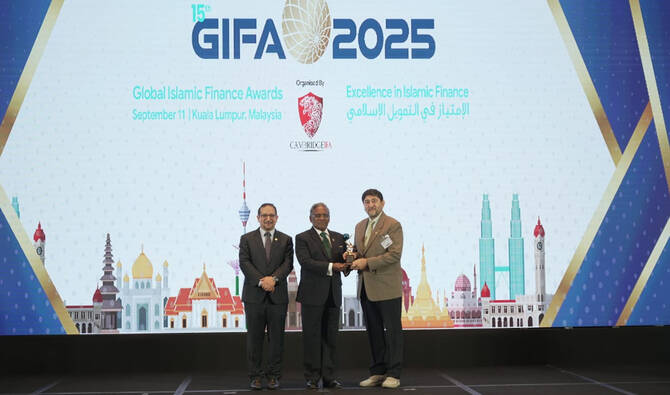
CEO and President of BankIslami Pakistan, Rizwan Ata (left), receives the“Best Islamic Banking Brand” at the Global Islamic Finance Awards (GIFA) 2025 in Kuala Lumpur, Malaysia, on September 11, 2025. (BankIslami)
Short Url
Updated 16 September 2025
Follow

Pakistan’s BankIslami recognized as ‘Best Islamic Banking Brand’ at global finance awards

  • The development comes months after Pakistan said Islamic banking assets had reached for the first time $40.7 billion by the end of March 2025
  • BankIslami says it remains committed to rolling out new Shariah-compliant tools, reaching more households through technology-driven solutions

KARACHI: Pakistan’s BankIslami has been named the ‘Best Islamic Banking Brand’ at the Global Islamic Finance Awards (GIFA) 2025 in Kuala Lumpur, Malaysia, the bank said on Monday, earning international recognition for innovation, customer-centric services and contribution to the growth of Islamic finance in the country.

GIFA is a globally recognized platform that honors institutions and individuals for contributions to Islamic banking and finance, according to a BankIslami statement.

It recognized BankIslami’s efforts to advance Islamic banking through awareness and access initiatives, interest-free financial solutions, and programs to expand financial inclusion.

The bank has played a pioneering role in developing Pakistan’s Islamic finance landscape, from deploying biometric ATMs to introducing Islamic digital banking solutions.

“Advancing Riba-free (interest-free) banking in Pakistan is a national cause, and as a financial institution, we see it as our responsibility to join hands and contribute,” BankIslami President Rizwan Ata was quoted as saying.

“We remain dedicated to our mission of Saving Humanity from Riba by expanding access, keeping products simple and transparent, and delivering service that earns trust.”

In May this year, the Pakistani central bank said Islamic banking assets had for the first time reached Rs11.5 trillion ($40.7 billion) by the end of March 2025 as the country actively moved toward implementing a fully Shariah-compliant financial system.

Pakistan’s Federal Shariat Court (FSC) directed the government in April 2022 to eliminate interest and align the country’s entire banking system with Islamic principles by 2027. Following the order, the government and the State Bank have taken several measures ranging from changing laws to issuing sukuk Islamic bonds to replace interest-based treasury bills and investment bonds.

With a network of more than 500 branches in over 210 cities, it offers Shariah-compliant financial products for individuals and businesses, including Hajj savings plans and small-media enterprise (SME) financing.

“BankIslami remains committed to advancing its mission by rolling out new Shariah-compliant financial tools, extending reach to more Pakistani households through technology-driven solutions, building partnerships with community-based organizations, and promoting financial literacy for inclusive and ethical banking,” it said.


Pakistan, UK sign £35 million Green Compact to strengthen climate resilience

Updated 21 December 2025
Follow

Pakistan, UK sign £35 million Green Compact to strengthen climate resilience

  • Pakistan ranks among nations most vulnerable to climate change and has seen erratic changes in its weather patterns
  • UK will help Pakistan mobilize climate finance, strengthen regulatory frameworks and develop bankable climate projects

ISLAMABAD: Pakistan and the United Kingdom (UK) have formalized a comprehensive climate partnership with the launch of a Green Compact that aims to enhance climate resilience, accelerate clean energy transition and scale up nature-based solutions, including mangrove conservation, Pakistani state media reported on Sunday.

The agreement, signed in Islamabad by Federal Minister for Climate Change and Environmental Coordination Dr. Musadik Malik and UK Minister for International Development Jennifer Chapman, unlocks £35 million in targeted support for green development and long-term climate action, according to Radio Pakistan broadcaster.

Pakistan ranks among nations most vulnerable to climate change and has seen erratic changes in its weather patterns that have led to frequent heatwaves, untimely rains, storms, cyclones, floods and droughts in recent years. In 2022, monsoon floods killed over 1,700 people, displaced another 33 million and caused over $30 billion losses, while another 1,037 people were killed in floods this year.

Mohammad Saleem Shaikh, a spokesperson for Pakistan’s Ministry of Climate Change, described the compact as a “decisive move toward action-oriented climate cooperation,” noting that its implementation over the next decade will be critical for Pakistan which regularly faces floods, heatwaves and water stress.

“The Compact is structured around five core pillars: climate finance and investment, clean energy transition, nature-based solutions, innovation and youth empowerment, and adaptation and resilience,” the report read.

“Under the agreement, the UK will work with Pakistan to mobilize public and private climate finance, strengthen regulatory frameworks for green investment, and develop bankable climate projects.”

Clean energy forms a central component of Pakistan’s transition, with Islamabad planning to expand solar and wind generation to reduce fossil fuel dependence, improve energy security and stabilize power costs, according to Shaikh.

“Renewable energy is now economically competitive, making the transition both environmentally and financially viable,” he was quoted as saying.

“Nature-based solutions, particularly large-scale mangrove restoration, will protect coastal communities from storm surges and erosion while enhancing biodiversity and carbon sequestration.”

Under the Compact, technical support, mentoring and access to investors will be provided to climate-smart startups and young innovators, reflecting Pakistan’s recognition of youth-led initiatives as central to future climate solutions.

On the occasion, Chapman, on her first official visit to Pakistan, underscored the urgency of climate action, highlighting the UK’s support for renewable energy, mangrove and ecosystem restoration, early-warning systems, climate budgeting and international investment flows into Pakistan.

Shaikh described the Green Compact as “a strategic turning point” in Pakistan–UK relations on climate change, saying its effective implementation is essential for Pakistan to meet its national climate targets.