

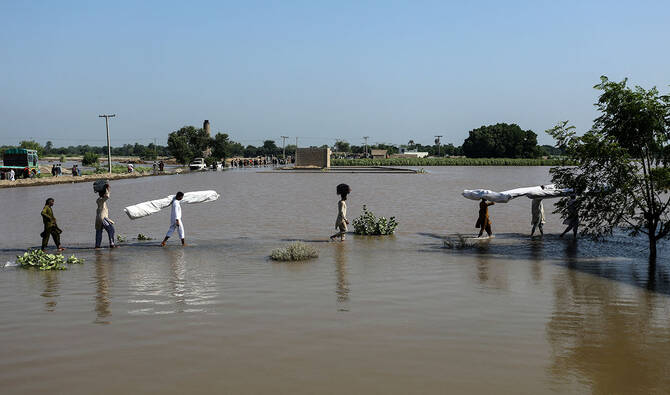

ISLAMABAD: Pakistan is turning to advanced technologies and innovative agricultural practices to fight back climate change, a parliamentary panel was informed on Monday, amid widespread death and destruction from monsoon rains, glacial bursts, floods and other similar incidents.
Since late June, nearly 1,000 people have lost their lives in these incidents, according to the National Disaster Management Authority (NDMA). The northwestern Khyber Pakhtunkhwa (KP) accounts for 504 of these deaths, while floods have caused widescale economic losses in the breadbasket Punjab province. While Pakistan contributes less than 1 percent to global greenhouse gas emissions, it remains one of the most vulnerable countries to climate-related disasters. The
South Asian country suffers around $4 billion due to climate change and this year’s flooding could deepen that blow, according to NDMA chief Lt. Gen. Inam Malik.
On Monday, top officials from Pakistan’s KP, and Gilgit-Baltistan (GB) and Azad Kashmir regions briefed a National Assembly’s standing committee on climate change about the steps being taken to mitigate the impacts of climate change on local communities. The committee was informed that deforestation in northern Gilgit-Baltistan has reached “alarming levels,” with approximately 4 million cubic feet of timber cut down in the Diamer district alone over the past three decades, which has disrupted the ecological balance and directly impacted livelihoods of local people, economy and natural resources.
“We are trying to reverse this trend through administrative measures and the use of modern technology to stop illegal forest cutting and timber smuggling in the area,” Gilgit-Baltistan Home Secretary Ali Asghar said, adding the GB administration was monitoring forested areas through drones and CCTV cameras.
The official said the region has suffered Rs50 billion ($176 million) losses this monsoon season due to rains and glacier melts that destroyed thousands of homes, roads and bridges.
Officials from KP’s forest department said the province has made significant strides in combating deforestation and its total forested areas has increased to 1.45 million hectares from 1.37 million hectares over the last two decades.
“We are now using surveillance cameras at all KP check-posts to monitor and prevent illegal smuggling. These cameras are linked to cloud servers so that local officials cannot tamper with video evidence,” KP Secretary of Climate Change Shahid Zaman told the panel, noting that a new project was underway to use satellite technology to monitor and control deforestation.
The official cited poverty as a major driver of deforestation, explaining that many locals rely on wood for fuel and building materials as they cannot afford alternatives.
To address this, he said, the government has launched several initiatives, including mass tree plantation drives, new legislation, a dedicated forest protection force, and surveillance through cameras.
Punjab, which accounts for the largest share of the country’s breadbasket, is already adopting climate-smart farming techniques aimed at improving resilience, boosting productivity, and lowering emissions. These include the use of improved seed varieties, drip irrigation systems and tunnel farming method.
“We are working on germplasm (genetic materials of plants) which can resist extreme heat and extreme cold,” Dr. Shoukat Ali from Faisalabad’s University of Agriculture told Arab News, adding that the initial results are “encouraging.”
He clarified that different varieties of crops being used in Punjab and Sindh provinces can improve yield, but those seeds are not tolerant to extreme weather.
In addition to agricultural innovation, Punjab launched in April its first drone-based environmental surveillance system, “Hawk Eye Project,” to monitor industrial activities and identify pollution sources. These drones, equipped with thermal imaging, can detect pollution sources and monitor environmental degradation.
In recent months, the South Asian country has launched electro-optical and remote-sensing satellites from Chinese launch centers to monitor resources and boost disaster management efforts, while it is using drones for crop monitoring, disease detection, and precision agriculture under the government-backed initiatives.
Officials say these technologies help farmers identify areas that need water, fertilizer or pesticides, reducing both waste and environmental damage.
Punjab’s Minister for Health Khawaja Salman Rafique told Arab News last month they would use satellite data to assess flood damages in affected areas.
“We have information on the [damaged] crops through satellite,” he said. “The satellite will tell us that water entered one field and not another. So, on the basis of facts, data and analysis, [people will be] compensated.”


