

Syria targets $2bn in budget revenues from state-owned firms

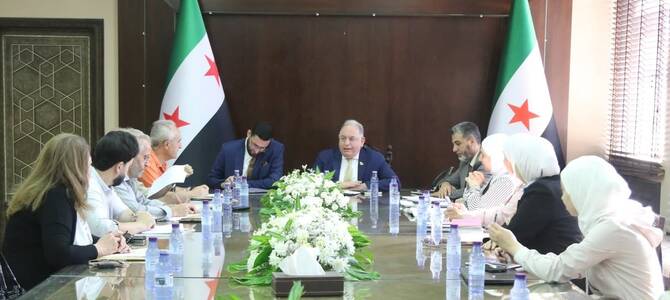
Syrian Finance Minister Yisr Barnieh attends a committee meeting on drafting a legislative framework for state-owned economic enterprises with senior officials and industry representatives. Facebook
Short Url
Updated 15 September 2025
Follow

Syria targets $2bn in budget revenues from state-owned firms

RIYADH: Syria plans for state-owned economic enterprises to contribute over $2 billion per annum to the national budget within the next two to three years, the country’s finance minister revealed.

In a post on Facebook, Yisr Barnieh explained that the aim is for these companies to be overseen by boards primarily composed of independent experts, rather than government officials serving due to their public sector roles.

The ambition comes as Syria enters a new economic era, helped by the US lifting key economic sanctions on the country, which is expected to prompt large-scale financial flows, trade normalization, and reintegration into global markets.

The country’s economy was severely damaged by 14 years of conflict, with gross domestic product shrinking by over 50 percent since 2010 and gross national income per capita dropping to only $830 in 2024 — significantly below the global low-income benchmark.

While the Syrian economy is expected to grow by 1 percent in 2025, according to a World Bank report released in July, it still faces continued security challenges, liquidity constraints, and suspended foreign assistance.

In his Facebook post, Barnieh said: “We seek to lay the legal foundation that will help us transform these institutions and companies (absolute generalizations are not permissible) from loss-making companies in rigid, bureaucratic molds plagued by corruption, mismanagement, and waste of public resources, into successful, efficient, competitive companies that serve development.”

He added: “These companies are based on the highest levels of sound and disciplined governance and are provided with the independence, capabilities, tools, and incentives that enable them to grow through specialized, professional management— management built on experience, professionalism, and integrity, not favoritism.” 

The comments came amid a meeting of a committee tasked with developing a legislative framework to regulate and enhance the work of government-owned economic companies.

“Our goal in developing a law regulating the work of government-owned economic companies is not to improve or update the existing systems for managing these institutions and companies. No, our goal is much deeper and more profound than that. Our goal is a radical, far-reaching change in the philosophy of managing and operating these companies,” Barnieh said. 

The newly formed government has begun implementing steps to align the country’s macroeconomic, fiscal, and monetary policies, emphasizing transparent public fund management and prudent fiscal and monetary practices. It is also working to attract essential foreign investment and secure aid pledges to aid in economic recovery.


Closing Bell: Saudi main index slips to close at 10,588 

Updated 14 December 2025
Follow

Closing Bell: Saudi main index slips to close at 10,588 

RIYADH: Saudi Arabia’s Tadawul All Share Index slipped on Sunday, losing 127.15 points, or 1.19 percent, to close at 10,588.83. 

The total trading turnover of the benchmark index was SR2.57 billion ($685 million), as 28 of the stocks advanced and 232 retreated.    

Similarly, the Kingdom’s parallel market Nomu lost 108.53 points, or 0.46 percent, to close at 23,719.13. This comes as 22 of the stocks advanced while 47 retreated.    

The MSCI Tadawul Index lost 17.17 points, or 1.22 percent, to close at 1,393.34.     

The best-performing stock of the day was Sport Clubs Co., whose share price surged 3.69 percent to SR9.00.   

Other top performers included Flynas Co., whose share price rose 2.55 percent to SR72.30, as well as National Industrialization Co., whose share price surged 2.13 percent to SR10.09. 

Consolidated Grunenfelder Saady Holding Co. recorded the most significant drop, falling 6.61 percent to SR8.90. 

Sustained Infrastructure Holding Co. also saw its stock prices fall 5.75 percent to SR30.82. 

CHUBB Arabia Cooperative Insurance Co. also saw its stock prices decline 5.72 percent to SR22.40. 

On the announcements front, Wataniya Insurance Co. said it has received a notice of award for a one-year contract with Saudi National Bank to provide general insurance as well as protection and savings insurance services, in line with agreed terms and conditions. 

According to a Tadawul statement, coverage will begin on Jan. 1, 2026. The contract value exceeds 15 percent of the company’s total revenues, based on its latest audited financial statements for 2024.  

Wataniya Insurance Co. ended the session at SR14.35, up 1.92 percent. 

Fawaz Abdulaziz Alhokair Co., or Cenomi Retail, has announced executing a SR1.5 billion facility agreement structured as a short-term loan with Emirates NBD – Kingdom of Saudi Arabia. A bourse filing revealed that the financing duration is three years with an option to extend for a total of two years. 

Cenomi Retail ended the session at SR20.00, up 0.26 percent. 

First Milling Co. has announced the Board of Directors’ recommendation to amend the firm’s bylaws Article “Company Management” to increase the number of board members from seven to eight. This change reflects the firm’s commitment to broadening the range of expertise and skills on its board, in line with its growth and expansion plans for the next phase. 

The company reiterated its commitment to fulfilling all necessary procedures and obtaining approvals from the relevant authorities. The recommendation will be submitted to the upcoming General Assembly, with the date to be announced in due course. 

First Milling Co. ended the session at SR49.22, down 1.06 percent.