

Pakistan’s Sindh wary of high flood level at Guddu as Punjab death toll hits 104

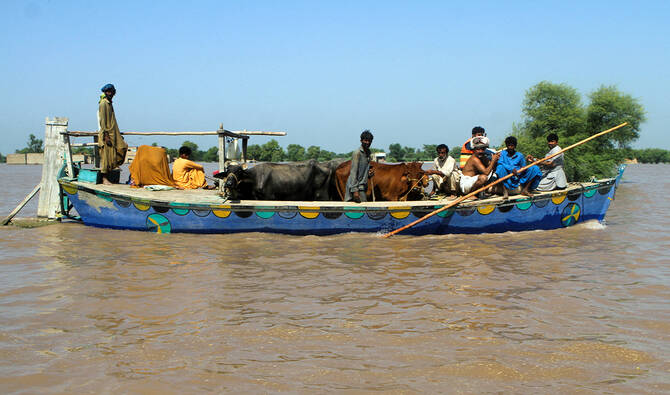
Residents travel with their cattle in a boat as they evacuate a flooded area following monsoon rains and rising water levels of the Chenab River in Muzaffargarh District of Punjab province, Pakistan, on September 13, 2025. (Reuters)
Short Url
Updated 14 September 2025
Follow

Pakistan’s Sindh wary of high flood level at Guddu as Punjab death toll hits 104

  • Sindh Information Minister Sharjeel Memon says provincial government keeping close watch on water levels at barrages
  • Total number of people relocated to safer areas in Sindh has reached 163,364, while 84,118 patient treated at medical camps

ISLAMABAD/KARACHI: Pakistan’s southern Sindh province remained wary of a high flood level at Guddu Barrage on Sunday, as the death toll from rains and deluges in Punjab since late August reached 104, the provincial disaster management authority (PDMA) said. 

Floods in Pakistan’s eastern Punjab province since late August have wreaked havoc by affecting more than 4.5 million people and inundating over 4,700 settlements. Heavy monsoon rains and excess water released by Indian dams have caused rivers Ravi, Chenab and Sutlej in Punjab to swell and overflow downstream, raising the risks of catastrophic floods in Sindh. 

The Punjab Disaster Management Authority (PDMA) has said that while a fresh spell of monsoon rains across the upper catchment of the country’s major rivers was expected next week from Sept. 16-19, Director General PDMA Irfan Ali Kathia said on Saturday that the water level in Punjab’s rivers is expected to decrease in the next 48 hours.  

Sindh Information Minister Sharjeel Inam Memon said the provincial government is keeping a close watch on the water levels at the province’s barrages, saying authorities were carrying out relief and rescue operations there. 

“There is a high-level flood at Guddu Barrage and a medium-level flood at Sukkur Barrage,” Memon was quoted as saying by the provincial information ministry. 

Guddu and Sukkur barrages are the two main structures that channel water into central and southern Sindh. Memon said the upstream flow of water at Guddu Barrage has been recorded at 612,269 cusecs and the downstream flow at 582,942 cusecs. The barrage is designed to hold up to 1.1 million cusecs of water. 

At Sukkur Barrage, the upstream flow has been recorded at 488,820 cusecs and the downstream flow at 438,390 cusecs, the minister added. 

Memon said the total number of people relocated to safer areas in Sindh has reached 163,364, adding that the number of people in relief camps has climbed to 469.

He said the provincial government has set up 177 fixed and mobile health sites, where 6,596 patients were treated in the past 24 hours. So far, a total of 84,118 patients have been provided with medical facilities while the number of livestock relocated to safer areas has reached 438,835.

Meanwhile, in Punjab, the PDMA shared that water levels were on the decline at most points in river Chenab. Water flows at Marala, Khanki, Qadirabad and Chiniot bridge were all recorded at steady levels while at Trimmu Headworks, one of the river’s major control points, the water level was recorded at 84,756 cusecs at a falling level.

River Ravi also showed receding levels of water, with Jassar, Ravi Syphon, Shahdara and Balloki water levels all recorded at steady levels. Further downstream, at Panjnad, where the Ravi, Chenab and Sutlej converge before meeting the Indus, flows were recorded at 402,919 cusecs. 

Nationwide, the death toll from rain-related incidents since Jun. 26 has reached 972, with the highest number of casualties reported from the northwestern Khyber Pakhtunkhwa (KP) province, 504.

IMF ASSESSING FLOOD DAMAGES

Meanwhile, as Pakistan reels from the floods, a top International Monetary Fund (IMF) official in Pakistan said on Saturday his organization is assessing damages caused by the deluges and will use its next review mission to evaluate appropriate policy responses to support affected people and strengthen national resilience.

“We extend our heartfelt condolences to the people of Pakistan as they endure the devastating floods,” said Mahir Binici, Resident Representative of the IMF in Pakistan. “We are deeply saddened by the tragic loss of life.”

“An assessment of the flood damage caused by torrential monsoon rains is still ongoing, as the situation continues to evolve,” he continued.
 “The upcoming EFF review mission provides an opportunity to discuss the appropriate policy response to support flood-affected populations and protect the most vulnerable.”

Binici also noted that both the EFF and the IMF’s Resilience and Sustainability Facility (RSF) provide frameworks crucial for external and financial stability amid these natural calamities.

The RSF, approved in May, offers Pakistan around $1.4 billion to help build economic resilience against climate vulnerabilities and disasters, though its disbursement depends on successful reviews under the EFF.

Separately, Prime Minister Shehbaz Sharif announced immediate relief for households in flood-hit districts, ordering power distribution companies to suspend collection of August electricity bills and adjust any payments already received in the next billing cycle.


Zimbabwe surprise as T20 World Cup Super Eights begin without Australia

Updated 20 February 2026
Follow

Zimbabwe surprise as T20 World Cup Super Eights begin without Australia

  • Pakistan and New Zealand will clash in Colombo on Saturday as the second “Super Eights” phase of the T20 World Cup kicks off
  • India carry hopes of millions of cricket-obsessed fans of winning back-to-back T20 World Cups and lifting the trophy on home soil

Kolkata: Pakistan and New Zealand will clash in Colombo on Saturday as the second “Super Eights” phase of the T20 World Cup kicks off without former champions Australia, who shockingly failed to make it out of their group.

Instead, surprise packages Zimbabwe, who did not even qualify in 2024, topped Group B after a stunning unbeaten campaign where they not only beat Australia but also co-hosts Sri Lanka.

An injury-depleted Australia endured a chaotic campaign and failed to make the second phase of the T20 World Cup for the first time since 2009.

Australia’s acerbic media did not hold back in their criticism, citing selection “stuff-ups” and “shambolic” preparations, including a 3-0 pre-tournament series loss in Pakistan, for the embarrassment.

Australia coach Andrew McDonald admitted his players were “devastated” but any inquest into the failure would only begin “when we exit the shores here.”

India, the world number one-ranked T20 side, are hot favorites to retain their crown on home soil.

However, in the second round they face a tough rematch of the 2024 final against an in-form South Africa in Ahmedabad at a packed 130,000-capacity Narendra Modi stadium on Sunday.

Both teams came through the first round phase with four wins from four.

India are on a 12-match unbeaten run at the T20 World Cup, stretching back to their defeat in the semifinal against eventual winners England in 2022.

No team has won back-to-back T20 World Cups or lifted the trophy on home soil, and India have the hopes of hundreds of million of cricket-obsessed fans on their shoulders.

But India have not been consistent and have a problem at the top of the order with their number one-ranked batter Abhishek Sharma recording three consecutive ducks.

Their batting has looked shaky and India were 77-6 against the United States before coming through to win.

Also in Super Eights Group 1 are Zimbabwe and the West Indies, who meet in Mumbai on Monday, with all that group’s games being hosted in India.

ENGLAND YET TO FIRE

The West Indies toppled England convincingly in the group phase and the two-time champions have all-round strength in depth.

They won the T20 World Cup the last time it was hosted in India, in 2016, and have started in clinical fashion, winning all four group games.

They will be extremely wary of Zimbabwe, whose colorful band of traveling supporters have had plenty to cheer so far. Even a washout against Ireland could not dampen their spirits.

In Sri Lanka, Group 2 pits the co-hosts against England, Pakistan and New Zealand.

The top two from each group will advance to the semifinals.

Pakistan were the last team to secure their berth. They did so by beating Namibia by 102 runs, with captain Salman Agha calling it a “complete performance” as they bounced back from a group defeat to bitter rivals India.

Another pre-tournament fancy, England stumbled through their group matches in Mumbai and Kolkata, losing to the only Test-playing side they faced, the West Indies.

Harry Brook’s side were unconvincing in wins against minnows Nepal, Scotland and finally Italy, who were making their World Cup debut.

But they return to a happy hunting ground in Kandy to face Sri Lanka on Sunday at a venue where England swept a T20 series 3-0 this month, with Sam Curran taking a hat-trick along the way.

Their top order needs to find form, with explosive openers Jos Buttler and Phil Salt yet to make a telling score and Brook failing to fire.

Sri Lanka have also been hot and cold.

Pathum Nissanka scored a superb century on Monday to all but end Australia’s tournament.

But they lost to Zimbabwe in their final group game, although Nissanka was in the runs again with 62.