A federal judge ruled on Friday that US President Donald Trump’s administration had unlawfully directed the firing of thousands of federal workers, but the judge did not order their reinstatement, citing recent US Supreme Court decisions.
US District Judge William Alsup in San Francisco stuck by his preliminary conclusion in the case that the US Office of Personnel Management in February unlawfully ordered numerous agencies to fire probationary employees en masse.
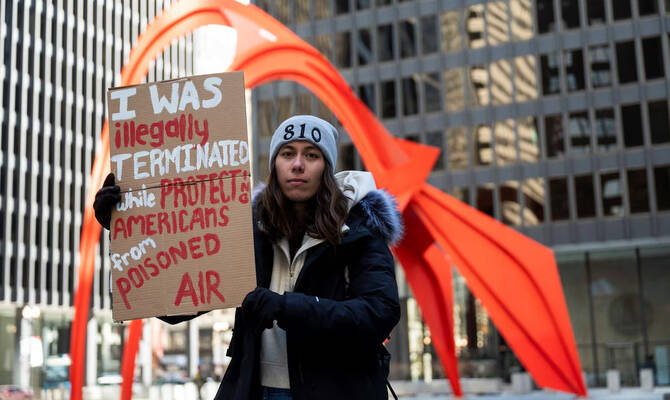
Unions, nonprofits and Washington State sued after Trump’s administration moved to fire roughly 25,000 probationary employees, who typically have less than a year of service, though some are longtime workers in new jobs.
Alsup said ordinarily he would “set aside OPM’s unlawful directive and unwind its consequences, returning the parties to the ex ante status quo, and as a consequence, probationers to their posts.”
“But the Supreme Court has made clear enough by way of its emergency docket that it will overrule judicially granted relief respecting hirings and firings within the executive, not just in this case but in others,” Alsup wrote.
In April, the Supreme Court paused a preliminary injunction Alsup issued in the case requiring six agencies to reinstate 17,000 employees while the litigation moved forward.
Alsup said too much had happened since the Supreme Court’s April decision for him to order employees to be reinstated now, as many had gotten new jobs while the administration transformed the government.
But Alsup, an appointee of Democratic President Bill Clinton, said the workers “nevertheless continue to be harmed by OPM’s pretextual termination ‘for performance,’ and that harm can be redressed without reinstatement.”
He ordered 19 agencies, including the US Departments of Defense, Veterans Affairs, Agriculture, Energy, Interior and Treasury, to update the employees’ files by November 14 and barred them from following OPM directives to fire workers.
Everett Kelley, the American Federation of Government Employees’ national president, in a statement said Alsup’s ruling “makes clear that thousands of probationary workers were wrongfully fired, exposes the sham record the government relied upon, and requires the government to tell the wrongly terminated employees that OPM’s reasoning for firing them was false.”
The White House did not respond to a request for comment on Saturday.


![]()

Trump administration unlawfully directed mass US worker terminations, judge rules
Short Url
https://arab.news/83jzz
Trump administration unlawfully directed mass US worker terminations, judge rules
- Unions, nonprofits and Washington State sued after Trump’s administration moved to fire roughly 25,000 probationary employees, who typically have less than a year of service, though some are longtime workers in new jobs


Latest updates




© 2026 SAUDI RESEARCH & PUBLISHING COMPANY, All Rights Reserved And subject to Terms of Use Agreement.