

Ukraine hits one of Russia’s largest oil refining complexes

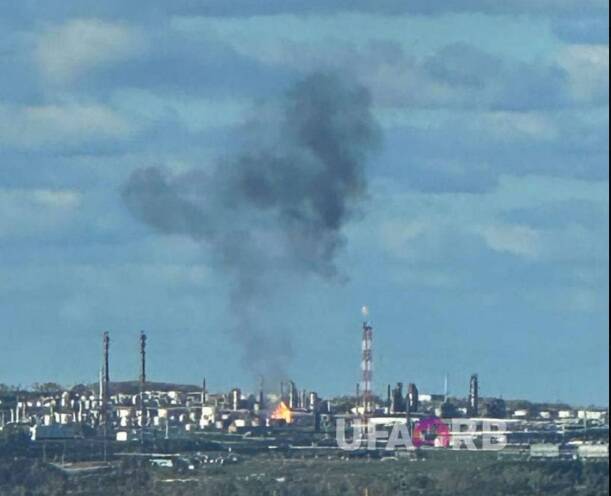
A Ukrainian drone crashed into one of Russia's largest oil refining complexes on Saturday, sparking a fire and causing minor damage, a Russian official said. (X/@evgen1232007)
Short Url
Updated 14 September 2025
Follow

Ukraine hits one of Russia’s largest oil refining complexes

  • Videos posted on social media appeared to show a drone drifting toward the facility before exploding in a ball of flames
  • “Bashneft’s facility was subjected to a terrorist attack by aircraft-type drones,” Khabirov said

MOSCOW: A Ukrainian drone crashed into one of Russia’s largest oil refining complexes on Saturday, sparking a fire and causing minor damage, a Russian official said.
The complex, which belongs to Russian oil company Bashneft, lies on the outskirts of the central Russian city of Ufa around 1,400 kilometers (870 miles) from the front line in Ukraine.
Videos posted on social media appeared to show a drone drifting toward the facility before exploding in a ball of flames, sending a cloud of smoke into the sky.


“Today, Bashneft’s facility was subjected to a terrorist attack by aircraft-type drones,” the head of Russia’s Bashkortostan region, Radiy Khabirov, said on Telegram.
One drone crashed into the plant, while another was shot down, he said.
“There were no casualties or injuries. The production site sustained minor damage, and a fire broke out, which is currently being extinguished,” he added.
Since Moscow launched its full-scale military offensive in Ukraine in February 2022, Kyiv has responded with attacks on Russian refineries in an attempt to curb the Kremlin’s ability to fund the conflict.
A wave of Ukrainian attacks on Russian refineries over the summer hit processing capacity at several key sites and pushed fuel prices up at the pump.
The Kremlin described Bashneft’s Ufa refining complex in 2016 as “one of the largest in the country,” saying it produced more than 150 types of oil products.


Trump expands travel ban, adding 5 more countries and imposing new limits on others

Updated 6 sec ago
Follow

Trump expands travel ban, adding 5 more countries and imposing new limits on others

  • Nationals from Syria, South Sudan, Burkina Faso, Mali and Niger are banned from visiting the US
  • The White House also fully restricted travel on people with Palestinian-Authority-issued travel documents

WASHINGTON: The Trump administration is expanding its travel ban to include five more countries and impose new limits on others.
This move Tuesday is part of ongoing efforts to tighten US entry standards for travel and immigration. The decision follows the arrest of an Afghan national suspect in the shooting of two National Guard troops over Thanksgiving weekend.
In June, President Donald Trump announced that citizens of 12 countries would be banned from visiting the United States and those from seven others would face restrictions. The decision resurrected a hallmark policy of his first term.
At the time the ban included Afghanistan, Myanmar, Chad, the Republic of Congo, Equatorial Guinea, Eritrea, Haiti, Iran, Libya, Somalia, Sudan and Yemen and heightened restrictions on visitors from Burundi, Cuba, Laos, Sierra Leone, Togo, Turkmenistan and Venezuela.
On Tuesday, the Republican administration announced it was expanding the list of countries whose citizens are banned from entering the US to Burkina Faso, Mali, Niger, South Sudan and Syria. The administration also fully restricted travel on people with Palestinian-Authority-issued travel documents.
An additional 15 countries are also being added to the list of countries facing partial restrictions: Angola, Antigua and Barbuda, Benin, Côte d’Ivoire, Dominica, Gabon, Gambia, Malawi, Mauritania, Nigeria, Senegal, Tanzania, Tonga, Zambia and Zimbabwe.
The Trump administration said in its announcement of the expanded travel ban that many of the countries from which it was restricting travel had “widespread corruption, fraudulent or unreliable civil documents and criminal records” that made it difficult to vet their citizens for travel to the US. It also said some countries had high rates of people overstaying their visas, refused to take back their citizens who the US wished to deport or had a “general lack of stability and government control,” which made vetting difficult.
“The restrictions and limitations imposed by the Proclamation are necessary to prevent the entry of foreign nationals about whom the United States lacks sufficient information to assess the risks they pose, garner cooperation from foreign governments, enforce our immigration laws, and advance other important foreign policy, national security, and counterterrorism objectives,” reads the White House proclamation announcing the changes.
The Afghan man accused of shooting the two National Guard troops near the White House has pleaded not guilty to murder and assault charges.