WASHINGTON: US President Donald Trump said Saturday he was ready to sanction Moscow, but on the condition that all NATO allies agree to completely halt purchases of Russian oil and implement their own sanctions.
He also suggested members of the transatlantic alliance consider slapping tariffs of 50 percent to 100 percent on China as a way to help end Russia’s war in Ukraine.
“I am ready to do major Sanctions on Russia when all NATO Nations have agreed, and started, to do the same thing, and when all NATO Nations STOP BUYING OIL FROM RUSSIA,” Trump said in a post on his Truth Social platform, which he described as a letter to all NATO nations and the world.
Trump has repeatedly threatened Russia with additional sanctions — including last weekend after the Kremlin unleashed its biggest-ever aerial barrage against Ukraine — as a way to hit at revenue Moscow needs for its grinding war.
But so far he has failed to follow through, frustrating Kyiv.
The president, who met his Russian counterpart Vladimir Putin last month at a summit in Alaska, branded NATO nations’ purchase of Russian oil “shocking” and said it weakens their bargaining power over Moscow.
“Anyway, I am ready to ‘go’ when you are. Just say when?“
Trump also raised the prospect of NATO imposing tariffs on China, which is believed to have boosted strategic cooperation with Moscow and held a high-profile summit with Putin recently in Beijing.
“I believe that (NATO sanctions on Russia), plus NATO, as a group, placing 50 percent to 100 percent TARIFFS ON CHINA, to be fully withdrawn after the WAR with Russia and Ukraine is ended, will also be of great help in ENDING this deadly, but RIDICULOUS, WAR,” Trump said.
“China has a strong control, and even grip, over Russia, and these powerful Tariffs will break that grip.”
If the 32-member alliance “does as I say, the WAR will end quickly,” Trump said. “If not, you are just wasting my time.”

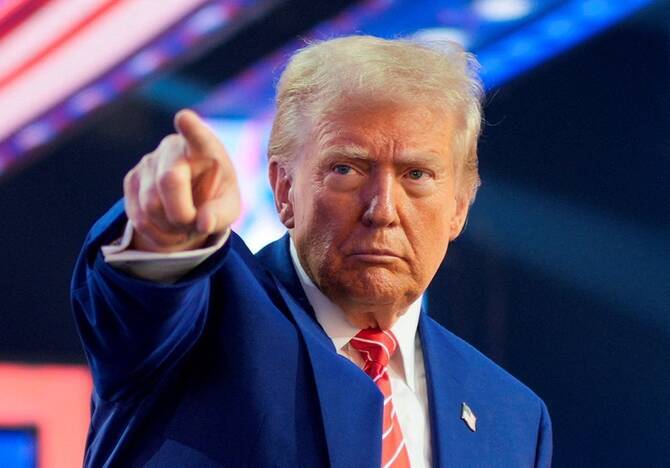
Trump demands NATO halt Russia oil purchases before US sanctions
https://arab.news/p8mpx
Trump demands NATO halt Russia oil purchases before US sanctions
- He also suggested members of the transatlantic alliance consider slapping tariffs of 50 percent to 100 percent on China as a way to help end Russia’s war in Ukraine
- “I am ready to do major Sanctions on Russia when all NATO Nations have agreed, and started, to do the same thing,” Trump said
Modi starts Mideast-Africa tour as India-Oman free-trade pact nears completion
- Oman’s Shoura Council approved the trade deal’s draft last week
- Modi begins trip in Amman, heading to Addis Ababa and Muscat
NEW DELHI: Prime Minister Narendra Modi left New Delhi on Monday for a tour covering Jordan, Oman and Ethiopia, as his government looks to strengthen partnerships with West Asia and Africa and finalize a free-trade deal with Muscat.
Modi’s four-day trip will start in Amman, at the invitation of King Abdullah.
“I am sure this visit will boost bilateral linkages between our nations,” Modi said on social media upon his arrival in Jordan, where he was received by Prime Minister Jafar Hassan.
On Tuesday, he is scheduled to arrive in Addis Ababa for his first state visit to Ethiopia. A day later, he will be in Muscat, where the Shoura Council last week approved the draft Comprehensive Economic Partnership Agreement with India.
“If it is signed during this visit, it will significantly deepen the economic ties between India and Oman. And it will open up a new chapter in the history of India-Oman trade and commercial relationship,” Ministry of External Affairs Secretary Arun Chatterjee told reporters ahead of Modi’s departure.
He said Modi would be accompanied by a high-level delegation for his second visit to Oman, after his last trip in February 2018. It also follows the visit of Oman’s Sultan Haitham bin Tariq to India in December 2023.
Free-trade negotiations between India and Oman began in November 2023, with the first round in New Delhi and the second in Muscat.
When the talks concluded in March 2024, Oman sought revisions on market-access terms and the final signature was postponed.
Announcements of the deal’s possible finalization have been made in the past few months by India’s Commerce and Industry Minister Piyush Goyal and the Omani ambassador to New Delhi, Issa Saleh Al-Shibani.
It would be its second with a GCC country after a 2022 trade deal with the UAE, as India has been trying to reach a similar agreement with the whole bloc.
“The framework is expected to be the same as the UAE’s, that is, a Comprehensive Economic Partnership Agreement. This is significant given that the progress on India-GCC FTA has been slow and non-consequential so far,” said Muddassir Quamar, associate professor at the School of International Studies, Jawaharlal Nehru University.
While Oman is one of Delhi’s smaller GCC trading partners — trailing behind the UAE and Saudi Arabia, with bilateral trade about $10 billion — it remains strategically important, particularly in energy and logistics.
“The FTA is likely to give a boost to India-Oman economic and trade relations, especially of goods and services. (It is) important given India has worked to enhance its trade and economic relations with the Gulf countries that are (among) the most dynamic and fast-expanding global economies,” Quamar told Arab News.
“It is also important because there is immense potential for Indian businesses and industries to partner with their Gulf and Omani partners in contributing to the diversification and economic growth plans.”


