

Pakistan pledges to stand with Qatar after Israeli strikes target Hamas leaders in Doha

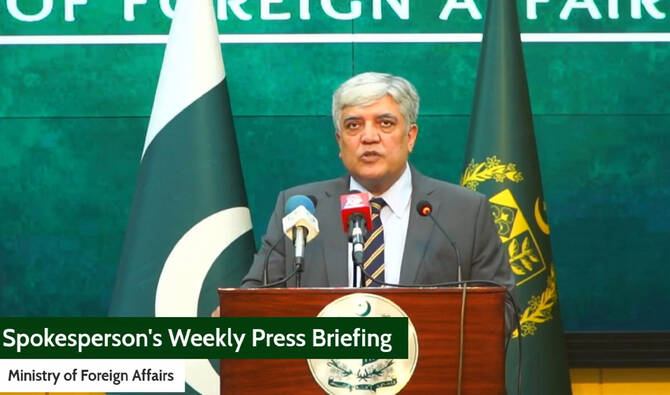
The screengrab taken from a video of Pakistan’s Ministry of Foreign Affairs shows the foreign office’s spokesperson, Shafqat Ali Khan, addressing the weekly media briefing in Islamabad on September 12, 2025. (MOFA)
Short Url
Updated 12 September 2025
Follow

Pakistan pledges to stand with Qatar after Israeli strikes target Hamas leaders in Doha

  • Israel attempted to kill Hamas political leaders with the attack in Doha, which has been mediating a ceasefire in Gaza
  • Islamabad earlier called on the United Nations Security Council to hold Israel accountable for its ‘unprovoked aggression’

ISLAMABAD: Pakistan on Friday pledged its support to Qatar for the defense of its sovereignty after this week’s Israeli airstrikes targeted Hamas leaders in Doha, raising alarm about a potential military escalation in an already volatile region.

Israel attempted to kill the political leaders of Hamas with the attack on Tuesday, in what the United States (US) described as a unilateral attack that does not advance American and Israeli interests.

The United Nations Security Council (UNSC) condemned the strikes, but did not mention Israel in a statement agreed to by all 15 members at an emergency meeting summoned at the request of Algeria, Pakistan and Somalia.

On Thursday, Pakistan Prime Minister Shehbaz Sharif met with Qatar’s Emir Sheikh Tamim bin Hamad Al-Thani in Doha to stress Muslim unity as the Gulf country called for a collective regional response to Israeli airstrikes.

“The Prime Minister conveyed Pakistan’s strongest condemnation of the Israeli attack on Doha on September 9, terming it a blatant and flagrant violation of Qatar’s sovereignty and territorial integrity,” Shafqat Ali Khan, a spokesperson for the Pakistani foreign office, told reporters in Islamabad.

“Pakistan will continue to stand shoulder to shoulder with the brotherly people and the leadership of Qatar in defense of their national sovereignty and security.”

Khan said the leadership and people of Pakistan were deeply disturbed by this attack.

“The Prime Minister emphasized that Israel’s present aggression in the Middle East must be stopped and the Ummah needed unity among its ranks in the face of Israeli provocations,” he said.

“The Prime Minister appreciated Qatar’s responsible, constructive and mediatory role in efforts to bring peace in Gaza and stressed that such acts of Israeli aggression were clearly meant to undermine regional stability and threaten ongoing diplomatic and humanitarian efforts.”

Qatar has been hosting and mediating in negotiations aimed at securing a ceasefire in the Gaza war.

Speaking at the UNSC, Qatari Prime Minister Sheikh Mohammed bin Abdulrahman Al-Thani accused Israel of trying to derail efforts to end the war in Gaza, which has killed over 64,000 Palestinians since Oct. 2023, by attacking Hamas leaders in Doha, but pledged to continue its mediation efforts.

Pakistan’s permanent representative to the UN, Ambassador Asim Iftikhar Ahmad, said at a time when delicate negotiations on Gaza peace deal were progressing toward a possible breakthrough, striking the territory of a principal mediator and those directly involved in negotiations is a deliberate attempt to “sabotage diplomacy, derail peace efforts, and prolong the suffering of civilians.”

“It is evident, that Israel, the occupying power, is bent on doing everything to undermine and blow-up every possibility of peace,” he said. “Israel’s destructive policies are incompatible with the international community’s quest for peace and stability. Sadly, it has been emboldened by the weak response, and inaction by this Council.”

He called on the UNSC to hold Israel accountable for its “unprovoked aggression.”

“The Council must go beyond; must hold Israel accountable; safeguard the role and protection of mediators engaged in peace efforts; and recommit to the centrality of international law and the UN Charter in maintaining international peace and security,” Ahmad added.


Pakistan, global crypto exchange discuss modernizing digital payments, creating job prospects 

Updated 05 December 2025
Follow

Pakistan, global crypto exchange discuss modernizing digital payments, creating job prospects 

  • Pakistani officials, Binance team discuss coordination between Islamabad, local banks and global exchanges
  • Pakistan has attempted to tap into growing crypto market to curb illicit transactions, improve oversight

ISLAMABAD: Pakistan’s finance officials and the team of a global cryptocurrency exchange on Friday held discussions aimed at modernizing the country’s digital payments system and building local talent pipelines to meet rising demand for blockchain and Web3 skills, the finance ministry said.

The development took place during a high-level meeting between Finance Minister Muhammad Aurangzeb, Pakistan Virtual Assets Regulatory Authority (PVARA) Chairman Bilal bin Saqib, domestic bank presidents and a Binance team led by Global CEO Richard Teng. The meeting was held to advance work on Pakistan’s National Digital Asset Framework, a regulatory setup to govern Pakistan’s digital assets.

Pakistan has been moving to regulate its fast-growing crypto and digital assets market by bringing virtual asset service providers (VASPs) under a formal licensing regime. Officials say the push is aimed at curbing illicit transactions, improving oversight, and encouraging innovation in blockchain-based financial services.

“Participants reviewed opportunities to modernize Pakistan’s digital payments landscape, noting that blockchain-based systems could significantly reduce costs from the country’s $38 billion annual remittance flows,” the finance ministry said in a statement. 

“Discussions also emphasized building local talent pipelines to meet rising global demand for blockchain and Web3 skills, creating high-value employment prospects for Pakistani youth.”

Blockchain is a type of digital database that is shared, transparent and tamper-resistant. Instead of being stored on one computer, the data is kept on a distributed network of computers, making it very hard to alter or hack.

Web3 refers to the next generation of the Internet built using blockchain, focusing on giving users more control over their data, identity and digital assets rather than big tech companies controlling it.

Participants of the meeting also discussed sovereign debt tokenization, which is the process of converting a country’s debt such as government bonds, into digital tokens on a blockchain, the ministry said. 

Aurangzeb called for close coordination between the government, domestic banks and global exchanges to modernize Pakistan’s payment landscape.

Participants of the meeting also discussed considering a “time-bound amnesty” to encourage users to move assets onto regulated platforms, stressing the need for stronger verifications and a risk-mitigation system.

Pakistan has attempted in recent months to tap into the country’s growing crypto market, crack down on money laundering and terror financing, and promote responsible innovation — a move analysts say could bring an estimated $25 billion in virtual assets into the tax net.

In September, Islamabad invited international crypto exchanges and other VASPs to apply for licenses to operate in the country, a step aimed at formalizing and regulating its fast-growing digital market.