

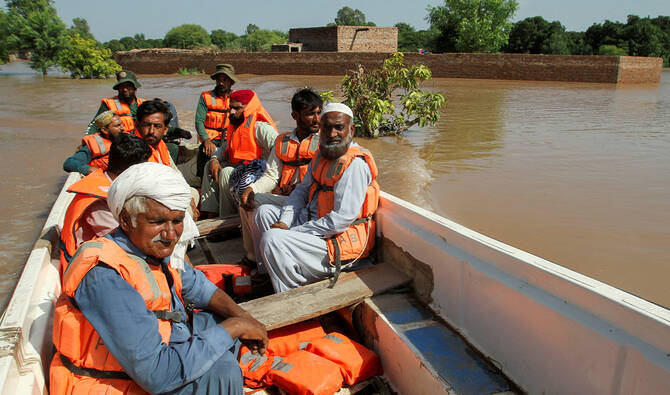

ISLAMABAD: At least nine people were killed after a boat capsized near the historic Multan city in Pakistan eastern Punjab province, the provincial disaster management authority said on Friday, as floodwaters continued to move southwards threatening the Sindh province.
Punjab, home to more than half of the country’s 240 million people and its main farming belt, has been devastated since record monsoon rains and India’s release of excess water swelled the Ravi, Chenab and Sutlej rivers in late August, killing 97 people and submerging over two million acres of farmland.
The deluges have affected more than 4,500 villages and over 4.4 million people, according to Punjab Relief Commissioner Punjab Nabeel Javed. Rescuers have so far transported 2.4 million people and 19.1 million livestock to relief camps after rescuing them from marooned villages in several districts.
A rescue boat this week capsized during a similar operation near Multan in southern Punjab, where the three rivers have been flowing in high floods after leaving a trail of destruction in northern and central districts of the country’s breadbasket province.
“The boat was transporting 25 people to safety when it capsized near Jalal Pur Pirwala,” PDMA spokesperson Mazhar Hussain told Arab News. “Nine people lost their lives in the incident.”
The development came as the inflow of water was recorded 69,812 cusecs in Ravi river at Sidhnai, 96,598 cusecs in Sutlej at Islam headworks and 665,576 cusecs at Panjnad headworks at the confluence of Sutlej and Chenab in Bahawalpur from where the water heads toward the Indus river in Sindh that empties in the Arabian Sea.
Provincial authorities in Sindh were busy evacuating people and livestock from riverine areas in the province, following a Flood Forecasting Division’s warning of a “very high” flood level in the Indus in the next 24 hours.
On Friday, Bilawal Bhutto-Zardari, a former foreign minister and head of the ruling Pakistan Peoples Party (PPP) in Sindh, lamented a delay by the central government in issuing an international appeal for assistance.
“The delay by the government to initiate their international appeal for assistance through UN mechanisms is beyond comprehension. This is standard practice for disasters of this scale internationally,” he said on X.
“Countries all over the world do the same within the first 72 hours of such disasters. There is no excuse to cut of the millions affected from this assistance. We demand the government initiate this process immediately.”
The United Nations has already allocated $5 million from its Central Emergency Response Fund (CERF) to support Pakistan’s response efforts to the ongoing devastating floods, UN Secretary General’s spokesperson Stéphane Dujarric said this week.
Monsoon season brings Pakistan up to 80 percent of its annual rainfall, but increasingly erratic and extreme weather patterns are turning the annual rains, which are vital for agriculture, food security and the livelihoods of millions of farmers, into a destructive force.
Rains, floods, landslides and similar incidents have killed at least 946 people nationwide since June 26, according to the National Disaster Management Authority (NDMA). The disaster has revived memories of the 2022 deluges, when a third of the country was submerged, over 1,700 people were killed and losses exceeded $35 billion.
The NDMA has warned the ongoing spell of monsoon rains, the last of this season, is likely to continue for another two days.
Prime Minister Shehbaz Sharif on Thursday directed the climate change ministry draft a 300-day plan within 15 days to mitigate risks from monsoon rains and melting glaciers, state media reported.
Climate Change Minister Musadik Malik said the plan would include preventive measures aimed at reducing losses from the next year’s monsoon season.
“We must act within our own resources, with the support of our civil administration, welfare institutions, and armed forces to safeguard our children and communities,” the Associated Press of Pakistan (APP) news agency quoted Malik as saying.
“This is not unique to Pakistan. The entire world is changing, and all nations must wake up to this reality.”


