

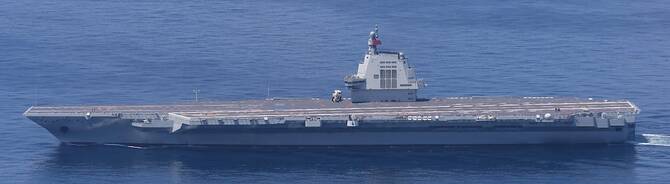

BEIING: China said on Friday that its third and newest aircraft carrier, the Fujian, recently sailed through the sensitive Taiwan Strait to carry out “scientific research trials and training missions” in the South China Sea.
Beijing has ploughed billions of dollars into modernizing its military in recent years, a trend that has unnerved some governments in East Asia despite China insisting its aims are peaceful.
China has two carriers in operation – the Liaoning and Shandong – with the Fujian currently undergoing sea trials.
China’s navy said on Friday that undertaking cross-regional trials “is a normal part of the aircraft carrier’s construction process”.
It is “not directed at any specific target”, a spokesman for the Chinese navy, Leng Guowei, said in a statement.
However, its transit through the sensitive Taiwan Strait was intended to signal “China’s rise as a strong military power, and beyond that, a maritime great power”, said Collin Koh, a senior fellow at the S. Rajaratnam School of International Studies in Singapore.
“It’s to flex China’s newfound military strength and send a veritable signal to potential adversaries,” he said.
Taiwan’s Ministry of National Defense said Friday it had used “joint intelligence, surveillance and reconnaissance means to fully grasp the situation and responded accordingly”.
Japan’s defense ministry said that on Thursday afternoon it had identified three Chinese naval ships advancing southwest in waters approximately 200 kilometers (124 miles) northwest of one of the disputed Senkaku Islands, known in Chinese as the Diaoyu Islands.
“Among these, the Fujian aircraft carrier was confirmed by the Japan Maritime Self-Defense Force for the first time,” it said in a statement.
Japan said in July that China’s intensifying military activities could “seriously impact” its security, citing the first confirmed incursion by a Chinese military aircraft into its airspace last August in an annual threat assessment.
China said that a coastguard fleet had “patrolled within the territorial waters of the Diaoyu Islands” on Friday.
Last year, Chinese vessels sailed near the Japanese-administered islands a record 355 times, according to Tokyo.
Expanding its reach
Compared to the other seas, the South China Sea “presents a more challenging environment with harsher conditions, making the trials more rigorous” for the Fujian, said Song Zhongping, a Chinese military commentator.
After undergoing sea trials and completing further adaptive training, the Fujian will likely be commissioned into active service, Song said.
The Soviet-built Liaoning is China’s oldest aircraft carrier, commissioned in 2012, while the Shandong entered service in 2019.
Analysts at Washington-based think tank CSIS have said the Fujian is expected to feature more advanced take-off systems, allowing the Chinese air force to deploy jets carrying larger payloads and more fuel.
China has stepped up a massive expansion of its naval forces in recent years as it seeks to grow its reach in the Pacific and challenge a US-led alliance.
The US Department of Defense said in a December report that China numerically has the largest navy in the world, with a battle force of more than 370 ships and submarines.
Beijing said in June that its Liaoning and Shandong carrier formations conducted combat drills in the western Pacific Ocean, unsettling regional neighbors including Japan.
A Taiwanese security official also said that month Beijing had deployed its two aircraft carrier groups around the island in May.
The Chinese Communist Party has refused to rule out using force to seize control of Taiwan, a democratic, self-ruled island that China insists is part of its territory.


