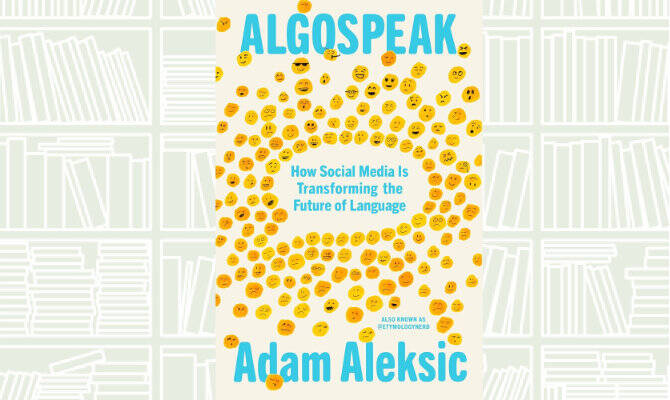
Book Review: ‘Algospeak: How Social Media is Transforming the Future of Language’

Short Url
Updated 03 December 2025
Follow

Book Review: ‘Algospeak: How Social Media is Transforming the Future of Language’

  • Adam Aleksic examines substitutions and coded phrases used online to bypass censorship, from PG-rated or silly alternatives to fruit emojis and dollar signs replacing letters

In “Algospeak: How Social Media is Transforming the Future of Language,” author Adam Aleksic explores how algorithms are reshaping the words we use and the ways in which we communicate.

Known online as “Etymology Nerd,” the Harvard-educated content creator, who co-founded and led the Harvard Undergraduate Linguistics Society, has been digging into word origins since 2016. He has built a wide audience with his bite-sized educational TikTok videos which explain where trending words come from and how they spread.

The term “algospeak” blends “algorithm” with a concept popularized by tech journalist and fellow book author Taylor Lorenz, describing how creators adapt language to avoid platform restrictions.

“Social media platforms want to promote the most compelling content possible so it makes sense that the words will reach us through maximally compelling mediums, like memes rather than something more serious. ‘Unalive’ is far more likely to spread today than boring traditional alternatives, such as ‘passed away’,” Aleksic writes.

The word “unalive” illustrates how online language quickly filters into offline spaces, from middle school classrooms to playgrounds, often boosted by memes. Aleksic notes: “Language and memes and metadata are one and the same, all of it shaping our vocabulary and identities.”

Fleeting words used by teens may sound like gibberish to adult ears, but they are still worthy of note even if they are merely trendy for a short amount of time, he argues. It helps us figure out who we are, what we are talking about and how we see ourselves — even if by the time you read this review, new words have come and gone.

Aleksic examines substitutions and coded phrases used online to bypass censorship, from PG-rated or silly alternatives to fruit emojis and dollar signs replacing letters.

This isn’t new. Teenagers have long softened words and code-switched in front of authority figures in everyday speech, but now these shifts are documented, amplified and collectively adopted online.

This chronically online generation uses the language to playfully and strategically avoid shadow banning or content removal — including in high-stakes contexts such as posts about the conflict in Gaza. It works.

This is not the death of language, Aleksic insists, but its evolution. Memes, emojis and subtle code words show how communities collectively and creatively innovate, creating words and phrases in real time while navigating the constraints of platforms. “Algospeak” reveals language as a living, evolving system, shaped by algorithms, culture and the people who use it.


Bollywood’s Aishwarya Rai Bachchan reflects on identity, women’s strength at RSIFF

Updated 59 min 37 sec ago
Follow

Bollywood’s Aishwarya Rai Bachchan reflects on identity, women’s strength at RSIFF

JEDDAH: Bollywood icon Aishwarya Rai Bachchan turned heads at the fifth Red Sea International Film Festival, entertaining the audience with candid reflections on her personal and professional journey.

At an In Conversation panel event in Jeddah, she began by reflecting on a time before her cinematic career, when she was crowned Miss World in 1994 — a moment that paved the way for her screen debut in Mani Ratnam’s 1997 Tamil film “Iruvar.”

 “I was encouraged by members of the media to represent India, and for me, the opportunity went far beyond the idea of a traditional beauty contest,” she said.

During her time on the international stage, she realized how little the world understood about her country.

“Standing as the only Indian contestant, I was asked questions about tigers, snake charmers and education systems that felt so archaic. It made me reflect on our global perception,” she said.

That awareness fueled her commitment to the “Beauty with a Purpose” ethos, and she used her platform to drive awareness, charitable efforts and long-term impact.

“I was just so glad that I got the opportunity to use that title as a larger platform to effect contribution and change,” she told the audience.

Her transition into cinema was guided by curiosity and humility. With no formal training, she embraced every role as a chance to learn, notably through her early collaboration with celebrated director Mani Ratnam: “I approached every character as a student of the craft.”

Emphasizing her preference for roles that explored complex female experiences, she added: “Women, by birth, are strong. They are the embodiment of strength, empowerment, beauty and femininity.”

This strength manifested itself in every role women played as daughters, mothers, friends and leaders, she said, and cinema offered the chance to bring those qualities to life on screen.

Rai Bachchan also discussed the power of audiences in shaping her journey and said: “The love and support I’ve received has been deeply personal. It’s given me strength and conviction throughout my career.”

The actress, who wore a striking black Dolce & Gabbana gown with a plunging V-neck, accessorized with an emerald and diamond pendant, also had some advice for younger generations on navigating social media wisely: “Stay real. Let validation come from within, not from screens,” she said.