UNSC to meet today on Israel’s strike in Qatar after Pakistan request

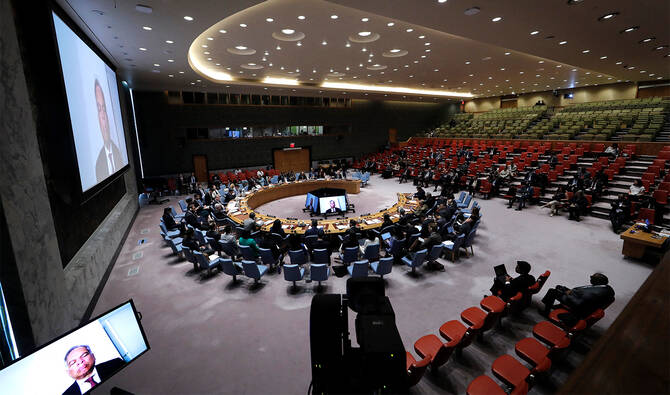
An overall view as the UN Security Council holds an emergency meeting on the situation in Gaza at United Nations headquarters on August 10, 2025 in New York. (AFP/File)
Short Url
Updated 11 September 2025
Follow

UNSC to meet today on Israel’s strike in Qatar after Pakistan request

  • Pakistan calls the attack a dangerous escalation and a threat to international peace
  • Qatar’s prime minister says Netanyahu’s action killed any hope of Gaza hostage release

ISLAMABAD: The United Nations Security Council will hold an emergency meeting today, Thursday, on Pakistan’s request to discuss Israeli airstrikes in Doha that killed at least six people, including a Qatari security officer, after Pakistan, Algeria and Somalia called for action.

Pakistan condemned Israel’s attack targeting a residential building in Doha that housed Hamas members discussing a Gaza ceasefire proposal floated by the American administration.

Qatar has been a key mediator in ceasefire and hostage negotiations between Israel and Hamas, hosting the group’s political bureau while engaging closely with Washington and Cairo. Israel’s strike has raised fears the Gulf state could scale back or reconsider its mediation role, further complicating efforts to halt the Gaza war.

“The UN Security Council is set to hold an emergency meeting on Thursday in response to Israel’s strikes targeting Hamas officials in Qatar, a Arabian Gulf Islamic country,” the state-owned Associated Press of Pakistan said.

It added the event was scheduled to be held at 3 p.m. New York time, which will be midnight in Pakistan.

Pakistan’s Deputy Prime Minister and Foreign Minister Ishaq Dar said in a statement on Wednesday the strikes were a “dangerous escalation in an already volatile region” and urged the Security Council to treat the assault as “a grave threat to international peace and security.”

Qatar’s Prime Minister Sheikh Mohammed bin Abdulrahman Al Thani said Israeli Prime Minister Benjamin Netanyahu had “killed any hope” of releasing hostages still held in the Gaza Strip after Israel attacked Hamas leaders in Doha.

Netanyahu acknowledged the attack, saying it was a “wholly independent Israeli operation” for which his government took “full responsibility.”

Pakistan’s Mahnoor Omer named among TIME’s ‘Women of the Year’ for 2026

Updated 01 March 2026
Follow

Pakistan’s Mahnoor Omer named among TIME’s ‘Women of the Year’ for 2026

  • Omer moved a Pakistani court against the so-called ‘period tax’ in Sept. 2025 which has since sparked a national debate
  • Taxes on sanitary pads in Pakistan can add up to 40 percent to retail price, UNICEF says only around 12 percent women use such products

ISLAMABAD: Pakistani women’s rights activist Mahnoor Omer, who fought against taxes on menstrual products, has been named among the TIME magazine’s ‘Women of the Year’ for 2026.

Omer’s efforts have been recognized alongside 16 activists, artists, athletes and businesswomen in the TIME’s Women of the Year 2026 list, including Olympic gold medalist Sydney McLaughlin-Levrone and Oscar-nominated filmmaker Chloe Zhao.

Dissatisfied with the efforts to educate Pakistani girls about sexual violence, Omer founded the Noor Foundation at the age of 14 and held her own workshops with village girls about everything from climate change to menstruation, according to the TIME magazine.

Two years later, a conversation with a domestic worker about the price of pads made her realize that not everyone could afford these essentials. She moved a court against the so-called “period tax” in Sept. 2025 and the case has sparked a national debate on the subject, considered a taboo by many in Pakistan, since its first hearing late last year.

“A decade and one law degree after her interest in activism was sparked, Omer, now 25, is putting her passion and expertise to work in the name of gender equity,” TIME wrote about Omer on its website.

Taxes imposed on sanitary products in Pakistan can add up to 40 percent to the retail price. UNICEF estimates just 12 percent of women in the country use commercially produced pads or tampons. The alternative, using cloth, risks health impacts including rashes and infections, and can make it impossible for girls to attend school while menstruating.

Omer’s suit, which awaits the government response, has sparked a national discussion. She says she spoke about menstruation to her father and male cousins, who thanked her for standing up for their daughters.
The 25-year-old, who is currently enrolled in a master’s degree in gender, peace, and security at the London School of Economics, sees this case as just the first of many.

“I’m not free until every woman is free,” she was quoted as saying by TIME. “I want to leave no stones unturned in terms of what I can do with the next few decades, as a lawyer for the women in my country and gender minorities in general.”