



BEIRUT: Six-year-old Omar Abu Kuwaik still believes that by his next birthday, his missing hand will have grown back.
He is one of thousands of Palestinian children who have lost limbs and loved ones in Israel’s bombing campaign of the Gaza Strip.
“It’ll be big again when I turn seven,” he tells his aunt, softly rubbing his left arm, which ends just below his elbow.
Omar was the lone survivor of an Israeli airstrike that flattened his grandparents’ home in Gaza in December 2023, killing his parents, sister and extended family.
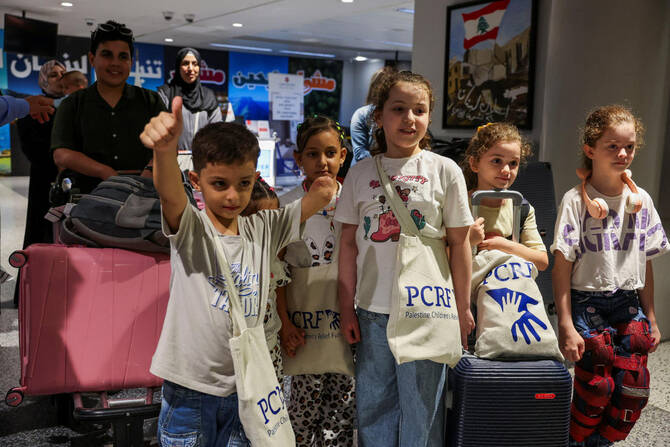
He is among a small group of Gazan families who arrived in the Lebanese capital Beirut earlier this month for medical treatment.
His aunt Maha Abu Kuwaik says he now calls her “mama.”
“He’s scared of everything now — sleep, doctors, any loud sound. He asks me not to be sad. ‘Smile, Mama,’ he says. ‘I don’t like it when people cry’,” she told Reuters, her voice cracking.
Omar was pulled from the rubble with severe burns, a shattered leg, and his left hand already severed by the blast.
With Gaza’s hospitals in ruins, Maha sought help from the World Health Organization, which helped evacuate Omar to Egypt for basic treatment before his transfer to Lebanon.
Maha had to leave her own children in Gaza to accompany Omar.
“It was the hardest decision of my life — to leave my sons in a war zone,” she said. “But Omar had no one else. I couldn’t leave him.”
Doctors in Beirut are now considering a prosthetic hand and reconstructive surgery for Omar.
’YOU’RE A HERO’
Fourteen-year-old Amir Hajjaj only remembers snapshots of the night his world changed: a red flash, an explosion, then silence.
“I was just sitting on a chair,” he said softly, “then everything turned red, and I was on the ground. I didn’t even know what happened.”
An Israeli strike hit his family’s home in northern Gaza in late 2023. Shrapnel pierced both his shoulders, his leg, and his hand. He bled for hours as Israeli tanks shelled their street during their escape, Amir’s older sister Alaa said.
“He kept saying, ‘Leave me, save yourselves’,” Alaa recalled. “But how could I leave him behind?“
Amir bled for four days in an overcrowded hospital. By the time doctors got to him, it was too late to save the fingers of his right hand.
He was evacuated to Cairo, where the Palestine Children’s Relief Fund later arranged for his transfer to Beirut. He is now awaiting nerve treatment and physiotherapy.
“He tries to hide his hand in photos. I tell him, ‘You’re a hero,’” Alaa told Reuters.
At least 45,000 children have been wounded in Gaza, many of them suffering life-changing injuries, according to the United Nations Children’s Fund (UNICEF). Over 18,000 children have been killed in the war, among a total death toll of 64,000, it said.
Israel began its offensive in Gaza after Palestinian militant group Hamas launched a cross-border attack into Israel that killed 1,200 people, according to Israel. It controls all entry and exit from the enclave and is pursuing an offensive in Gaza City despite mounting international pressure.
More recent efforts to evacuate civilians have repeatedly stalled due to relentless airstrikes, decimated infrastructure and shifting Israeli evacuation routes.
Olfat Abdulkarim Abdallah, a mother of three, arrived in Lebanon with her two wounded daughters: Mays, 5, who has three fractures and a torn nerve in her leg, and Aya, 7, who lost her right leg.
An Israeli strike tore through their home in Gaza on November 8, 2023. “I didn’t even hear the explosion,” Olfat said, her voice barely above a whisper.
“I only heard Aya scream. Mays didn’t make a sound. She just looked down at the blood pouring out of her.”
Olfat clings to the hope that her daughters’ pain might finally give way to healing. Doctors at the American University of Beirut Medical Center and the Ghassan Abu Sittah Children’s Fund said Aya will need a new limb, while Mays might walk again with physiotherapy alone.
“I’m holding onto the possibility that this treatment will give them a better life than the horrors they’ve lived,” their mother said.



