



KARACHI: Record monsoon floods have destroyed up to 60% of Pakistan’s rice crop and badly damaged sugarcane and cotton, industry groups warned this week, saying the devastation could derail production targets and weigh on the fragile economy.
Punjab province, Pakistan’s most populous and its main farming belt, has borne the brunt of the disaster of the latest monsoon spell that began late last month. According to figures from the Provincial Disaster Management Authority (PDMA) released on Tuesday, 66 people have been killed, 21 million displaced or evacuated to safer areas, and around 1.95 million acres of farmland inundated after weeks of record monsoon rains across Punjab which have swelled the Chenab, Ravi and Sutlej rivers.
Floodwaters are now merging into the Indus in the southern province of Sindh, threatening farmland, villages and major towns. Releases from Indian dams on the Sutlej River have added to the flows, as authorities in New Delhi ease pressure on swollen reservoirs during heavy rains.
The scale of the inundation has raised alarm among farmers and industry groups, who warn that key national output goals are now under threat.
For cropping season 2025-26, Pakistan’s Federal Committee on Agriculture has set output goals of 9.17 million tons of rice, 9.7 million tons of maize, 80.3 million tons of sugarcane and 10.2 million bales of cotton. But flooding in Punjab has left those targets “in jeopardy,” according to the Pakistan Business Forum (PBF).
“This crisis must be treated as a wake-up call to reform our agricultural strategies,” PBF President Khawaja Mehboob ur Rehman told Arab News. “We must stop viewing floods purely as disasters and start managing them as resources.”
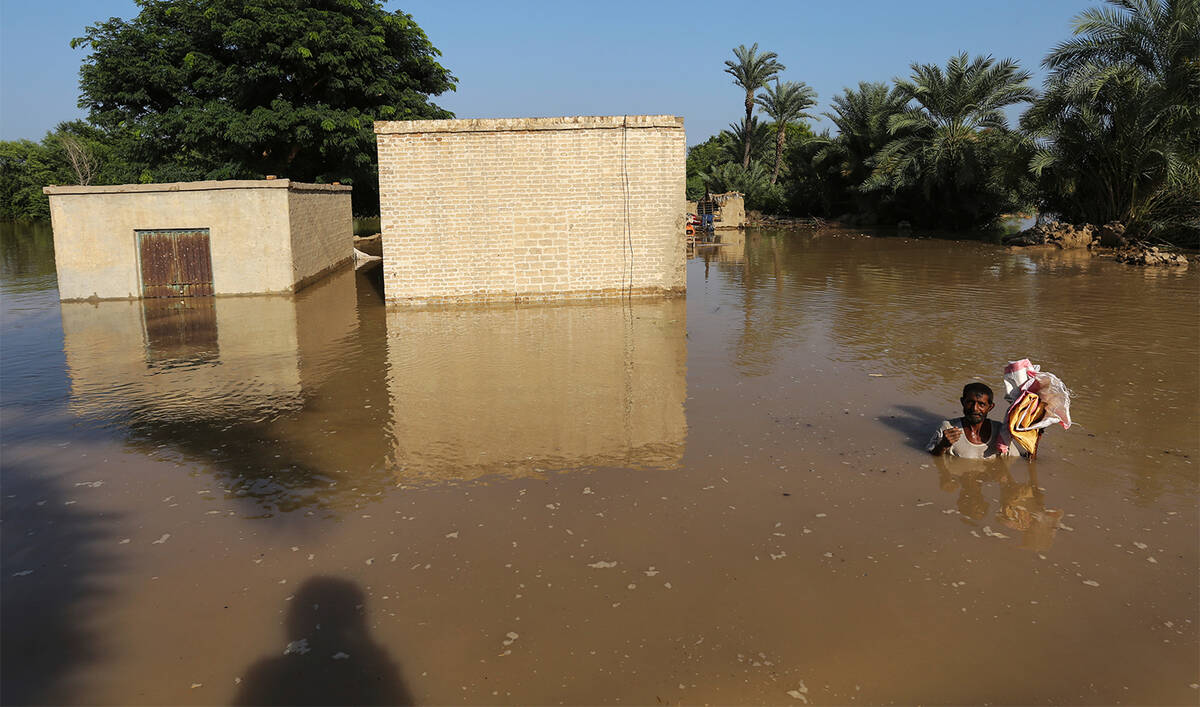
A villager waits to get evacuated from a flooded area in Daryapur village near Jalalpur Pirwala, in Multan district, Pakistan, on Sept. 9, 2025. (AP)
PBF’s preliminary assessment put the damage in Punjab at more than 1.5 million acres of farmland, including 300,000 acres in Faisalabad division, 200,000 acres in Gujrat and Gujranwala, 130,000 acres in Bahawalpur, 145,000 acres in Sahiwal and 99,000 acres in Lahore division. The group said land in Multan, Vehari and Khanewal had also been badly affected.
The forum estimated crop losses of 60% of the rice harvest, 30% of sugarcane and 35% of cotton, and warned that Pakistan might have to import around 5 million tons of wheat to stabilize domestic prices.
Ahmad Jawad, PBF’s chief organizer, said floods may shave 0.80 percent off GDP this year.
“While the headline figure of 0.80% of GDP may appear modest from a macroeconomic perspective, this is only an initial assessment and may increase,” he told Arab News.
Brokerage firm Arif Habib revised down its projection for Pakistan’s annual growth from 3.4% to 3.2%, saying the agriculture sector would expand by only 1.1% this year.
“Pakistan’s growth trajectory, once showing signs of recovery, is again under strain as the 2025 floods devastate the agricultural sector,” Arif Habib said in a research note.
The firm estimated total flood losses at Rs409 billion ($1.4 billion), with agriculture absorbing nearly three-fourths, or Rs302 billion ($1.0 billion).
“This [Rs302 billion or $1.0 billion loss] accounts for nearly three-fourths of the total estimated loss and about 0.24 percent of GDP, reflecting the sector’s acute vulnerability to climate shocks and the risks these events pose to food security and rural livelihoods,” said Sana Tawfik, head of research at Arif Habib.
The brokerage projected agriculture-related import pressures of nearly $1.93 billion in fiscal 2026, including as much as 737,000 tons of cotton imports costing $1.06 billion.
Inflation could also accelerate to 7.2% from a pre-flood estimate of 5.5% as shortages of staples like rice, sugar, vegetables and meat push up prices.
PBF has urged the government to declare an “Agricultural Emergency,” launch canal infrastructure projects in Punjab and Sindh, and provide interest-free loans of up to Rs2 million ($7,200) for small and medium farmers.
“The local banks should come and take the responsibility under force majeure and give interest-free loans to the farmers,” PBF president Rehman added.
Other recommendations include cracking down on riverbank encroachments, improving local water storage and authorizing imports of wheat and rice to stabilize the market.


