Nepal lifts ban on social media platforms after protests where police killed 19 people

1 / 2
An aerial view shows demonstrators gathered outside Nepal's Parliament (top) during a protest in Kathmandu on September 8, 2025, condemning social media prohibitions and corruption by the government. (AFP)
2 / 2
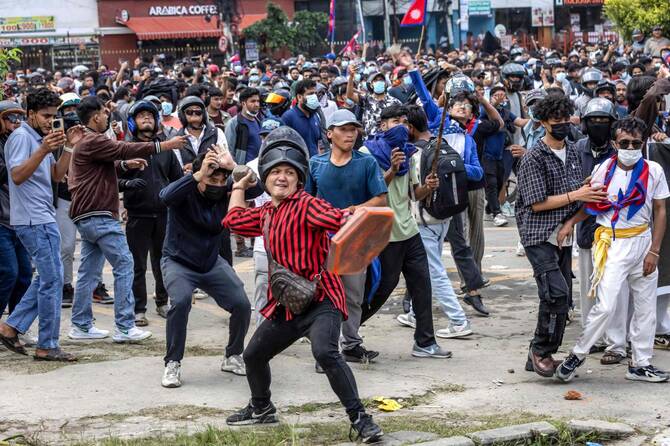
Demonstrators clash with riot police personnel during a protest outside the Parliament in Kathmandu on September 8, 2025, condemning social media prohibitions and corruption by the government. (AFP)
Short Url
Updated 09 September 2025
Follow

Nepal lifts ban on social media platforms after protests where police killed 19 people

  • The Home Minister Ramesh Lekhak also resigned late Monday at an emergency Cabinet meeting called by Prime Minister Khadga Prasad Oli

KATMANDU: Nepal’s government lifted ban on social media platforms Tuesday a day after violent street protests that left at least 19 people killed.
Some of the world’s largest platforms, including Facebook, X and YouTube were blocked last week, followed by a massive protest rally in the capital Kathmandu on Monday.
Police in Nepal’s capital of Kathmandu opened fire Monday on demonstrators protesting a government attempt to regulate social media.
The Home Minister Ramesh Lekhak also resigned late Monday at an emergency Cabinet meeting called by Prime Minister Khadga Prasad Oli.
Rallies swept the streets around the Parliament building, which was surrounded by tens of thousands of people angry at authorities who said the companies had failed to register and submit to government oversight.
The gunfire unfolded as the government pursues a broader attempt to regulate social media with a bill aimed at ensuring the platforms are “properly managed, responsible and accountable.” The proposal has been widely criticized as a tool for censorship and for punishing government opponents who voice their protests online.
About two dozen social networks that are widely used in Nepal were repeatedly given notices to register their companies officially in the Himalayan nation, the government said. Those that failed to register have been blocked since last week.
Neither Google, which owns YouTube, nor Meta, the parent company of Facebook, Instagram and WhatsApp, responded to requests for comment from The Associated Press. Elon Musk’s X platform did not respond either.
The video-sharing app TikTok, Viber and three other platforms have registered and operated without interruption.
The government imposed a curfew around Parliament, the government secretariat, the presidential house and key parts of the city and in two other cities of Nepal.
Seven of those killed and scores of the wounded were received at the National Trauma Center, the country’s main hospital in the heart of Kathmandu.
“Many of them are in serious condition and appear to have been shot in the head and chest,” said Dr. Badri Risa. Families waited anxiously outside for news of their relatives while people lined up to donate blood.
“Stop the ban on social media. Stop corruption, not social media,” the crowds outside Parliament chanted, waving the red and blue national flags. Monday’s rally was called the protest of Gen Z, which generally refers to people born between 1995 and 2010.
The government’s proposed bill includes asking the companies to appoint a liaison office or a point of contact in the country. Rights groups have called it an attempt by the government to curb freedom of expression and fundamental rights.
Nepal in 2023 banned TikTok for disrupting “social harmony, goodwill and diffusing indecent materials.” The ban was lifted last year after TikTok’s executives pledged to comply with local laws, including a ban of pornographic sites that was passed in 2018.


Zelensky says peace proposals to end the war in Ukraine could be presented to Russia within days

Updated 5 sec ago
Follow

Zelensky says peace proposals to end the war in Ukraine could be presented to Russia within days

  • But issues like the status of Ukrainian territory occupied by Russia remain unresolved. US-led peace efforts are gaining momentum
  • But Russian President Vladimir Putin may resist some proposals including security guarantees for Ukraine
KYIV: Ukrainian President Volodymyr Zelensky says proposals being negotiated with US officials for a peace deal to end his country’s nearly four-year war with Russia could be finalized within days, after which American envoys will present them to the Kremlin before further possible meetings in the United States next weekend.
Zelensky told reporters late Monday that a draft peace plan discussed with the US during talks in Berlin earlier in the day is “very workable.” He cautioned, however, that some key issues — notably what happens to Ukrainian territory occupied by invading Russian forces — remain unresolved.
U.S-led peace efforts appear to be picking up momentum. But Russian President Vladimir Putin may balk at some of the proposals thrashed out by officials from Washington, Kyiv and Western Europe, including postwar security guarantees for Ukraine.
Kremlin spokesman Dmitry Peskov repeated Tuesday that Russia wants a comprehensive peace deal, not a temporary truce.
If Ukraine seeks “momentary, unsustainable solutions, we are unlikely to be ready to participate,” Peskov said.
“We want peace — we don’t want a truce that would give Ukraine a respite and prepare for the continuation of the war,” he told reporters. “We want to stop this war, achieve our goals, secure our interests, and guarantee peace in Europe for the future.”
American officials on Monday said that there’s consensus from Ukraine and Europe on about 90 percent of the US-authored peace plan. US President Donald Trump said: “I think we’re closer now than we have been, ever” to a peace settlement.
Plenty of potential pitfalls remain, however.
Zelensky reiterated that Kyiv rules out recognizing Moscow’s control over any part of the Donbas, an economically important region in eastern Ukraine made up of Luhansk and Donetsk. Russia’s army doesn’t fully control either.
“The Americans are trying to find a compromise,” Zelensky said, before visiting the Netherlands on Tuesday. “They are proposing a ‘free economic zone’ (in the Donbas). And I want to stress once again: a ‘free economic zone’ does not mean under the control of the Russian Federation.”
The land issue remains one of the most difficult obstacles to a comprehensive agreement.
Putin wants all the areas in four key regions that his forces have seized, as well as the Crimean Peninsula, which Moscow illegally annexed in 2014, to be recognized as Russian territory.
Zelensky warned that if Putin rejects diplomatic efforts, Ukraine expects increased Western pressure on Moscow, including tougher sanctions and additional military support for defense. Kyiv would seek enhanced air defense systems and long-range weapons if diplomacy collapses, he said.
Ukraine and the US are preparing up to five documents related to the peace framework, several of them focused on security, Zelensky said.
He was upbeat about the progress in the Berlin talks.
“Overall, there was a demonstration of unity,” Zelensky said. “It was truly positive in the sense that it reflected the unity of the US, Europe, and Ukraine.”