Pakistan arrests dozens at protest over Daesh-claimed suicide attack

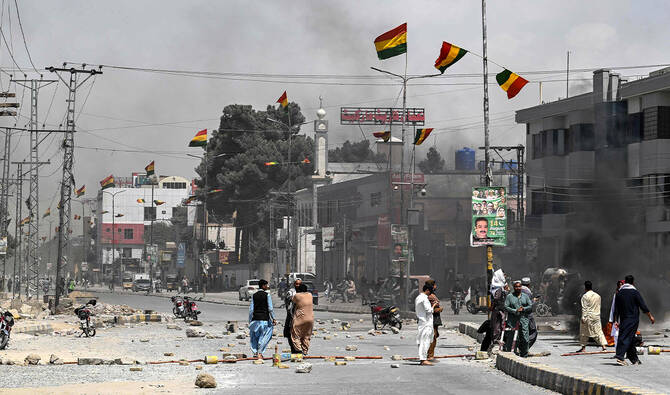
Protesters block a road during a strike called by the Balochistan National Party (BNP) in Quetta on September 8, 2025. (AFP)
Short Url
Updated 08 September 2025
Follow

Pakistan arrests dozens at protest over Daesh-claimed suicide attack

  • Businesses were shut, demonstrators took to streets across a dozen cities in Balochistan in response to the Sept. 2 bombing
  • Daesh claimed responsibility for the bombing in a stadium parking lot in Quetta, where hundreds of BNP supporters had gathered

QUETTA: Police arrested at least 60 people and deployed tear gas in Pakistan’s poorest province during a strike on Monday, as protesters demanded accountability over a suicide attack claimed by Daesh.

Businesses were shut and demonstrators took to the streets across more than a dozen cities in Balochistan in response to a September 2 bombing at a political rally that killed 15 people.

In provincial capital Quetta, police arrested protesters blocking a road and fired tear gas to disperse them.

“The government has already warned the protesters that although they have their democratic right to protest peaceful, they have no right to force people to be off the roads or disrupt the vehicle traffic and force the people to close their businesses,” senior police superintendent Muhammad Baloch told AFP.

Balochistan, a turbulent province on the border with Iran and Afghanistan, is regularly the scene of violence, often carried out by militants from the regional branch of the Daesh, Islamic State-Khorasan, as well as by IS-Pakistan or Baloch separatists.

Ahead of the strike, the Balochistan National Party (BNP) urged the public to unify across political, tribal and class lines to demand those behind the attack to be exposed.

“Isn’t the state responsible for this? Wasn’t it the duty of the state to protect these innocent people?” said BNP chief Akhtar Mengal.

The Daesh group claimed responsibility for the bombing in a stadium parking lot in Quetta, where hundreds of BNP supporters had gathered for a rally.

Last year was the deadliest in a decade in Pakistan, with a spike in violence along the western border with Afghanistan.

Pakistan’s largest and most resource-rich province, sparsely populated Balochistan is also its poorest, and regularly ranks among the lowest on human development indicator scorecards.

Baloch separatists have been fighting a decades-long insurgency against the Pakistan military with the aim of ending discrimination against the Baloch people on their land, which has been met with a severe counter-terrorism crackdown.


Pakistan offers Turkmenistan its Arabian Sea ports for wider access to ‘South Asia and beyond’

Updated 11 December 2025
Follow

Pakistan offers Turkmenistan its Arabian Sea ports for wider access to ‘South Asia and beyond’

  • PM Sharif meets Turkmen president in Ashgabat, calls for deeper trade and energy cooperation
  • Islamabad cites Karachi and Gwadar as key to boosting regional connectivity, including TAPI links

ISLAMABAD: Pakistan on Thursday urged Turkmenistan to expand trade and connectivity through Karachi and Gwadar, saying its Arabian Sea ports offer Turkmen businesses and exporters a direct route to South Asian and global markets, Prime Minister Shehbaz Sharif’s office said after high-level talks in Ashgabat.

Pakistan and Turkmenistan have long discussed regional transport corridors and energy cooperation, including the Turkmenistan–Afghanistan–Pakistan–India (TAPI) gas pipeline, a proposed multibillion-dollar project that would carry Turkmen natural gas south through Afghanistan into Pakistan and India. Islamabad has also pushed to link the landlocked Central Asian states to the sea by offering transit access through its deep-water ports, which sit at the crossroads of the Middle East, Central Asia and South Asia.

On Thursday, Pakistan's Sharif met Serdar Berdimuhamedov, the president of Turkmenistan, in Ashgabat as both countries look to revive momentum in bilateral engagement after years of regional instability. Pakistan has supported Turkmen neutrality policies at the United Nations, while Ashgabat has backed Pakistan during crises, including helping evacuate Pakistani nationals caught in Iran during the Iran–Israel conflict earlier this year.

“The Prime Minister reaffirmed Pakistan’s desire to enhance connectivity with Turkmenistan through land and sea routes and said that Karachi and Gwadar ports were ideally located to be utilized by the Turkmen side to enhance their outreach to South Asia and beyond,” Sharif’s office said in a statement.

Sharif reiterated his intention to deepen trade and economic ties with Turkmenistan, saying enhanced transport links and energy cooperation could anchor long-term regional integration. He invited President Berdimuhamedow and Turkmenistan’s national leader, Gurbanguly Berdimuhamedow, on official visits to Pakistan next year.

Sharif is on a two-day visit to Turkmenistan for the International Forum on Peace and Trust, accompanied by Deputy Prime Minister and Foreign Minister Ishaq Dar, Energy Minister Awais Leghari, Information Minister Attaullah Tarar and senior officials.

Turkmenistan’s president thanked Sharif for attending the UN-backed peace forum and said Ashgabat was keen to expand cooperation across multiple sectors, according to the statement.